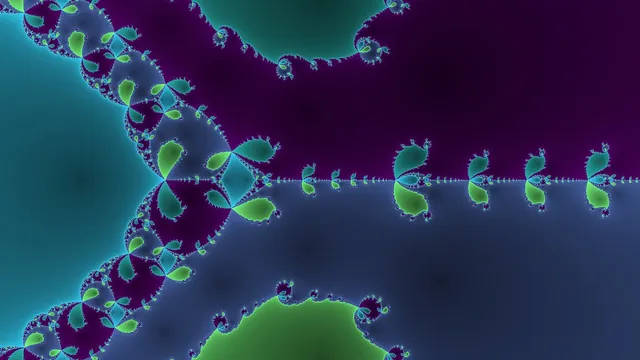
Newton’s fractal (which Newton knew nothing about)
Based on 3Blue1Brown's video on YouTube. If you like this content, support the original creators by watching, liking and subscribing to their content.
Newton’s method updates a guess using x_{n+1}=x_n−p(x_n)/p′(x_n), repeatedly applying a local linear approximation to p(x).
Briefing
Newton’s method turns a simple root-finding rule into an endlessly intricate fractal when it’s run over the complex plane. Starting from a seed value, the iteration repeatedly replaces the polynomial by its local linear (tangent) approximation and jumps to where that line hits zero. Most seeds quickly converge to one of the polynomial’s true roots, but the “map” of which root each seed reaches changes violently under tiny perturbations—so the boundaries between outcomes become fractal and never settle into smooth curves.
The setup begins with a practical problem: solving polynomial equations. In engineering and computer graphics, polynomials show up constantly—for instance, Bezier curves used to render fonts. To decide how pixels relate to a curve, systems often reduce distance-to-curve questions to calculus: the minimum of a polynomial-derived function is found by setting its derivative (another polynomial) equal to zero. That naturally raises the computational question of how to find polynomial roots beyond the quadratic and cubic cases where closed-form formulas exist.
For higher degrees, exact formulas become unreliable or nonexistent in the usual sense. The transcript notes the classical result that general quintic polynomials cannot be solved by a universal formula built from standard operations and radicals, pushing practice toward numerical methods. Newton’s method is one such workhorse: pick an initial guess x0, compute x1 = x0 − p(x0)/p′(x0), then repeat. Convergence is fast when the starting point lies near a root, but it can bounce around or fail when it doesn’t.
The fractal emerges when the same iteration is applied to complex starting points. Even if a polynomial has only one real root, allowing complex inputs guarantees additional roots in the complex factorization (via the fundamental theorem of algebra). When seeds are colored by which root they approach, large regions become uniform—each region corresponds to seeds that reliably converge to a particular root. The chaos concentrates on the boundaries between these regions: two seeds that are extremely close can end up converging to different roots.
A key structural reason for the boundary’s roughness is described through a shared-boundary property: for any one color region (seeds converging to a specific root), the boundary of that region matches the boundary of every other color region. This implies that no small neighborhood can contain exactly two colors; any tiny circle around a boundary point must intersect all colors or only one. As a result, the boundary cannot include smooth segments, because smoothness would typically separate only two outcomes locally. The transcript connects this to fractal dimension, citing a boundary dimension around 1.44 for the shown example.
The complexity is therefore not an accident of one polynomial. It also explains why quadratic cases look comparatively tame: with only two roots, a “two-color” boundary is the only possibility, so the constraint doesn’t force the same kind of visible fractal boundary behavior. The deeper mathematical framework behind the shared-boundary phenomenon is attributed to holomorphic dynamics.
Finally, the transcript closes by emphasizing the irony of naming: Newton had no access to these complex-plane visualizations, yet his method generates them. The broader point is that simple ideas can hide future relevance—so questions about Newton’s method (like whether iterations can cycle) connect to other major objects such as the Mandelbrot set, setting up a follow-up discussion.
Cornell Notes
Newton’s method iteratively finds polynomial roots by jumping from a seed x to where the tangent-line (linear approximation) to p(x) crosses zero: x_{n+1}=x_n−p(x_n)/p′(x_n). In the complex plane, coloring each seed by which root it converges to produces large uniform regions, but the boundaries between regions are fractal and infinitely detailed. The transcript highlights a structural theorem-like property: the boundary of the basin of attraction for any one root is the same as the boundary for every other root, meaning tiny circles near the boundary intersect either all colors or only one. This forbids smooth boundary segments and forces roughness at every zoom level, consistent with a measured fractal dimension (~1.44 in the example). The behavior is framed as a consequence of holomorphic dynamics rather than a quirk of one polynomial.
Why does Newton’s method sometimes converge quickly and sometimes behave chaotically?
How does the complex-plane version of Newton’s method create a “map” with sharp boundaries?
What is the “shared boundary” property, and why does it force fractal roughness?
Why is the quadratic case comparatively “boring” in these pictures?
What role does the unsolvability of the quintic play here?
How do Voronoi diagrams relate to Newton fractals?
Review Questions
- In Newton’s method, what exact quantity determines the next iterate x_{n+1}, and how does p′(x) influence step size?
- What does it mean for the boundary of one color region to equal the boundary of all other color regions, and how does that prevent smooth boundary segments?
- Why does increasing the polynomial degree from 2 to 3 change the qualitative behavior of the Newton fractal’s boundaries?
Key Points
- 1
Newton’s method updates a guess using x_{n+1}=x_n−p(x_n)/p′(x_n), repeatedly applying a local linear approximation to p(x).
- 2
In the complex plane, coloring seeds by which root they converge to produces large uniform basins separated by fractal boundaries.
- 3
Tiny perturbations to initial complex seeds can switch the final root, concentrating sensitivity on basin boundaries.
- 4
A shared-boundary property implies the boundary of one root’s basin matches the boundary of every other basin, preventing neighborhoods from containing only two colors near boundary points.
- 5
Because smooth boundary segments would typically separate only two outcomes locally, the shared-boundary constraint forces rough, infinitely detailed boundaries at every zoom level.
- 6
Quadratic polynomials (two roots) look simpler because there are only two colors, so the shared-boundary constraint doesn’t force the same multi-color boundary complexity.
- 7
The transcript attributes the underlying boundary behavior to holomorphic dynamics rather than to algebraic issues like quintic unsolvability.