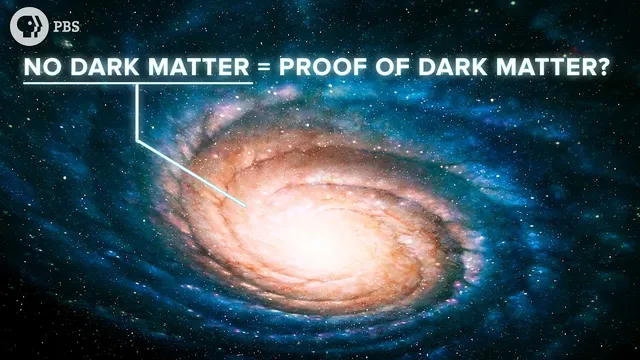
No Dark Matter = Proof of Dark Matter?
Based on PBS Space Time's video on YouTube. If you like this content, support the original creators by watching, liking and subscribing to their content.
Dark matter remains undetected as a particle, but galaxy and cluster dynamics plus gravitational lensing and Cosmic Microwave Background constraints consistently indicate an unseen mass component.
Briefing
Dark matter may be real after all—not because a particle has been detected, but because some galaxies appear to contain little or none of it, challenging modified-gravity ideas that tie “extra” gravity to ordinary matter. The tension has been building for decades: galaxies and galaxy clusters move as if far more mass exists than telescopes can see, yet every direct search for the dark matter particle has come up empty. That stalemate has fueled two competing explanations—an unseen substance that interacts weakly with light, or a breakdown (or modification) of gravity itself on cosmic scales.
Support for the dark matter substance has come from multiple independent measurements. Gravitational lensing maps the total mass of galaxies and clusters by how they bend background light, and those mass estimates line up with what galaxy and cluster orbits require. The Cosmic Microwave Background also constrains how much dark matter existed in the early universe, again roughly matching the late-time picture. Modified gravity models have struggled to reproduce this full set of observations without special pleading.
A key pressure point for modified gravity is a common structural assumption: gravity’s “missing” component is effectively pinned to normal matter—baryons like protons and neutrons. If that’s true, baryons should always generate the same gravitational effects at large scales, meaning dark matter and baryons should never be separable in real systems. The Bullet Cluster provided the most famous test. In that cosmic collision, the galaxies passed through each other while the hot gas collided and slowed, leaving the gas concentrated near the impact site. Gravitational lensing, however, mapped most of the mass to the galaxies rather than the gas—exactly what one expects if dark matter behaves like a weakly interacting particle that sails through the collision, but not if the “extra gravity” is produced by the gas.
Now a new observational claim adds another twist: an ultra diffuse galaxy named “Fritz” appears to have about the mass you’d expect from its stars alone, with little room for a dominant dark matter halo. The team led by Pieter van Dokkum and Shani Danieli at Yale University studied stars and globular clusters in the galaxy “1052/DF2,” measuring stellar motions to infer its total mass. The result is roughly 130 million solar masses (with an 18 million solar mass uncertainty), while the galaxy’s starlight implies a stellar mass of about 100 million solar masses. In other words, the inferred mass-to-light budget suggests that dark matter is not required to explain Fritz’s internal dynamics.
The finding is strengthened by context: in typical galaxies of this type, dark matter should outweigh stars by hundreds of times. The researchers also report a second candidate ultra diffuse galaxy in the same group that appears similarly deficient, and they have additional targets awaiting velocity measurements. If these systems truly lack dark matter, it becomes harder for modified-gravity models that generate “dark” effects from baryons to remain universally consistent.
The authors offer tentative formation scenarios—such as gas and stars being expelled during past interactions with a nearby elliptical galaxy, or quasar activity driving out gas and later triggering star formation in a region without the usual dark matter halo. Those ideas are speculative, and more measurements are needed. Still, the core implication is clear: galaxies that seem to form and persist without dark matter would be a powerful new lever for deciding whether the universe’s missing mass is an exotic substance—or whether gravity itself needs rewriting.
Cornell Notes
The search for dark matter has failed to find a particle directly, but multiple lines of evidence still point to an unseen mass component. Gravitational lensing and galaxy dynamics match each other, and the Cosmic Microwave Background supports a large dark matter fraction in the early universe. Modified-gravity theories often assume the “extra” gravitational effects are tied to baryons, which would prevent dark matter and normal matter from separating in collisions. The Bullet Cluster already showed such separation: lensing mass follows galaxies rather than colliding gas. A new study of an ultra diffuse galaxy (“Fritz,” 1052/DF2) finds stellar motions consistent with a total mass near the stellar mass, implying little dark matter—an outcome that would be difficult for many modified-gravity schemes and motivates more observations.
Why did astronomers start suspecting dark matter in the first place?
What makes gravitational lensing such a decisive tool in the dark matter debate?
How does the Bullet Cluster challenge modified-gravity models?
What did the Fritz (1052/DF2) observations measure, and what did they imply?
Why is a dark-matter-deficient ultra diffuse galaxy significant for the theory fight?
Review Questions
- What observational evidence links the mass inferred from gravitational lensing to the mass inferred from galaxy or cluster dynamics?
- Why does the Bullet Cluster’s separation between galaxies and gas matter for modified-gravity theories?
- How do stellar velocity measurements in Fritz (1052/DF2) translate into a conclusion about whether dark matter is required?
Key Points
- 1
Dark matter remains undetected as a particle, but galaxy and cluster dynamics plus gravitational lensing and Cosmic Microwave Background constraints consistently indicate an unseen mass component.
- 2
Modified-gravity models often assume the “extra” gravitational effects are generated by baryons, implying dark matter and normal matter should not separate in collisions.
- 3
The Bullet Cluster collision showed lensing mass aligned with galaxies rather than with the colliding gas, matching the behavior expected of weakly interacting dark matter.
- 4
A new study of the ultra diffuse galaxy Fritz (1052/DF2) measured stellar and globular cluster motions and inferred a total mass (~130 million solar masses) close to the stellar mass (~100 million).
- 5
If Fritz and similar ultra diffuse galaxies truly contain little dark matter, that would be difficult for baryon-tied modified-gravity schemes to reproduce without special assumptions.
- 6
Tentative formation scenarios—such as gas ejection during interactions or quasar-driven outflows—are proposed to explain how such galaxies could form without a normal dark matter halo, but more data are needed.