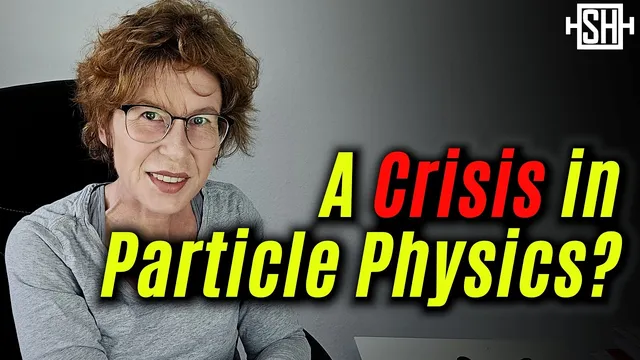
No, Matt, this is no crisis
Based on Sabine Hossenfelder's video on YouTube. If you like this content, support the original creators by watching, liking and subscribing to their content.
Naturalness is treated as a rule that dimensionless constants should be order one, and the transcript argues this is numerology rather than a testable constraint.
Briefing
The central claim is that today’s “physics crisis” talk—especially the hierarchy problem and the broader appeal to “naturalness”—rests on numerology rather than testable science, and that it has repeatedly produced wrong predictions. The argument matters because it challenges a long-running cultural habit in particle physics: treating aesthetic criteria about what “should” be small or large as if they were hard constraints on nature.
A key target is the idea of “naturalness,” where physicists define “natural” numbers as dimensionless quantities of order one. Under that rule, some observed constants look wildly unnatural. The cosmological constant is the flagship example: the measured value is about 120 orders of magnitude away from what naturalness-based reasoning would suggest. In general relativity, the cosmological constant is a free parameter—its value is not derived from first principles but measured—so the naturalness move is to relate it to other constants (like Newton’s constant) through dimensional analysis and then demand that the resulting relation be “approximately one.” That demand yields a prediction that is catastrophically wrong. Instead of abandoning the premise, the argument says, physicists elevate naturalness into a “sacred principle,” then wrap it in more elaborate mechanisms such as vacuum fluctuations and quantum gravity.
The discussion then pivots to why this is not a genuine scientific crisis in the sense popularized by Thomas Kuhn. In Kuhn’s framework, a crisis arises when a theory faces evidence or internal inconsistency that forces revision and potentially a paradigm shift. By that standard, the standard model of particle physics is described as working: it matches the data collected by the Large Hadron Collider, and with the Higgs boson included it is internally consistent. So, rather than a crisis, the field allegedly manufactured one—most notably the hierarchy problem.
The hierarchy problem is framed as the extreme weakness of gravity compared with other forces, often quantified by ratios like the gravitational attraction versus electric attraction between an electron and a proton (roughly 10^-40). A logically equivalent restatement is that elementary particle masses are “too small.” The counterpoint offered is blunt: there is no logical contradiction in having small numbers, even if it would be nicer to have a deeper explanation.
From there, the argument attacks “technical naturalness,” a more formalized version of the naturalness idea. It traces to work around 1980 that links small parameters to symmetries or other “protection” mechanisms. But the record, the argument says, is poor: technical naturalness has not generated successful predictions and has instead driven multiple false ones. Examples cited include the cosmological constant problem, the theta parameter leading to the axion (later ruled out), and the expectation that supersymmetry would produce new particles at the LHC soon after it turned on—an expectation that did not pan out. Even claims of “successes” are disputed: the charm quark prediction is described as stemming from simplicity rather than technical naturalness, and other commonly cited cases are said not to be genuine predictions.
Finally, the argument distinguishes real crises from manufactured ones. Genuine foundation-level tensions are said to include dark matter (a mismatch between models and observations), cosmological disagreements with data, and internal inconsistencies such as missing quantization of gravity and the quantum measurement problem. The concluding message is that physics should reserve “crisis” for problems with measurable consequences, not for aesthetic constraints that have failed to self-correct.
Cornell Notes
The transcript argues that “naturalness” is not a scientific principle but a numerology-style criterion: dimensionless constants are treated as “should be order one,” and when they aren’t, physicists invent mechanisms to fix the mismatch. The cosmological constant is used as the clearest example—naturalness reasoning yields a prediction about 120 orders of magnitude off, yet the premise persists. The hierarchy problem is portrayed as a manufactured crisis: the standard model fits LHC data and is internally consistent, so there’s no Kuhn-style crisis demanding revision. Technical naturalness is criticized for a long record of failed predictions, including axion expectations and supersymmetry searches. Real crises are instead identified as dark matter, cosmology tensions, and foundational inconsistencies like gravity quantization and the quantum measurement problem.
What does “naturalness” mean in this argument, and why does it create a “crisis” narrative?
How is the cosmological constant used to illustrate the critique?
Why does the transcript claim the hierarchy problem is not a real Kuhn-style crisis?
What is technical naturalness, and what is the critique of its track record?
How does the transcript challenge the “fine-tuning” story around the Higgs mass?
What does the transcript list as actual crises in physics?
Review Questions
- What specific assumption about dimensionless parameters underlies the naturalness argument, and how does it lead to the cosmological constant mismatch?
- Why does the transcript claim the standard model lacks a Kuhn-style crisis despite the hierarchy problem?
- Which examples are used to argue that technical naturalness has failed as a predictive heuristic?
Key Points
- 1
Naturalness is treated as a rule that dimensionless constants should be order one, and the transcript argues this is numerology rather than a testable constraint.
- 2
The cosmological constant is presented as the clearest naturalness failure: naturalness-based reasoning yields a prediction about 120 orders of magnitude off.
- 3
The standard model is described as matching Large Hadron Collider data and being internally consistent, so the hierarchy problem is framed as an invented crisis rather than an evidence-driven one.
- 4
Technical naturalness links small parameters to symmetries or other “protection” mechanisms, but the transcript claims it has produced wrong predictions such as axion-related expectations and supersymmetry searches.
- 5
Claims of Higgs-mass “fine-tuning” are criticized as relying on mathematical terms that do not correspond to observable quantities.
- 6
Real foundation-level crises are identified as dark matter, cosmology disagreements, and internal inconsistencies like gravity quantization and the quantum measurement problem.