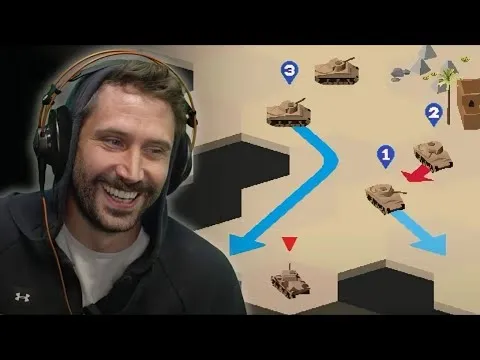
No One Hires Jr Devs So I Made A Game
Based on The PrimeTime's video on YouTube. If you like this content, support the original creators by watching, liking and subscribing to their content.
The game’s credibility comes from end-to-end engineering: hex-grid tactics rules, fog of war, shrinking battlefield pressure, rendering, and real multiplayer synchronization.
Briefing
A junior-friendly hiring problem turned into a full multiplayer browser game: the project builds a turn-based, one-on-one tank tactics game from scratch to prove real engineering depth—especially in the hard parts hiring managers can’t easily fake. The core pitch is simple: making games forces developers to tackle networking, state synchronization, rendering, UI input, and game rules in ways that don’t show up in “yet another to-do app.” That combination also creates something interviewers can probe—how data moves, how clients and servers agree, and how tricky edge cases get handled.
The game’s design centers on a 2D grid tactics loop played on a hexagonal board. Players move tanks and shoot in one of six directions, with uncertainty added through a limited field of view (fog of war) and a shrinking play area that dissolves hexes and tanks near the center as the match progresses—an anti-stalling mechanic similar in spirit to battle royale pressure. To support the hex grid, the project uses a “clearly superior” hexagonal layout and implements fog-of-war visibility so distant enemy units remain hidden even though they still exist in the simulation.
On the client side, the implementation leans on browser primitives rather than game engines: HTML canvas for drawing and TypeScript for the codebase. Sprites are packed into a single PNG and rendered by copying subregions each frame to create motion. Rendering choices aim for pixelated isometric aesthetics, and the canvas is made responsive without blurring by accounting for device pixel ratio. Interactivity includes dragging for movement and press-and-hold behavior for selecting shooting direction and range limits per turn.
The architecture splits responsibilities into a game state object (plain data), a display driver (rendering), and a game instance (orchestrating updates). Movement and zoom require coordinate translation between screen space and hex grid space, plus pixel-perfect scaling via two base sprite sizes (64 and 96) to keep zoom steps crisp. Pathfinding and move validation use graph search—described as variants of breadth-first search—so the client can highlight legal destinations while the server remains the authority.
Multiplayer is where the project gets most serious. The server is written in Go and uses WebSockets for real-time communication, with JSON chosen for simplicity over a custom binary protocol. Player rooms are managed via Go channels, and state machines help tame a messy web of channel connections. Every move and shot is validated server-side with checks for collisions, range limits, projectile stopping conditions (buildings and tanks), and visibility rules to prevent “wall hacks.” The client receives resolved results and updates instantly, while animation work is treated as a later layer.
By the end, two users can play on different devices, tanks can be destroyed, explosions and smoke are added as sprite effects, and the match pressure system (shrinking map) is implemented. The project also tackles UI complexity: canvas-painted buttons require custom pointer handling, and the input model is designed so actions can be triggered on press rather than release. Deployment is mentioned via a live URL and GitHub source, along with extra features outside the video scope.
The biggest practical setback is iOS reliability: aggressive background throttling and unreliable WebSocket reconnection behavior cause disconnects on window changes, forcing the reconnect workaround to be dropped. The takeaway is less about a single game mechanic and more about engineering credibility—building something hard end-to-end, where networking, rendering, and UI edge cases all have to work together under real constraints.
Cornell Notes
The project turns a frustration with junior hiring into a proof-of-work multiplayer browser game. It implements a turn-based tank tactics game on a hexagonal grid with fog of war and a shrinking battlefield to prevent stalling. The client uses TypeScript and HTML canvas (no game engine), packing sprites into a single PNG and handling responsive rendering, dragging, zoom, and custom canvas-based UI input. Multiplayer runs on a Go server using WebSockets and JSON; the server validates every move and shot (collisions, range, projectile stopping, and visibility) so clients can’t cheat. The result is a working two-player experience, with iOS WebSocket throttling proving a major reliability challenge.
Why does building a game create more interviewable engineering evidence than building a typical web app?
How does the game add uncertainty and prevent players from waiting out the match?
What does “server-authoritative” mean in this project’s multiplayer design?
Why is coordinate translation on a hex grid described as a hard problem here?
How does the project keep canvas rendering crisp during zoom?
What broke on iOS, and why was the workaround abandoned?
Review Questions
- What specific server-side validations are necessary to keep movement and shooting fair in a fog-of-war hex tactics game?
- How do fog of war and the shrinking battlefield work together to shape player behavior over a match?
- Describe how the project’s canvas UI differs from standard DOM button handling and why that matters for input timing.
Key Points
- 1
The game’s credibility comes from end-to-end engineering: hex-grid tactics rules, fog of war, shrinking battlefield pressure, rendering, and real multiplayer synchronization.
- 2
Fog of war is implemented as a visibility constraint so hidden enemy units remain invisible to the client, not just visually masked.
- 3
The client uses TypeScript with HTML canvas and custom input handling (dragging, press/hold shooting, and canvas-painted buttons) rather than relying on a game engine.
- 4
Multiplayer uses a Go server with WebSockets and JSON; the server validates every move and shot to prevent cheating and resolve collisions authoritatively.
- 5
Hex-grid movement requires nontrivial screen-to-grid coordinate projection, plus pathfinding to highlight legal destinations.
- 6
Sprite rendering is optimized by packing assets into a single PNG and copying subregions each frame, supporting pixelated isometric aesthetics.
- 7
iOS WebSocket throttling makes background reconnection unreliable, forcing the project to defer a robust reconnect solution.