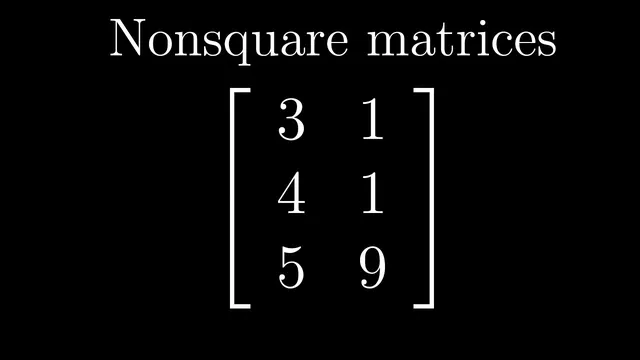
Nonsquare matrices as transformations between dimensions | Chapter 8, Essence of linear algebra
Based on 3Blue1Brown's video on YouTube. If you like this content, support the original creators by watching, liking and subscribing to their content.
A matrix’s number of columns equals the input dimension; its number of rows equals the output dimension.
Briefing
Non-square matrices aren’t a special case—they’re the standard way to encode linear transformations between spaces of different dimensions. A 2D-to-3D linear map can be represented by a 3x2 matrix: the two columns describe where the 2D basis vectors land, and the three rows record those landing spots using three coordinates. Geometrically, that means all outputs lie in a 2D column space: a plane through the origin inside 3D space. Because the matrix has full rank (the column space has the same dimension as the input), it genuinely captures a two-dimensional input being mapped into a three-dimensional output without collapsing the input’s dimensionality.
The key idea is that matrix encoding still works the same way: find the images of the input basis vectors, then stack their coordinate descriptions as columns. In the example given, the transformation sends i-hat to the coordinates (2, −1, −2) and j-hat to (0, 1, 1). Writing those as columns produces a 3x2 matrix, and the “3” in the row count signals that each basis vector’s image needs three coordinates to specify its location in the output space. Meanwhile, the “2” in the column count signals there are two independent input directions—so the map is naturally interpreted as taking 2 dimensions and producing points in 3 dimensions.
The same logic flips cleanly for other shapes. A 2x3 matrix indicates a transformation from 3D down to 2D: three columns correspond to three input basis vectors, while only two rows mean each landing spot is described using just two coordinates. That dimensional reduction can feel unintuitive because multiple distinct 3D directions must “squeeze” into a 2D plane, so the mapping can’t preserve all degrees of freedom. The transcript emphasizes that the discomfort is part of the geometry: you’re mapping a higher-dimensional space onto a lower-dimensional one.
There’s also a 2D-to-1D case, encoded by a 1x2 matrix. Here the output is a number (points on the real line), and linearity is visualized by how evenly spaced points on a line of dots remain evenly spaced after mapping onto the number line. Each column of a 1x2 matrix contains a single entry because each 2D basis vector’s image is just one coordinate on the line. The discussion notes that this particular kind of transformation connects closely to the dot product, setting up the next chapter.
Overall, the takeaway is a practical geometric dictionary: the number of columns tells how many input dimensions you start with, and the number of rows tells how many coordinates you need to describe the outputs. Once that’s internalized, non-square matrices become a direct way to reason about linear maps between dimensions—whether expanding into a higher-dimensional space, compressing into a lower-dimensional one, or projecting down to a line.
Cornell Notes
Non-square matrices encode linear transformations between spaces of different dimensions by listing where each input basis vector lands. A 3x2 matrix maps 2D inputs into 3D outputs: two columns represent the images of i-hat and j-hat, while three rows record those images using three coordinates. The outputs form a 2D plane through the origin (the column space), and full rank corresponds to the input’s dimensionality being preserved. A 2x3 matrix maps 3D onto 2D, squeezing three independent directions into a plane. A 1x2 matrix maps 2D vectors to numbers on the line, with linearity reflected in how evenly spaced points remain evenly spaced; this connects to the dot product.
How does a 3x2 matrix represent a linear transformation from 2D to 3D?
What does “column space” mean in the non-square setting?
Why does a full-rank 3x2 matrix still correspond to mapping two dimensions into three dimensions?
What does a 2x3 matrix imply about the direction of the transformation?
How is linearity visualized for a 1x2 matrix mapping 2D vectors to numbers?
Review Questions
- Given a matrix shape m×n, what are the input and output dimensions, and how do the rows and columns determine them?
- For a 3x2 matrix, what geometric object in 3D contains all possible outputs, and why?
- Why does a 2x3 matrix represent a dimensional reduction, and what does that suggest about how distinct 3D inputs relate to 2D outputs?
Key Points
- 1
A matrix’s number of columns equals the input dimension; its number of rows equals the output dimension.
- 2
Encoding a linear transformation between different dimensions still comes from mapping basis vectors and stacking their coordinate images as columns.
- 3
A 3x2 matrix maps 2D inputs into a 2D column space (a plane through the origin) inside 3D output space.
- 4
A 2x3 matrix maps 3D onto 2D, compressing three independent input directions into two coordinates.
- 5
A 1x2 matrix maps 2D vectors to real numbers; linearity can be visualized as preserving equal spacing on the number line.
- 6
Full rank in a non-square matrix corresponds to the column space having the same dimension as the input, preventing collapse of input degrees of freedom.