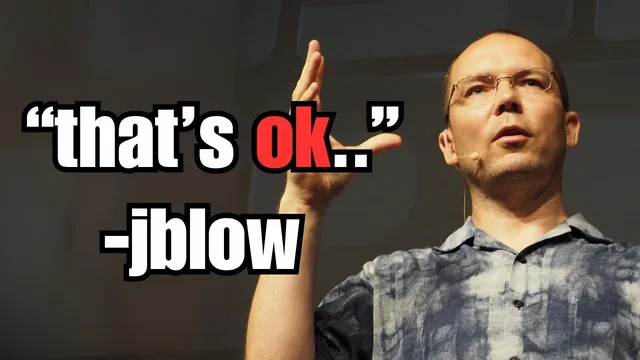
Not All Programmers Are Good | Prime Reacts
Based on The PrimeTime's video on YouTube. If you like this content, support the original creators by watching, liking and subscribing to their content.
Skill improvement in programming can be accelerated by a “multiplier” effect, meaning people often learn different tasks at different rates.
Briefing
Not all programmers are equally good—and that unevenness is normal, not a moral failing. Speed of improvement depends on a “multiplier” effect: some people pick up specific skills faster, while others struggle with the same tasks. The conversation treats that talent gap as observable in everyday life (including among the speaker’s own children) and argues it shouldn’t trigger defensiveness or the reflexive claim that everyone must be the same.
That talent reality matters because software work is often easier than people assume—especially when teams build on existing libraries, algorithms, and patterns rather than inventing everything from scratch. Examples like the Obamacare website debacle are used to illustrate how a small group can outperform a much larger effort when the core problems are not as novel as the headlines suggest. But scale is the key caveat: making something that looks modern is far simpler than making it robust, fault-tolerant, and able to handle real-world load. Twitter is cited as a case where the interface may not look like “rocket science,” yet the underlying scaling and reliability engineering is genuinely hard, even for talented teams.
The discussion then shifts from programmer ability to language design. Some programming languages aim to maximize productivity for highly skilled developers by making it easier to write correct, high-performance code—an approach associated with functional programming and the idea of using language constraints to prevent catastrophic mistakes. Other languages prioritize safety rails and ergonomics for broader audiences. The debate becomes less about “good vs. bad” and more about tradeoffs: should languages prevent users from “shooting themselves in the foot,” or should they allow experts to opt into raw power?
Zig is highlighted as a middle path: it offers optional safety features (like null protection) while still allowing explicit escape hatches such as unprotected pointers, with the cost of extra memory or runtime tagging when safety is enabled. Go is contrasted as a language that reduces foot-guns by handling memory management and forcing developers to think about nil, making it easier for many people to be productive without deep systems expertise.
A broader framework ties it together: different programming languages are designed for different kinds of work, similar to how Formula 1 driving differs from driving to a hotel. Some tools are optimized for people who want to manage every detail; others are optimized to make key aspects simpler. Even within that, the conversation rejects hopelessness: a “bad programmer” can become good through practice, and most people can improve substantially unless they face serious learning disabilities. Talent can accelerate learning and shape where someone excels, but it can also create risks—people may coast, avoid hard work, or let a strength become a weakness. The practical takeaway lands on agency: if someone feels stuck, trying languages and workflows designed for higher productivity and clearer constraints may be a path to leveling up.
Cornell Notes
The discussion argues that programmer ability varies and that this variation is normal, not controversial. It links faster skill acquisition to a “multiplier” effect—some people learn certain tasks much more quickly than others—while also insisting that practice can still move most people from “bad” to “good.” Software difficulty is split into two parts: building something that looks functional is often straightforward, but scaling, reliability, and fault tolerance are much harder. Language design becomes a central example of tradeoffs: languages like Zig and Go differ in how much safety they enforce versus how much control they leave to experts. The overall message is to match tools to the kind of work and skill level, and to use that fit as a route to improvement.
Why does the conversation treat “talent” as a real factor in programming rather than a harmful myth?
What’s the key distinction between building software quickly and building software that works at real scale?
How does the Obamacare website example support the broader point about software complexity?
What does Zig’s design illustrate about language safety versus expert control?
How does the “different kinds of programming” analogy change the debate about language choice?
Why does the conversation argue that “not all programmers are equally good” doesn’t imply hopelessness?
Review Questions
- What are the two different kinds of difficulty the conversation separates when judging software projects (and how do examples like Twitter fit)?
- How does Zig’s optional/null-safety approach aim to balance safety and performance compared with a more “rail-heavy” language like Go?
- What does the discussion claim about the relationship between talent, effort, and the risk of coasting?
Key Points
- 1
Skill improvement in programming can be accelerated by a “multiplier” effect, meaning people often learn different tasks at different rates.
- 2
Many software systems are built from known components, so a large portion of “real-world software” can be produced quickly by the right team.
- 3
The hardest part is often not the initial build but scaling, fault tolerance, and reliability under real traffic conditions.
- 4
Language design reflects tradeoffs between safety rails and expert control, rather than a single universal “best” approach.
- 5
Zig is presented as offering both safety (optionals/null protection) and explicit escape hatches (unprotected pointers) with measurable overhead when safety is enabled.
- 6
Go is framed as prioritizing productivity by reducing foot-guns through features like garbage collection and memory management.
- 7
Even with talent differences, most people can improve through practice; “not equally good” does not mean “no one can get better.”