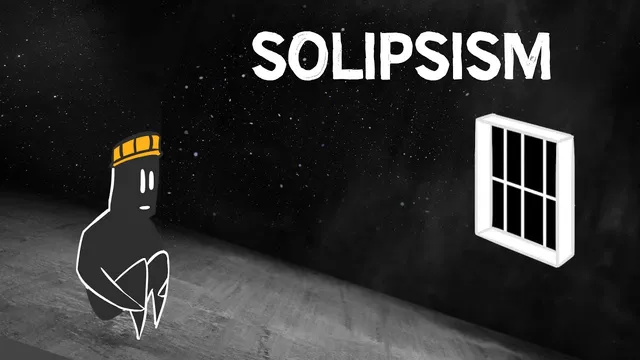
Nothing Exists But You | The Philosophy of Solipsism
Based on Einzelgänger's video on YouTube. If you like this content, support the original creators by watching, liking and subscribing to their content.
Zhuangzi’s butterfly dream illustrates how identity and “reality” can be reinterpreted from within experience, undermining certainty about the external world.
Briefing
Solipsism takes skepticism about reality to its logical endpoint: only one’s own mind has unquestionable standing, while everything outside it—including other people—could be illusion. The core issue isn’t whether the world feels real, but whether anyone can justify believing in an external world at all, given that perception is trapped inside consciousness. Zhuangzi’s butterfly dream dramatizes the problem: waking life can feel certain, yet the “real” identity of the dreamer and the dream’s world may be impossible to settle. If even the boundary between “me” and “not me” can’t be proven, the chair, the screen, the clouds, and other minds become candidates for a dreamlike construction rather than independent reality.
The argument sharpens around the “problem of other minds.” People assume that others are conscious in the same way they are, but there’s no direct access to another person’s inner experience. Since consciousness can’t be entered or observed from the outside, similarity of behavior and shared human traits can’t serve as definitive proof that another mind exists. That gap underwrites solipsism’s central claim: the mind has no valid reason to believe anything outside itself exists. Even the everyday confidence that objects persist when unobserved—like books in a closet—can’t be verified without experience, leaving open the possibility that things exist only as long as they are perceived.
Several philosophical touchpoints are used to frame why certainty collapses outside the self. Kant is invoked to emphasize that objects are never encountered “as they are by themselves,” only as they appear through the subject’s perceptual capacities. The Matrix analogy reinforces the same structure: what prisoners experience as a world may reduce, at enlightenment, to code—suggesting that sensory appearances could be a layer over something else. Berkeley’s subjective idealism is presented as a related but distinct position, captured by “Esse est percipi” (“To be is to be perceived”), arguing that reality depends on the knower and denying an absolute existence independent of perception.
Descartes supplies the psychological anchor for solipsism: “cogito ergo sum,” the one truth that can’t be rationally doubted is one’s own existence, because even doubting implies a thinker. From there, solipsism becomes a question of what stops skepticism from extending outward. If only the self is certain, then other people, the external world, and even the continuity of objects may be illusory.
Critics respond with an “argument from analogy,” claiming that other minds are likely because humans resemble oneself and social life depends on shared learning and context. Yet solipsism replies that resemblance still doesn’t bridge the evidential gap: behavior can mimic consciousness without proving it. The transcript closes by mapping possible solipsistic scenarios—simulation, a cosmic experiment with unconscious automatons, or a dream in which everything is generated by the mind—each preserving the same unsettling conclusion: certainty belongs to experience of the self, while the rest remains philosophically unverified.
Cornell Notes
Solipsism argues that only one’s own mind is certain, while the existence of an external world and other minds may be impossible to prove. Zhuangzi’s butterfly dream illustrates how even identity and “reality” can’t be settled from within experience. Kant’s view reinforces the idea that objects are known only through perception, never as they exist independently. Berkeley’s subjective idealism (“Esse est percipi”) ties reality to being perceived, and Descartes’ “cogito ergo sum” supplies the self as the only indubitable truth. Critics cite an argument from analogy, but solipsism counters that similarity of behavior can’t confirm consciousness beyond one’s own.
Why does Zhuangzi’s butterfly dream matter for solipsism?
What is the “problem of other minds,” and how does it weaken confidence in other people’s consciousness?
How do Kant’s ideas about subject and object support the skepticism behind solipsism?
How do Berkeley’s “Esse est percipi” and the closet-books example push the argument further?
What role does Descartes’ “cogito ergo sum” play in making solipsism feel unavoidable?
Why doesn’t the argument from analogy fully refute solipsism?
Review Questions
- What specific evidential limitation prevents direct proof of other minds, and how does solipsism use that limitation?
- How do Kant’s claims about objects “by themselves” differ from what a person can know through perception?
- Which scenarios (simulation, experiment, dream) preserve solipsism’s core uncertainty, and what do they imply about the source of “other people”?
Key Points
- 1
Zhuangzi’s butterfly dream illustrates how identity and “reality” can be reinterpreted from within experience, undermining certainty about the external world.
- 2
The “problem of other minds” highlights that consciousness can’t be directly accessed in others, so similarity of behavior isn’t proof of inner experience.
- 3
Kant’s subject-object distinction supports the idea that perception reveals objects only through the mind’s capacities, not as they exist independently.
- 4
Berkeley’s subjective idealism (“Esse est percipi”) ties existence to being perceived, making unobserved persistence philosophically unconfirmable.
- 5
Descartes’ “cogito ergo sum” establishes the self as the only indubitable truth, which makes skepticism about everything else feel structurally consistent.
- 6
Criticism via the argument from analogy relies on resemblance, but solipsism counters that resemblance doesn’t verify consciousness beyond one’s own experience.
- 7
Solipsistic scenarios—simulation, unconscious automatons in an experiment, or a dream world—attempt to explain “others” while keeping the same epistemic uncertainty about external reality.