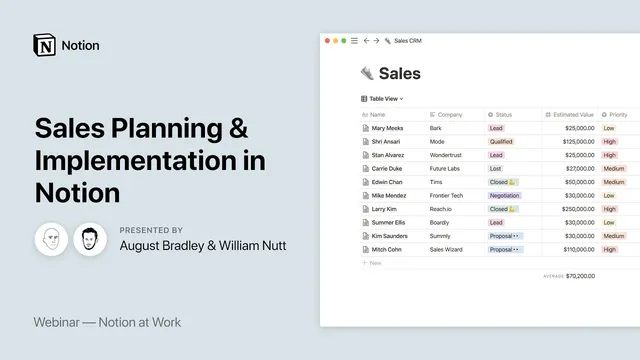
Notion at Work: Sales Planning & Implementation in Notion
Based on Notion's video on YouTube. If you like this content, support the original creators by watching, liking and subscribing to their content.
Build a sales pipeline that includes structured reflection: rate calls (1–5) and write debrief notes (outline adherence, deviations, call length, key learnings) to improve future outreach.
Briefing
A sales system in Notion that’s built for learning—not just logging—centers on one missing ingredient in most pipelines: structured reflection. Instead of treating outreach and call notes as busywork, the workflow pushes users to review what worked, what didn’t, and then adjust the next round of targeting, messaging, and follow-up. That learning loop matters because sales outreach often runs on low conversion rates, where small improvements in process and messaging can compound over time.
The system is organized around two parallel tracks: sales outreach and lead generation. On the outreach side, users start with list-building, then move contacts through a status sequence that reflects real-world sales motion: initial outreach, second outreach, replied, discussion, call scheduled, follow-up after the call, and finally circle back (neither a clean win nor a clean loss—just a reason to revisit later). The approach also discourages over-contacting; it recommends one or two follow-ups and then letting the lead breathe rather than spamming. Crucially, every sales call becomes a data point for improvement: calls are rated on a 1–5 scale, and each call gets a debrief capturing call length, whether an outline was followed, how it deviated, and key learnings. Later, those ratings and notes are reviewed to spot patterns behind wins and losses.
To make the system actionable, Notion dashboards pull in context from other knowledge sources. The sales-and-marketing dashboard uses self-referencing filtered database views that resurface tagged notes, media (articles, videos, podcasts), and knowledge topics specifically labeled for sales and marketing. The goal is to ensure that research and ideas don’t sit in a knowledge vault—they reappear at the moment they’re needed during outreach and calls.
For lead generation, the workflow shifts from direct pitching to consistent visibility in communities. A “content reach plan” maps which platforms matter (Facebook groups, YouTube, Twitter, Instagram, LinkedIn, newsletters, podcasts) and how often the user will engage. The emphasis stays on consistency and service: contribute value in discussions, avoid pitching first, and let profiles and credibility do the selling. A daily habit-style tracker then records whether the planned engagement happened—mirroring fitness tracking—so performance can be measured without obsessing over vanity metrics like exact follower counts.
The Q&A adds practical guidance on scaling the approach: prioritize one or a few channels rather than spreading thin across many groups; repurpose content only when it’s feasible to adapt formats for each platform; and if multiple services exist, add a multi-select “product/service” field to filter the target contact list. The system is also positioned as a standalone module that can plug into broader Notion reviews—especially weekly and monthly reviews—so outreach execution and reflection roll up into ongoing planning and iteration. Finally, a caveat is offered: the separation between lead tracking and client databases may depend on close rates—high-conversion businesses can integrate more tightly, while low-conversion, high-volume outreach may benefit from keeping pipelines distinct until a lead becomes a client.
Cornell Notes
The core idea is to manage sales in Notion as a learning system: track outreach and calls, then reflect on results so targeting and messaging improve over time. The workflow splits into two tracks—sales outreach (moving contacts through statuses like initial outreach, replied, discussion, call, follow-up, circle back) and lead generation (consistent community engagement and content visibility). Every sales call gets a 1–5 rating plus a structured debrief (outline adherence, deviations, call length, and key learnings), enabling pattern-finding across wins and losses. A sales-and-marketing dashboard also resurfaces tagged notes, media, and knowledge topics so research becomes usable at the right moment. The approach matters because it turns low-conversion outreach into iterative improvement rather than repetitive busywork.
How does the system prevent sales tracking from becoming “just numbers,” and what mechanism drives learning?
What does the outreach pipeline look like in practice, and why include a “circle back” state?
How does Notion connect sales execution to prior research and knowledge?
What’s the lead-generation strategy, and how is it operationalized day to day?
How should someone handle multiple Facebook groups or multiple channels without burning out?
If a business offers multiple services, how does the system keep targeting precise?
Review Questions
- What specific fields and steps are used to debrief a sales call, and how do those feed later learning?
- How do the sales-and-marketing dashboard’s filtered views (notes, media, knowledge topics) change the way outreach is executed?
- Why does the system recommend “circle back” instead of forcing every lead into win/loss categories?
Key Points
- 1
Build a sales pipeline that includes structured reflection: rate calls (1–5) and write debrief notes (outline adherence, deviations, call length, key learnings) to improve future outreach.
- 2
Track contacts through a realistic status sequence (including circle back) so leads aren’t prematurely discarded when timing or commitment is unclear.
- 3
Use Notion dashboard views to resurface tagged knowledge (notes, media, knowledge topics) in sales-and-marketing context, sorted by recency.
- 4
Separate outreach from lead generation: outreach moves individuals through statuses, while lead generation relies on consistent community engagement and content visibility.
- 5
Operationalize lead generation with a content reach plan (platforms + frequency) and a daily habit tracker that checks off planned engagement.
- 6
Avoid over-contacting: limit follow-ups to one or two and then pause rather than repeatedly messaging leads.
- 7
When offering multiple services, add a product/service multi-select field to filter the target contact list and keep outreach relevant.