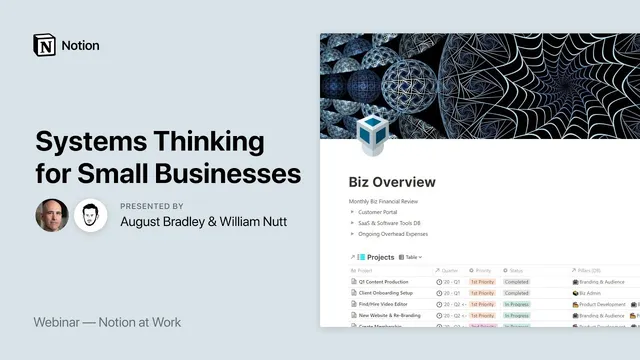
Notion at Work: Systems Thinking for Small Businesses
Based on Notion's video on YouTube. If you like this content, support the original creators by watching, liking and subscribing to their content.
Systems thinking treats business operations as an interrelated whole, where outcomes emerge from interactions—not from optimizing isolated components.
Briefing
Systems thinking is positioned as a force multiplier for small businesses using Notion: it helps teams and individuals see causal relationships across routines, habits, and workflows—so operations become faster, more reliable, and more efficient. The core claim is that building useful “pieces” inside Notion isn’t enough; without a systems mindset, those pieces won’t reinforce each other. With systems thinking, Notion becomes more than a database—it becomes a platform for designing behavior and feedback across the whole operating system.
The framework starts by contrasting systems thinking with reductionist approaches like component thinking and analytical thinking. Reductionism breaks work into parts and optimizes each part in isolation, but systems thinking insists that a system’s function emerges from how parts interact inside a larger context. A car, for example, isn’t defined by its engine, tires, or doors taken separately; it’s defined by what it does in the transportation system—how it moves people from point A to point B with specific tradeoffs like speed, cost, and capacity. From that view, the “whole” can produce properties that don’t exist in the components, a phenomenon called emergence.
Emergence is illustrated through familiar examples: consciousness and life emerging from biological systems, and “witness” emerging when oxygen and hydrogen combine into water. The practical takeaway is that spotting emergence requires stepping back to look at patterns that components alone can’t reveal—especially patterns that repeat over time. That leads to feedback loops, described as the engine of emergence. Feedback loops can compound positively—building momentum and resources cycle after cycle—or degrade destructively—diminishing until the system breaks. The goal is to design for the positive loops and identify the destructive ones early.
To make feedback loops actionable in Notion, August Bradley demonstrates a daily tracking system that feeds performance metrics and reflections into a single workflow. A “daily tracking” database is used as a habit and biometrics log (sleep, smart-scale data, workouts), plus business metrics (sales calls, lead discussions, KPIs). Each day includes planning and end-of-day evaluation: how much time was spent on planned activities and what portion of intended output was completed. Over time, the system “gamifies” behavior by rewarding success and making failures visible through trends—turning daily data into incentives and clarity.
Projects are treated as the unit of work tied to goal outcomes, with task sequences designed so completing one project strengthens the next. Hiring a video editor is given as an example: once editing is offloaded, subsequent content projects can move faster and with higher value.
Sustainability is handled through “balancing properties,” with weekly, monthly, and optional quarterly review cycles acting as guardrails. The reviews clean up the system, roll up performance data automatically via linked days, and surface what’s on track or slipping—without letting the system become messy or misleading. The Q&A reinforces that the weekly review should be manageable (about 20–30 minutes) and the monthly review similarly brief, with the rule that Monday work waits until the review is done.
Finally, the discussion turns to bottlenecks: in teams, the slowest point constrains the whole flow, and a well-designed Notion system should reveal where work is backing up so the team can relieve pressure and restore throughput. Automation is also framed as crucial—especially via an API—to reduce manual data entry and enable richer dashboards fed directly from smart devices and other systems.
Cornell Notes
Systems thinking is presented as a practical philosophy for running a business in Notion: it focuses on how parts interact, how patterns repeat, and how new capabilities (“emergence”) arise from those interactions. The approach emphasizes feedback loops—designing positive loops that compound over time while detecting destructive loops that erode performance. Sustainability comes from balancing properties, with weekly and monthly review cycles acting as guardrails that keep the system clean, accurate, and actionable. In Bradley’s Notion example, daily tracking of habits and business KPIs feeds rollups into reviews, making trends visible and turning planning-and-reflection into behavior change. The result is clearer causality, better problem-solving, and fewer surprises as operations scale.
Why does systems thinking treat “parts” as insufficient for understanding a business workflow?
What are feedback loops, and how do they create compounding outcomes in operations?
How does daily tracking in Notion translate into a feedback loop rather than just recordkeeping?
What role do “balancing properties” play, and why are reviews treated as guardrails?
How does Bradley’s system use Notion structure (relations and rollups) to power weekly review insights?
What does the system say about bottlenecks in teams?
Review Questions
- How does systems thinking define a system’s function, and why does that definition change what you should measure in a Notion workflow?
- Describe a positive and a destructive feedback loop. What signals in daily tracking would help you distinguish between them?
- Why are weekly and monthly reviews framed as balancing properties, and what failure mode do they prevent if skipped?
Key Points
- 1
Systems thinking treats business operations as an interrelated whole, where outcomes emerge from interactions—not from optimizing isolated components.
- 2
Feedback loops are the core pattern mechanism: design positive loops that compound and actively identify destructive loops that erode performance.
- 3
Notion becomes more powerful when daily planning and end-of-day evaluation feed rollups that make trends and causality visible.
- 4
Projects should be sequenced so completing one strengthens the next, turning execution into a compounding operational cycle.
- 5
Balancing properties keep systems sustainable; weekly and monthly review cycles act as guardrails that clean up the system and confirm alignment.
- 6
In team workflows, bottlenecks are the least efficient point; transparency in the system helps locate where work backs up so the team can relieve constraints.
- 7
Automation (especially via an API) is framed as essential to reduce manual data entry and enable richer dashboards fed by smart devices and other sources.