Notion Office Hours: Reboot your Life 🏁
Based on Notion's video on YouTube. If you like this content, support the original creators by watching, liking and subscribing to their content.
Rebooting life in this framework means restoring focus on what matters most now and aligning daily actions with long-term guiding principles.
Briefing
Rebooting life during high-stress periods starts with two linked priorities: focus on what matters most now, and alignment between daily actions and longer-term values. August Bradley’s Notion setup is built around that idea, using an “alignment zone” dashboard and a connected pyramid of execution—so people can keep moving even when anxiety, uncertainty, and constant news cycles make planning feel pointless. The system’s practical promise is simple: reduce mental noise, decide what deserves attention today, and run short feedback loops that keep goals and habits from drifting.
Bradley frames the current moment—shaped by pandemic-era anxiety, family crises, and work-from-home uncertainty—as a time when chaos makes systems more necessary, not less. The first productivity step, he says, is turning down news consumption to avoid doom loops that burn energy without progress. From there, the system targets negative feedback loops (rumination, self-doubt, reactive behavior) and replaces them with upward loops—habits and routines that compound capability. Meditation is treated as a behavioral “break” for thought spirals, while exercise and mindfulness are positioned as foundational for clarity and resilience.
Notion’s flexibility is central to the approach: unlike opinionated tools that impose a workflow, Notion can be shaped into a personal “app.” That power comes with a trade-off—custom systems take time to build and can become over-engineered—so Bradley emphasizes learning through iteration rather than chasing perfection. He also argues that the system isn’t meant to be copied wholesale; it’s meant to be mined for ideas, then adapted to what resonates.
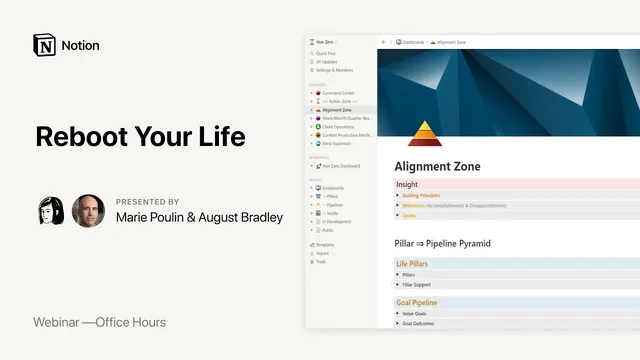
The core structure is a dashboard called the alignment zone, supported by two pages used most often: an “insight” area for self-awareness and a “pillar pipeline pyramid” for execution. Insight is built from recurring reflection cycles—annual, quarterly, monthly, and weekly—culminating in “guiding principles” that act like north stars. Bradley describes an annual review process that assesses the past year and prepares the next, producing a “state of being” (for example, “rising”) and then translating that into guiding principles and life pillars such as health, learning, business growth, and home/personal administration.
Execution flows downward through the pyramid: action items feed projects, projects connect to goal outcomes, and goal outcomes connect to value goals. A key design choice is separating “value goals” (aspirational, less transactional) from “goal outcomes” (more concrete and measurable), so priorities stay meaningful even when circumstances change. Goals also carry status tags like underway, waiting, or off track, letting people pause or re-sequence work without losing the bigger picture.
Day-to-day tracking is handled through a daily zone that prioritizes tasks for the day, captures quick metrics (sleep, fitness, communications, and other indicators), and pairs them with a daily journal routine: a single gratitude item, a “what would make today great” prompt, visualization, and end-of-day improvements. Weekly reviews are treated as the anchor that prevents drift; they also keep guiding principles visible and adjustable. Bradley’s broader message is that rebooting isn’t about rebuilding everything from scratch—it’s about tightening feedback loops, choosing what matters most now, and letting the system evolve based on friction and real-world results.
Cornell Notes
August Bradley’s Notion system is designed to reboot life under stress by enforcing two constants: focus on what matters most now, and alignment between daily actions and long-term values. The setup uses an “alignment zone” dashboard plus a connected “pillar pipeline pyramid” that links guiding principles → pillars → value goals → goal outcomes → projects → action items. Reflection happens through annual, quarterly, monthly, and weekly reviews, culminating in short guiding-principle statements that get revisited so priorities don’t silently drift. Execution is supported by daily tracking and a brief journal routine (gratitude, “what would make today great,” visualization, and end-of-day improvements). The result is a system that creates upward feedback loops and helps stop doom loops—especially by reducing news intake and using meditation/exercise to regain mental clarity.
What does “rebooting your life” mean in this system, and why does it matter during crises?
How does the “alignment zone” connect self-awareness to day-to-day execution?
Why separate “value goals” from “goal outcomes”?
What role do feedback loops play in the system?
How does the system prevent “endless to-do lists” and scheduling guilt?
What does a typical day look like inside the daily zone?
Review Questions
- Which two mechanisms—focus and alignment—does the system use to prevent drift, and how are they implemented in Notion’s dashboards?
- How do annual/quarterly/monthly/weekly reviews each contribute differently to guiding principles and execution?
- What design choices in the pillar pipeline pyramid make it easier to pause or re-sequence work during a crisis without losing direction?
Key Points
- 1
Rebooting life in this framework means restoring focus on what matters most now and aligning daily actions with long-term guiding principles.
- 2
Anxiety management is treated as productivity work: reduce news intake to avoid doom loops, and use exercise plus meditation to break negative thought cycles.
- 3
The “alignment zone” links self-awareness (insight and guiding principles) to execution through a connected pillar pipeline pyramid.
- 4
Guiding principles and “state of being” are produced through reflection cycles (annual, quarterly, monthly, weekly) and revisited so priorities stay current.
- 5
Value goals provide meaning while goal outcomes provide measurable progress; connecting both helps keep work motivating and adaptable.
- 6
Daily tracking and journaling create upward feedback loops by making progress visible and by prompting visualization and end-of-day improvements.
- 7
Weekly reviews act as the system’s stabilizer, keeping tasks, projects, and priorities from drifting when circumstances change.