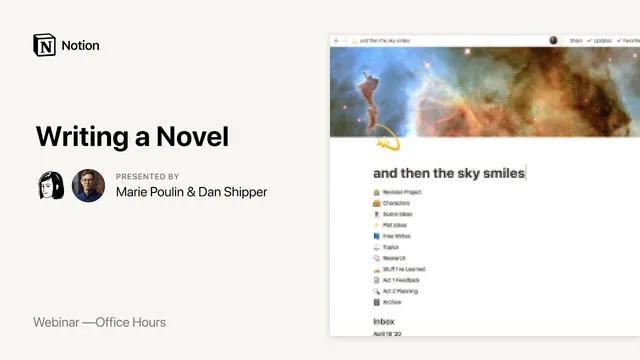
Notion Office Hours: Writing a Novel 📝
Based on Notion's video on YouTube. If you like this content, support the original creators by watching, liking and subscribing to their content.
Use Notion as a flexible cross-linking system so one idea can belong to multiple story elements (character, scene, theme) without losing context.
Briefing
Dan Shipper’s novel-writing workflow hinges on one practical idea: build a flexible knowledge system in Notion that captures characters, scenes, emotional “sparks,” and research—then write in steady bursts without letting planning complexity choke the drafting process. He keeps the system lightweight enough to stay usable during weekend writing, using cross-linking between overlapping concepts (an idea that belongs to a character can also belong to a scene) so he can quickly re-enter the story when time away makes details hard to recall.
Shipper describes a long arc from productivity roots to fiction. After founding Firefly and later selling it to Pega, he turned to writing as a way to learn how to work better—eventually starting a book that’s now in its fourth draft. For his middle-grade novel, “And the Sky Smiles,” he’s been working for about two years and is on that fourth draft as well. The story centers on a boy raised by grandparents in a near-future society where self-driving cars rely on “neuro chips.” When his grandmother develops Alzheimer’s and is slated for a study involving implanted neuro chips, a wave of car crashes leads the government to lock down neuro-chip use, pausing the study. The boy’s mission becomes solving the mysterious crashes to restart the research.
His drafting philosophy runs in two phases. First comes output: he aimed for roughly 1,000 words a day early on, caring less about quality than about producing a complete draft from beginning to end—even if it was “sucked.” Once finishing became a habit, he shifted toward improving the work. He also notes that if he were starting over, he might write more short stories first to gain more rapid revision cycles, but he chose the novel path anyway.
Inside Notion, Shipper organizes the project into major sections—especially a “characters” hub and a set of repositories for scene ideas, plot ideas, and research. A standout practice is collecting vivid emotional moments and language fragments from real life: the visceral joy of seeing a loved one after quarantine, the bodily feeling of embarrassment that turns out to be delight, and even quotable ideas about “celestial couch potatoes” and traveling through the mind. He revisits these stored details when drafting to restore emotion, clarity, and specificity.
He also treats themes as something that emerge rather than something imposed. Because he doesn’t successfully “write to an outline” (the story tends to go where it wants), he pulls recurring themes from his notes during revision—memory is one major theme, shaped by the grandmother’s Alzheimer’s. For structure, he relies more on a small “next scenes” page during active writing than on database-heavy planning.
Beyond Notion, his writing stack is intentionally simple: Google Docs holds chapter drafts, and he uses a workflow that resembles Scrivener’s compilation features via a script, though he stopped using Scrivener due to complexity. He shares early drafts with trusted friends for supportive feedback, and he also sought ongoing coaching from a novelist he emailed directly—described as a cheaper, personalized alternative to an MFA. When motivation dips, his advice focuses less on “staying motivated” and more on handling demotivation—lowering stakes, accepting that hard work brings difficult emotions, and using accountability groups and scheduled “brain time” to keep the process moving.
Overall, the session presents a repeatable model: capture the raw materials of fiction in a flexible system, draft through discomfort with consistent word production, then revise by extracting themes and tightening scenes—without over-engineering the planning stage.
Cornell Notes
Dan Shipper uses Notion as a flexible “command center” for his middle-grade novel “And the Sky Smiles,” linking characters, scenes, plot fragments, research, and emotional moments so he can quickly regain story context during weekend writing. He credits a two-phase process: first produce a complete draft by writing a lot (about 1,000 words/day early on), then improve quality through later revision. Instead of rigid outlining, he lets the novel evolve and later extracts themes that emerge—memory is central because of the grandmother’s Alzheimer’s. He keeps planning lightweight (pages and lists rather than database-heavy systems) and writes chapters in Google Docs. Feedback loops—trusted beta readers and a novelist coach—help him iterate without waiting for “perfect” drafts.
Why does Shipper stick with Notion instead of tools like Evernote or Tinderbox?
What’s the core story engine behind “And the Sky Smiles”?
How does Shipper describe his drafting process in phases?
What does Shipper store in Notion besides plot and characters?
How does he handle structure when he doesn’t reliably follow outlines?
What’s his approach to feedback and coaching?
Review Questions
- How does Shipper’s Notion setup support cross-linking between characters, scenes, and emotional details during weekend writing?
- What are the two phases of his writing process, and how do they change what he optimizes for at each stage?
- Why does he prefer pages and lists over databases for organizing novel material, and what tradeoff does he accept?
Key Points
- 1
Use Notion as a flexible cross-linking system so one idea can belong to multiple story elements (character, scene, theme) without losing context.
- 2
Draft in two phases: produce complete text first (quality later), then revise by extracting themes that emerged during writing.
- 3
Collect “emotional sparks” and language fragments from everyday life and store them for later scene-building and specificity.
- 4
Keep planning lightweight during active drafting—use a small “next scenes” page rather than rigid, database-heavy plotting.
- 5
Write chapters in a simple drafting tool (Google Docs) while keeping research and story context in Notion.
- 6
Build feedback loops early with trusted beta readers and consider coaching to accelerate revision without waiting for perfect drafts.
- 7
When motivation drops, lower stakes and treat demotivation as an emotion to work through—often helped by routines, accountability groups, and scheduled recovery time.