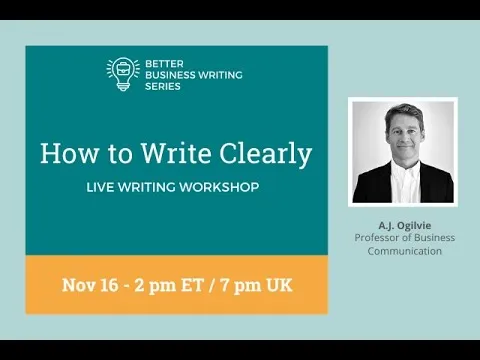
November's Better Business Writing Workshop: How to Write Clearly
Based on ProWritingAid's video on YouTube. If you like this content, support the original creators by watching, liking and subscribing to their content.
Clarity is a reader experience: readers must be able to find information, understand it, and act on it.
Briefing
Clear business writing isn’t a matter of sounding smart—it’s a reader experience built on trust, speed, and action. Aj Ogilvy frames clarity as something readers must be able to (1) find the relevant information, (2) understand it once they locate it, and (3) act on it—whether that action is making a decision, completing a task, or adopting a way of thinking. When any step fails, the breakdown isn’t just inconvenience; it can erode trust and waste real money and time. In business contexts, unclear writing can trigger the harsh assumption that the writer is hiding something, and that suspicion directly undermines relationships and investment.
Ogilvy ties clarity to economics as well as psychology. He cites a 2016 study by Josh Bernoff (referenced as a writing consultant) estimating roughly $400 billion a year is lost to time and money spent dealing with poorly written emails. With many workers spending about half their day reading at work, even modest improvements—like reducing reading time by 15%—can add up quickly. The practical takeaway: clarity is not cosmetic; it’s operational efficiency.
To make clarity actionable, Ogilvy offers five “keys,” presented as guiding principles rather than rigid rules. The first is “one big idea” at every scale: an entire document, each paragraph, and even each sentence should be reducible to a single central point. The second key is simple, reader-anchoring structure. He recommends three common frameworks: Problem → Solution (with a “bliss” section that paints the world after the solution works), So what? Now what? (why it matters, then what to do), and BLUF (Bottom Line Up Front), aligned with the McKinsey Pyramid Principle—especially effective when readers need an immediate takeaway.
The third key is designing for readability at the macro level: short paragraphs (often three to five sentences), short sentences, generous white space, and bullet points that make documents feel “snackable” rather than like a “wall of text.” The fourth key shifts to the sentence level: obsess over subjects. Ogilvy argues that clarity often fails because sentence subjects are vague, abstract, or hard to visualize. He also warns against nominalizations—noun forms ending in “-ion” that turn verbs into clunky abstractions—using examples where “suppliers negotiated honestly” reads more smoothly than “the honest negotiations… increased the likelihood.”
The fifth key is a cognitive sequencing rule: start with old knowledge and add new knowledge on top. Ogilvy illustrates this with Warren Buffett’s preface to the “Plain English Handbook,” noting how Buffett builds new information on concrete, familiar referents so readers don’t have to constantly reorient. The overall message is that clarity operates interdependently—from document structure down to word choice—and that writers must resist their natural writer-centric impulse to communicate from their own mental model. In the end, the test of clarity is simple: if someone else can’t understand and act, the writing hasn’t achieved it.
Cornell Notes
Aj Ogilvy defines clarity as a reader’s experience: people must be able to find information, understand it after finding it, and act on it. He links clarity to trust and business costs, arguing that unclear writing can damage relationships and waste substantial time and money. Five keys guide the approach: keep “one big idea” at the document, paragraph, and sentence levels; use simple structures like Problem→Solution (with “bliss”), So what?/Now what?, and BLUF; design for readability with short paragraphs, short sentences, and white space; choose concrete, vivid sentence subjects and avoid nominalizations; and start sentences with old knowledge before adding new knowledge. Buffett’s Plain English Handbook preface serves as the model text for these principles.
What does “clarity” mean in a business context, beyond being “easy to read”?
Why does Ogilvy connect clarity to trust and money?
How does “one big idea” work at different levels of writing?
What are the three recommended macro-structures for clarity, and when are they useful?
How do sentence subjects and nominalizations affect clarity?
What does it mean to “start with old knowledge and add new knowledge”?
Review Questions
- Pick one email or paragraph you’ve written recently. Can you state its “one big idea” in a single sentence? If not, what competing ideas are competing for attention?
- Rewrite one sentence by replacing a nominalization (e.g., an “-ion” noun) with a verb phrase. How does the sentence change in readability and concreteness?
- Choose a BLUF, Problem→Solution, or So what?/Now what? structure for a message you need to send. Where will you place the bottom line or the problem, and what “bliss” or “reasons” will you include to support it?
Key Points
- 1
Clarity is a reader experience: readers must be able to find information, understand it, and act on it.
- 2
Unclear writing can damage trust and create business costs, including wasted time spent reading and re-reading emails.
- 3
Every unit of writing—document, paragraph, sentence—should be reducible to one big idea to improve stickiness.
- 4
Use reader-anchoring structures such as Problem→Solution (with “bliss”), So what?/Now what?, and BLUF to make logic easier to follow.
- 5
Design for readability with short paragraphs, short sentences, and white space so the text feels “snackable.”
- 6
Choose concrete, vivid sentence subjects and avoid nominalizations that turn verbs into abstract nouns.
- 7
Build sentences by starting with old knowledge and adding new knowledge, so readers don’t have to constantly reorient.