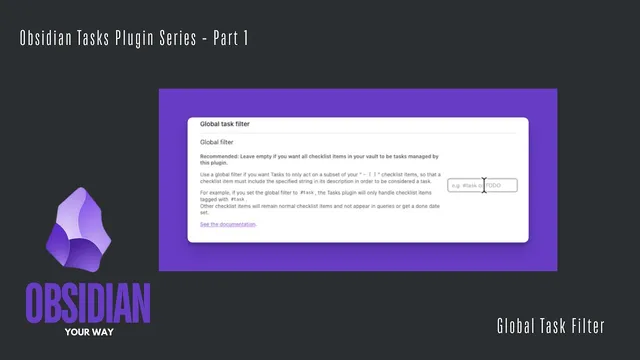
Obsidian Tasks Community Plugin Series, Part 1 - Global Task Filter
Based on Knowledge Work Nexus's video on YouTube. If you like this content, support the original creators by watching, liking and subscribing to their content.
The Global Task Filter (hashtag + emoji) determines which checkbox items are indexed as Tasks and therefore appear in Tasks queries.
Briefing
Obsidian’s Tasks plugin can automatically turn specific checkbox items into “real” tasks—if a single setting called the Global Task Filter is configured correctly. That global hashtag (and its related emoji) determines which checkboxes get indexed by task queries, which then controls what appears in task lists and dashboards. Getting this right early prevents the common frustration of seeing some items show up in queries while other checkboxes—seemingly similar—stay invisible.
The walkthrough begins by installing and enabling the Tasks community plugin in a fresh Obsidian vault. The key step is setting the Global Task Filter: any checkbox item that includes the chosen hashtag (the example uses “#task”) is treated as a task across the vault. The creator keeps other options at defaults for now—such as leaving preset/status/date behavior unchanged—so the demonstration can focus on how the global filter works. A second important toggle is “remove global filter from description.” When this is off, the hashtag remains visible in task text; when it’s on, the hashtag is stripped from the rendered task description after indexing.
To show the difference, the transcript creates two kinds of items: plain checklist entries (typed as normal checkboxes without the hashtag) and tasks (checkboxes that include the hashtag). Only the hashtagged items appear when a basic Tasks query is created using a fenced code block labeled “tasks.” The simplest query returns the three tasks created with the global hashtag, while the plain checklist items do not appear—because they lack the global filter marker.
Next, the “remove global filter from description” option is turned on, requiring an Obsidian restart. After restarting, the same tasks query no longer displays the hashtag in the results, even though the tasks still exist and are still indexed. This gives a cleaner visual presentation without changing which items qualify as tasks.
The demonstration then addresses what happens when the global hashtag itself changes. After switching the global filter away from “#task,” the existing tasks disappear from the query because they still contain the old hashtag. Adding a new checkbox using the updated hashtag makes it appear again. The practical takeaway: the global filter is effectively a gatekeeper for task discovery, so changing it can hide previously created tasks unless they’re updated or recreated.
Finally, the transcript shows two ways to create tasks: manually typing the global hashtag into a checkbox, and using the Tasks modal from the command palette (“create or edit task”), which inserts the hashtag automatically and supports richer fields like due dates, priorities, recurrence, statuses, and dependency-style “before/after” relationships. The overall message is that the global task filter should be chosen deliberately, because it shapes how tasks are recognized, displayed, and managed—whether the plan is to keep the same vault or evolve the system without migrating everything.
Cornell Notes
Obsidian Tasks uses a Global Task Filter—typically a hashtag plus an emoji—to decide which checkbox items become “tasks” that show up in Tasks queries. Items without the global hashtag behave like regular checklist items and won’t appear in task lists. Turning on “remove global filter from description” cleans up how tasks render by stripping the hashtag from the visible text after an Obsidian restart. Changing the global hashtag later can make existing tasks disappear from queries until they’re updated or recreated with the new hashtag. The plugin also supports task creation via a command-palette modal, which can auto-add the hashtag and fill fields like due dates, status, and dependencies.
What exactly does the Global Task Filter do in the Tasks plugin?
Why do some checklist items not show up in a Tasks query even when they look similar?
What changes when “remove global filter from description” is enabled?
What happens if the global hashtag in the Global Task Filter is changed?
How do you create tasks: manually with the hashtag or via the Tasks modal?
How do dependency-style “before/after” settings work in task creation?
Review Questions
- If a checkbox item does not include the Global Task Filter hashtag, what will happen to it in a fenced “tasks” query?
- How does enabling “remove global filter from description” affect what appears in query results, and why is a restart required?
- What practical issues arise when changing the global hashtag after tasks already exist in the vault?
Key Points
- 1
The Global Task Filter (hashtag + emoji) determines which checkbox items are indexed as Tasks and therefore appear in Tasks queries.
- 2
Checklist items without the global hashtag behave like ordinary checkboxes and won’t show up in a “tasks” query.
- 3
Enabling “remove global filter from description” cleans up task text by hiding the hashtag in query results, but requires an Obsidian restart.
- 4
Changing the global hashtag later can make previously created tasks disappear from queries unless they’re updated or recreated with the new hashtag.
- 5
Tasks can be created either by manually typing the global hashtag into a checkbox or by using the Tasks modal, which auto-adds the hashtag and supports richer fields.
- 6
The Tasks modal supports due dates, priorities, recurrence, statuses, and dependency-style “before/after” relationships, enabling more structured task management.