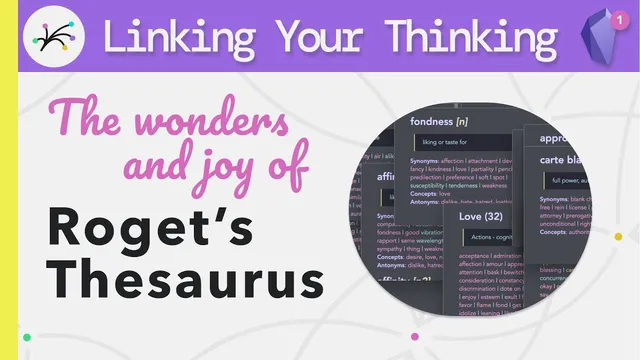
On the Wonders and Joy of the Thesaurus (in Obsidian)
Based on Linking Your Thinking with Nick Milo's video on YouTube. If you like this content, support the original creators by watching, liking and subscribing to their content.
Vocabulary expansion is framed as a defense against mental narrowing, using Orwell’s Newspeak as the cautionary model.
Briefing
Language control can shrink thought, but a richer vocabulary can widen it—and a digital thesaurus built for linked notes turns that idea into a practical workflow. The core claim is that expanding word choice doesn’t just make writing prettier; it improves how people think, analyze, and connect, while also reducing vulnerability to manipulation that relies on emotional, simplified language.
The transcript opens with George Orwell’s “1984” and Newspeak as a warning: removing “bad” and “great” words until only flattened opposites remain (“ungood” and “double plus good”) traps people in a narrower mental range. That framing sets up the video’s counterpoint: instead of treating big words as a threat to identity, people can use them as tools. The thesaurus becomes a way to resist “Big Brother” dynamics—whether literal or political—by making it harder for populists and other bad actors to steer attention using fear, anger, and outrage.
A major portion then focuses on a specific digital resource: a publicly hosted Obsidian Publish version of Peter Mark Roget’s thesaurus (1852), using the “third edition of the 21st century edition” and the concept index by Barbara Ann Kipfer. The creator describes receiving a “gift” from Dennis: a digital copy with a concept index, plus striking scale metrics—about 14,000 distinct notes with definitions, roughly 44,000 words total, and around 420,000 links connecting entries. In Obsidian, hovering over words reveals definitions instantly, and clicking through creates a “rabbit hole” effect where related terms and concepts branch outward.
The transcript demonstrates two navigation modes. First is lateral synonym browsing: starting from a word like “astonish,” the interface surfaces synonyms such as “amaze,” “astound,” “bewilder,” “overwhelm,” and “stupefy.” Second is concept-based browsing using the concept index: “astonish” is linked to “surprise,” which sits under a higher-order meta note (“actions of a cognitive nature”). From there, the user can move up a level to see broader categories and down to adjacent terms—turning word lookup into a structured exploration of meaning.
Beyond synonyms and concepts, the transcript emphasizes categories as a map for serendipity. The categories list includes domains like actions (cognitive, general, motion, physical), causes, fields of human activity (communications, education, entertainment, government, legal, military), professions, recreation, religion, social interactions, the arts, life forms, objects, matter, qualities, senses, and geography. Examples include landscape subcategories like “savannah,” “tundra,” “quagmire,” and “ravine,” framed as ways to describe not just places but felt experiences.
The closing takeaway is both practical and motivational: use the thesaurus for “word excursions” by scrolling the word list or opening the concept index categories note. The promised benefits are improved thinking, richer expression, more nuanced analysis of similarities and differences, greater joy in interactions, and a stronger defense against emotionally manipulative persuasion. The resource is positioned as freely available online via Obsidian Publish, encouraging immediate exploration.
Cornell Notes
The transcript argues that vocabulary expansion is a cognitive upgrade, not a vanity project. It uses Orwell’s Newspeak as a cautionary tale about how shrinking word choice can imprison thought, then counters with a digital thesaurus in Obsidian that links words to definitions and to higher-level concepts. By hovering for definitions and clicking through dense networks of links, users can browse synonyms laterally or move up and down a concept hierarchy (e.g., “astonish” → “surprise” → “actions of a cognitive nature”). The resource’s categories—ranging from human activities to senses and geography—turn lookup into “word excursions,” which the transcript claims can improve thinking, expression, and resilience against manipulative language.
How does the transcript connect vocabulary to freedom of thought?
What makes the digital thesaurus in Obsidian different from a traditional book thesaurus?
How does “concept index” navigation change the way synonyms are used?
What are the two main exploration strategies demonstrated?
Why does the transcript emphasize categories like “matter,” “senses,” or “geography”?
What practical benefits are claimed for using a thesaurus regularly?
Review Questions
- When does the transcript recommend using synonyms versus moving through the concept index hierarchy?
- What role do categories play in turning thesaurus use into “serendipitous encounters”?
- How does the Orwell/Newspeak example function as a motivation for vocabulary expansion in the transcript?
Key Points
- 1
Vocabulary expansion is framed as a defense against mental narrowing, using Orwell’s Newspeak as the cautionary model.
- 2
A digital thesaurus in Obsidian enables fast definition lookup via hover and rapid navigation through linked notes.
- 3
Exploration can be lateral (synonyms) or vertical (concept hierarchy), letting users move from a word to broader meaning categories.
- 4
The concept index links words to higher-order meta notes such as “actions of a cognitive nature,” changing how related terms are discovered.
- 5
Category browsing turns word lookup into structured “word excursions,” spanning domains from human activities to senses and geography.
- 6
The transcript links stronger word choice to improved analytical, creative, and connective thinking, plus better communication of complex emotions.
- 7
Richer vocabulary is presented as a practical tool for resisting emotionally manipulative persuasion that relies on simplified language.