On These Math Problems, Smarter People Do Worse
Based on Veritasium's video on YouTube. If you like this content, support the original creators by watching, liking and subscribing to their content.
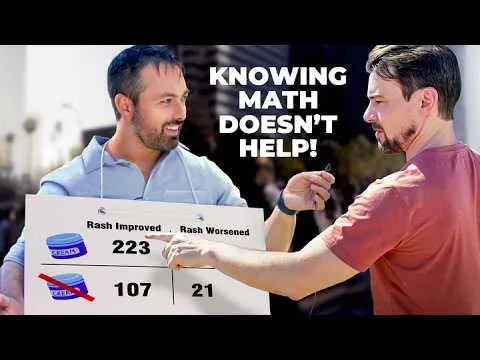
Correct answers in the skin-cream scenario depend on ratios (improved-to-worsened proportions), not on which group has the larger raw count of improvements.
Briefing
A counterintuitive pattern shows up when people answer quantitative questions: higher numeracy can make them more likely to get politically loaded problems wrong. The effect matters because it challenges the common belief that stronger math skills automatically lead to more accurate reasoning—especially when the “right” conclusion threatens or supports a person’s ideology.
The research begins with a simple proportional-reasoning trap using a fictitious skin-cream trial. Participants see a table counting how many people improved versus worsened after two weeks. Many people jump to an intuitive shortcut: whichever group has the larger raw number of “improved” cases must be better. But the correct interpretation depends on ratios. In the cream group, roughly three times as many people improved as worsened; in the control group, about five times as many improved as worsened. That means the cream, on average, made rashes worse—even though the “improved” count looks larger at first glance.
Dan Kahan and colleagues tested this with a nationally diverse sample of 1,111 Americans. Before answering, each participant took a numeracy assessment measuring quantitative reasoning rather than advanced math. When the skin-cream question used the “cream helps” framing, accuracy rose with numeracy in the expected direction—yet the higher-numeracy participants were also more likely to avoid the intuitive mistake and select the correct proportional answer. That part looks like numeracy doing its job.
The twist comes when the same proportional table is presented with reversed column headings, flipping which conclusion is correct. Again, higher numeracy predicts higher accuracy. But the study’s real target is politics: participants were split by self-reported political affiliation and then given either a gun-control version of the fictitious study or the skin-cream version.
For the apolitical skin-cream problem, liberals and conservatives follow the same accuracy pattern—no ideological split emerges. For the gun-control problem, the split is stark. When the data imply gun-control laws reduce crime, Democrats perform well and Republicans struggle; when the data imply gun-control laws increase crime, the pattern reverses. Crucially, numeracy no longer guarantees accuracy in the “threatening” direction. Among the most numerate participants, performance is worse than it should be: they become more likely to reach the conclusion that fits their prior beliefs rather than the conclusion demanded by the numbers.
The same conditional polarization appears across other issues like fracking and global warming, and even when reasoning ability is measured through science literacy or open-minded thinking. The broader takeaway is uncomfortable: people may use quantitative skill selectively—applying it to justify what they already believe—while still feeling rational.
The discussion closes with practical ideas for reducing tribal reasoning: avoid partisan rhetoric and focus on specific local policies; cultivate curiosity so people are more willing to examine evidence that conflicts with ideology. The emphasis is on awareness and accountability, not a magic fix—because the tendency to align beliefs with one’s group is deeply rooted in social survival, and it becomes more visible in today’s high-volume online information environment.
Cornell Notes
Quantitative reasoning can fail in predictable ways when politics is involved. In a fictitious skin-cream trial, correct answers depend on proportional reasoning (ratios of improved to worsened cases), and higher numeracy helps people avoid an intuitive but wrong shortcut. The pattern changes when the same style of data is embedded in a gun-control scenario where the correct conclusion conflicts with a party’s ideology. Then numeracy stops protecting accuracy: highly numerate participants are more likely to select the ideologically consistent interpretation rather than the one demanded by the numbers. The result is polarization that grows with reasoning skill, suggesting people may use quantitative ability to rationalize prior beliefs.
Why does the skin-cream question create a “smart people do worse” effect?
How did the study measure numeracy, and what did it predict in the skin-cream version?
What changes when the same proportional table is used for gun control?
How does numeracy interact with ideology in the gun-control results?
What broader pattern links gun control to issues like fracking and global warming?
What practical interventions are suggested to reduce this kind of polarization?
Review Questions
- In the skin-cream example, what ratio comparison leads to the conclusion that the cream made rashes worse?
- Why does numeracy help in the skin-cream task but fail to protect accuracy in the gun-control task when ideology is threatened?
- What does the transcript suggest about the relationship between science literacy, open-minded thinking, and political polarization?
Key Points
- 1
Correct answers in the skin-cream scenario depend on ratios (improved-to-worsened proportions), not on which group has the larger raw count of improvements.
- 2
Higher numeracy improves accuracy when the correct conclusion is not ideologically threatening, helping people avoid an intuitive but wrong shortcut.
- 3
When the same quantitative structure is placed inside a political context, accuracy becomes conditional on party alignment rather than on numeracy alone.
- 4
Highly numerate participants can perform worse than expected when the data contradict their ideology, suggesting selective reasoning or motivated interpretation.
- 5
Polarization grows with reasoning skill across multiple issues, including gun control, fracking, and global warming, and also appears in measures like science literacy and open-minded thinking.
- 6
Reducing tribal reasoning may require avoiding partisan rhetoric and emphasizing specific local policies, plus cultivating curiosity rather than only increasing technical comprehension.