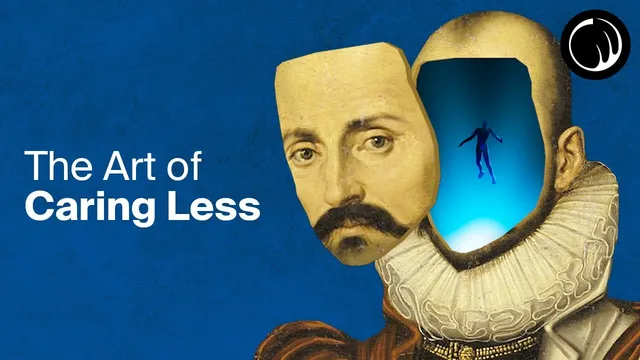
Once You Stop Caring, the Results Come - The Philosophy of Michel de Montaigne
Based on Pursuit of Wonder's video on YouTube. If you like this content, support the original creators by watching, liking and subscribing to their content.
Montaigne’s philosophy centers on honest self-examination rather than achieving certainty about the world.
Briefing
Michel de Montaigne’s enduring insight is that a good life doesn’t come from mastering the world with flawless reason—it comes from honest self-examination, accepting uncertainty, and learning how to live (and die) with that knowledge. His philosophy matters because it reframes “wisdom” as a practical, human practice rather than a theoretical achievement: people should focus on what they can govern (their judgments), treat knowledge as provisional, and stop performing intellectual certainty.
Montaigne’s approach was forged by a lifetime shadowed by mortality. Born in 1533 to a wealthy merchant family in France, he gained a rigorous education early, mastered Latin, and later worked as a magistrate serving the French crown. But his thirties brought a concentrated run of losses and near-death events: the death of a close friend (likely plague), his father’s long illness from kidney stones, his younger brother’s death after a head injury, a horseback accident that nearly killed him, and the death of his first child in infancy. In 1570 he withdrew from public life to his inherited estate, retreating into near-solitude with more than 1,500 books. Over years of seclusion, he produced his masterwork—Essays—first published in 1580 and continually revised.
What made Montaigne’s work transformative wasn’t only its themes—sorrow, fear, education, friendship, solitude—but the method. He wrote in an intimate, candid, often humorous voice, aiming to expose himself “plain natural and ordinary” and to offer a complete, honest exploration of the human condition. A major 20th-century scholar and translator, Donald M. Frame, argued that Montaigne’s essays function like a new kind of communication after loss: the reader becomes a stand-in for the dead friend, and the writing turns into a direct self-portrait.
Montaigne also challenged the era’s confidence in reason as a path to mastery. Reason, he allowed, is useful—but the person wielding it isn’t automatically better at poise or success than anyone else. He mocked the self-bolstering traditions of intellectual life, insisting that humans are a mix of folly and wisdom and that intellectuals often leave out “more than half” of reality by writing only reverently and according to rules. Instead of treating the mind as a purely rational engine, Montaigne emphasized the body: thoughts are shaped by physical feelings, desires, and perceptions, and every life is strained by aging, sickness, and the certainty of death—whether one is a ruler, writer, or housekeeper.
His practical ethic echoed the Stoics: focus on what can be controlled—one’s own judgments—and accept what cannot. Yet Montaigne’s self-knowledge was not tidy. He embraced contradiction, change, and ambiguity, treating the self as something that shifts with circumstances. His skeptical empiricism prioritized sense perception over reasoning while still treating both as fallible tools. The famous motto “What do I know?” captured the point: philosophy isn’t about landing on absolute truth, but about free judgment expressed from within the self.
Montaigne died on September 13, 1592, from quinzy, a disease that often causes paralysis of the tongue. Even so, his life’s work was built on speaking bluntly and exploring his inner workings before it was too late. His legacy spread widely—Rene Descartes, Jean-Jacques Rousseau, Blaise Pascal, Friedrich Nietzsche, Ralph Waldo Emerson, and even Shakespeare—while his essay form helped shape modern nonfiction. The core message remains simple and demanding: stop chasing certainty, look closely at ordinary life, and learn how to die while living with that clarity.
Cornell Notes
Michel de Montaigne built a philosophy of living from self-examination rather than from intellectual certainty. After years of personal loss and near-death experiences, he withdrew to his estate, wrote candidly in his Essays, and treated knowledge as provisional. He argued that reason helps but doesn’t make anyone superior, because humans are shaped by the body, by uncertainty, and by changing circumstances. Drawing on Stoic control of one’s judgments and on skeptical empiricism, Montaigne urged “What do I know?”—a practice of free judgment that accepts contradiction. His approach influenced major thinkers and helped define the modern essay as a serious way to explore the human condition.
Why did Montaigne’s life events push him toward a new kind of philosophy?
What does Montaigne mean by “What do I know?” and how does it shape his view of truth?
How did Montaigne challenge the idea that reason automatically leads to mastery?
Why is the body central to Montaigne’s philosophy?
What does Montaigne’s Stoic influence look like in practice?
How does Montaigne handle contradiction and change in his writing?
Review Questions
- How does Montaigne’s emphasis on the body undermine the idea that pure reason is the main route to wisdom?
- In what ways does Montaigne’s skepticism differ from simply rejecting knowledge altogether?
- Why does Montaigne treat contradiction as compatible with truth about human life?
Key Points
- 1
Montaigne’s philosophy centers on honest self-examination rather than achieving certainty about the world.
- 2
Personal losses and near-death experiences helped drive his retreat into solitude and the sustained practice of writing as a self-portrait.
- 3
Reason is a tool, not a guarantee of mastery; intellectual certainty often masks human limitations.
- 4
The body shapes thought through feelings, desires, and perceptions, tying every life to sickness, aging, and death.
- 5
A Stoic-inspired focus on controlling one’s judgments is paired with skeptical empiricism about what can be known.
- 6
Montaigne embraces contradiction and change as natural features of human understanding across different circumstances.
- 7
His essay form—candid, informal, and continually revised—helped define modern nonfiction and influenced major later writers and philosophers.