One Thought Can Change You Forever
Based on Pursuit of Wonder's video on YouTube. If you like this content, support the original creators by watching, liking and subscribing to their content.
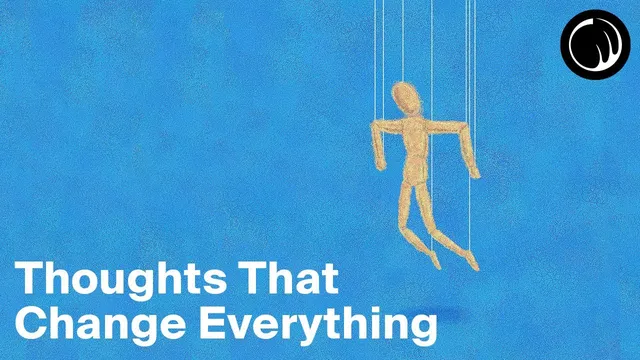
Determinism treats human actions as the end result of prior causes, making “choice” feel like a downstream effect rather than an origin.
Briefing
A philosophical crisis over determinism ends with a practical pivot: Casey can’t escape the idea that choices are caused, but he finds meaning anyway by treating “free will” as an illusion that still works—because lived experience depends on an observer who can navigate and interpret.
The trouble begins after Casey watches a determinism video arguing that every event, including human action, follows an unbroken chain of prior causes. He agrees with the logic: he didn’t choose his parents, his genetics, his early experiences, or the first thoughts that shaped everything afterward. What feels like choosing, then, is just another link in the causal chain. That alignment between intuition and logic collapses into disorienting dissonance—if everything is fixed, what is the point of life, and how could meaning be “chosen” at all?
Over the next days, Casey tries to test free will in everyday moments. At a park, he insists he chose to sit on a bench without any external trigger. But when he watches a dog follow its nose, he realizes the same question applies: does the dog choose what it wants, or is it pulled by desire and conditioning? Casey then turns inward and can’t locate a “source” of wanting he controls. Desires arise from prior information, temperament, and unconscious inputs—so even the act of wanting to want becomes part of the same causal machinery.
He repeats the attempt at escape during dinner with friends, ordering a fish meal he doesn’t want purely to prove he can override determinism. A friend punctures the effort: Casey still did what he wanted—meaning the “proof” was driven by another desire. The pattern continues at a coffee shop when he refuses to decide on cream or sugar and leaves it to chance. A coin flip lands heads, and he ends up with black coffee when he wanted cream and sugar. The randomness doesn’t restore freedom; it only replaces one kind of constraint with another.
The cumulative effect is existential: Casey can’t “unknow” what he now believes, and he slides into a fatalistic shutdown—staring at a wall, doing nothing, then barely functioning through the night. Yet the crisis breaks when he plays a video game. He knows the story, rules, and outcomes are predetermined by code, and he still becomes fully immersed, enjoying tasks and challenges as they unfold. The key realization lands: even if he has no control over the causal path, his participation is still necessary to the experience. Meaning doesn’t require metaphysical escape; it requires an experiencer.
Casey reframes himself as “not my choices, not my actions,” but the observer of consciousness that can navigate and find meaning within whatever causal sequence plays out. After that shift, life looks different—but not empty. He returns to normal social life, meets friends at a bar, and enjoys the night the same way he always had, now without needing free will as a condition for meaning.
Cornell Notes
Casey’s worldview fractures after learning determinism: every action is the result of prior causes, so “choice” feels like an illusion. He tries to disprove it through small experiments—choosing to sit at a park, ordering food he doesn’t want to prove he can override desire, and leaving cream/sugar to a coin flip—but each attempt collapses into the same conclusion: even the desire to prove freedom is caused. The existential crash follows, including a period of fatalistic withdrawal. The turning point comes when he plays a predetermined video game and still finds genuine immersion and meaning, leading him to treat “free will” as an illusion that still functions for lived experience.
How does determinism challenge Casey’s sense of free will?
Why doesn’t Casey’s park “choice” prove he has free will?
What flaw does Casey’s friend point out about his dinner experiment?
Why does the coin-flip cream/sugar test fail to restore freedom?
What changes Casey’s outlook after the existential shutdown?
How does Casey’s final reframing resolve the “illusion” problem?
Review Questions
- What specific everyday tests does Casey run to try to prove free will, and what common failure do they share?
- How does Casey’s understanding of “wanting to want” undermine the idea that he controls his desires?
- Why does immersion in a predetermined video game become the turning point for Casey’s crisis?
Key Points
- 1
Determinism treats human actions as the end result of prior causes, making “choice” feel like a downstream effect rather than an origin.
- 2
Casey’s attempts to prove free will fail because the desire to prove freedom is itself a want produced by earlier causes.
- 3
Randomness (like a coin flip) does not restore agency; it replaces causation with chance without creating control.
- 4
An inability to “unknow” determinism can trigger a severe existential response, including withdrawal and meaning collapse.
- 5
The crisis eases when Casey recognizes that meaning can arise from being an experiencer inside a predetermined sequence.
- 6
Knowing an experience is an illusion doesn’t prevent it from functioning; the illusion matters because it shapes lived reality.