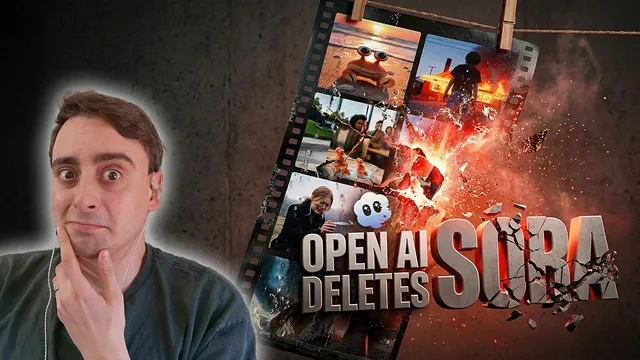
Open AI is Deleting Sora - Thoughts as a Weekly User
Based on MattVidPro's video on YouTube. If you like this content, support the original creators by watching, liking and subscribing to their content.
OpenAI is ending the Sora app, with Android and iOS access slated to disappear and the Sora API likely following later.
Briefing
OpenAI is shutting down the Sora app—an abrupt retreat from a consumer-facing AI video playground that many users treated as a creative home base. The move matters because it signals where OpenAI’s priorities—and its most scarce resource, compute—are heading next: away from expensive, low-revenue experimentation and toward architectures and deployments expected to be more profitable.
The announcement, posted on Sora’s app page, frames the change as a farewell rather than a technical failure: “We’re saying goodbye to the Sora app. It’s flying high in the sky… going out to the back of the barn.” The shutdown is expected to affect both Android and iOS access and likely the Sora API later, with additional details promised on how creators can preserve their work. The tone is meant to acknowledge community impact, but the reaction among weekly users and power creators is disappointment—especially for those who built followings through original prompts and remixes.
A central claim is that Sora’s economics never penciled out. Sora is described as extremely expensive to run, with the transcript’s estimate putting losses at roughly $15 million per day. The app also wasn’t generating enough money to justify continued investment, particularly after early novelty faded. While monthly users reportedly held up better than downloads, the overall base was still too small for the cost of producing photorealistic video at scale.
At the same time, Sora’s training value is treated as a key reason it existed at all. The transcript argues that the video data and user-created outputs are “extremely valuable” for training future models—potentially feeding improvements across OpenAI systems such as ChatGPT. That suggests Sora wasn’t only a product; it was also a data pipeline and a research proving ground for future video generation.
The shutdown also carries a reputational cost. The transcript highlights a specific risk: OpenAI’s most engaged consumer segment—people who test new tools, find flaws, and produce standout original content—may become less willing to invest time in the next experiment if it can disappear within months. That could chill the remix-driven ecosystem that made Sora feel culturally alive.
The broader strategic direction is framed as a shift toward enterprise B2B solutions and compute allocation for “state-of-the-art” work that can monetize sooner. The transcript points to a named next focus—“Spud”—and notes signals that video features were shelved for ChatGPT, even as demand for Sora-like capabilities likely remains. The implication is that OpenAI wants to keep video generation in its future, but with cheaper, more efficient architectures and a less willy-nilly deployment model.
In short: Sora’s end is portrayed less as an AI bubble popping and more as a resource reallocation decision. The technology’s potential remains, but the app’s consumer model is deemed financially unsustainable—prompting OpenAI to chase the next generation of models and deployments where returns are expected to be clearer.
Cornell Notes
OpenAI is ending the Sora app, with the shutdown expected to remove access on Android and iOS and likely later affect the Sora API. The decision is framed as an economics-and-compute move: Sora’s photorealistic video generation is extremely costly, while revenue from a comparatively small user base wasn’t enough to justify continued spending. At the same time, Sora’s user-generated video data is treated as valuable training material that can support future model development, potentially across OpenAI systems like ChatGPT. The change also risks alienating Sora’s most active creators, since rapid cancellation can reduce willingness to invest time in future experiments. Overall, the transcript links Sora’s closure to a broader shift toward enterprise-focused, more profitable AI work and to new architectures such as “Spud.”
What reasons are given for shutting down the Sora app, beyond community disappointment?
Why would OpenAI launch Sora if it wasn’t financially sustainable?
What does the transcript suggest about the impact on creators and the remix ecosystem?
How does the transcript connect Sora’s shutdown to OpenAI’s longer-term strategy?
What future technical direction is mentioned?
Review Questions
- What economic factors does the transcript cite as the main drivers of Sora’s shutdown, and how do user metrics (downloads vs. monthly users) fit into that argument?
- How does the transcript reconcile Sora’s consumer cancellation with the claim that Sora data remains useful for future model training?
- Why does the transcript argue that rapid product cancellations can affect creator behavior and the quality of future user-generated ecosystems?
Key Points
- 1
OpenAI is ending the Sora app, with Android and iOS access slated to disappear and the Sora API likely following later.
- 2
The decision is attributed primarily to compute cost: Sora’s video generation is described as extremely expensive and not matched by sufficient revenue.
- 3
User-created outputs are treated as valuable training data, helping justify Sora’s cost even if the app itself wasn’t profitable.
- 4
Early novelty faded for many users, with downloads dropping even if monthly users held up somewhat, leaving the business case weak.
- 5
Rapid shutdown can damage trust with Sora’s most active creators, who built followings through original prompts and remixes.
- 6
The strategy shift points toward enterprise B2B focus and more profitable AI work, while keeping video generation as a future goal.
- 7
A next architecture/model named “Spud” is cited as part of the direction for future progress.