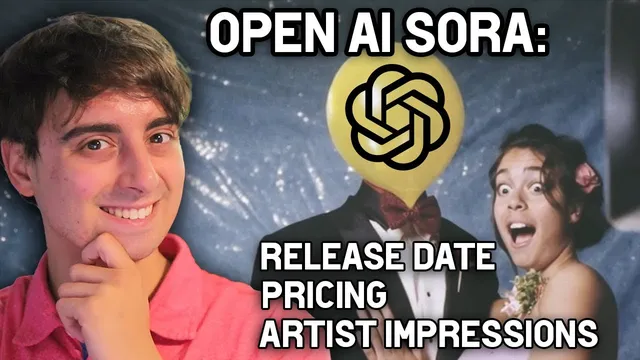
Open AI Sora - Access Expands to Artists, Release Date, & Cost Predictions
Based on MattVidPro's video on YouTube. If you like this content, support the original creators by watching, liking and subscribing to their content.
Sora access is expanding to selected artists and external creators, with new demos and short films used to validate cinematic motion and concept animation.
Briefing
OpenAI’s Sora is moving from tightly controlled access toward broader use by artists and external creators, signaling a release path that could land in the latter part of the year—likely after the U.S. election. New demos and short films made by outside creatives are being used as proof points: the model can generate photorealistic, cinematic motion; build simulated worlds; and handle surreal concepts that would be difficult or time-consuming with traditional VFX workflows. Early access is also framed as a feedback loop, with creators supplying input to improve the product.
The strongest evidence of Sora’s readiness comes from the range of creative experiments now circulating. Artists are producing watchable, story-like sequences rather than isolated clips, including surreal character concepts (like a person with a balloon head) and physically grounded camera moves through changing environments (such as underwater-to-disco-ball transformations). Several examples emphasize consistency in motion and framing—camera movement stays stable even when the subject matter becomes abstract. There are still visible limitations: fine physics details can break down (for example, glass behaving unrealistically), faces may not remain perfectly consistent across shots, and some hybrid creatures come out “mashed” or partially wrong. Even so, the demos are repeatedly described as good enough to feel like film scenes, with enough smoothness and visual coherence to reduce the “icky AI” feeling many people associate with earlier generations.
A key theme is that Sora’s value isn’t only realism; it’s the ability to turn impossible ideas into moving images quickly. Creators are pushing prompts toward cinematic techniques—zooming, rapid scene transitions, and stylized worlds—while also exploring text-like or object-specific transformations (such as shoe-focused concepts). The model’s adaptability shows up across formats too: music-video style work, found-footage aesthetics, and 3D sculpture-oriented visualization. Some experiments are positioned as VFX substitutes, where AI can generate shots that might otherwise require hours of compositing, tracking, and rendering.
On timing, the access expansion is compared to the earlier rollout pattern of DALL·E 2: a research preview phase, then selective artist access, then gradual expansion. A waitlist is expected soon. Release timing is also linked to election-season risk concerns—specifically the fear of informational tampering with AI-generated video. The argument for delaying until after the election is that OpenAI’s safety controls are stronger than those of some other systems, reducing the likelihood of harmful misuse.
Cost predictions are the other major pillar. Using compute estimates tied to large-scale deployment (including assumptions about H100 GPUs and potential Blackwell hardware), generating a one-minute video is estimated to take roughly 12 minutes on a single H100, with training costs described as extremely high. The likely consumer price is projected as “a few dollars” for around a 60-second clip, with early access probably limited by cost and capacity. The expectation is pay-per-generation rather than broad monthly subscriptions at first, with longer clips costing more and generation speed improving as larger Blackwell systems come online. Even with falling hardware and electricity costs, the rollout is expected to start expensive and gradually become more accessible by 2025—making Sora a practical alternative to traditional VFX for many creators, even if general public access arrives later than the demos suggest.
Cornell Notes
Sora’s access is expanding beyond OpenAI’s internal circle, with artists and external creators producing short films and demos that highlight cinematic motion, photorealism, and the ability to animate surreal concepts. The results look strong in camera movement and overall watchability, though physics details, facial consistency, and complex hybrid creatures still show failure modes. The rollout is expected to follow a DALL·E 2-like pattern: selective access first, then a waitlist, then broader availability. Timing is speculated to land in September or October, or after the election if safety and misuse concerns drive a delay. Cost estimates suggest early pricing will likely be pay-per-generation, potentially “a few dollars” for about a 60-second clip, with compute-heavy generation times improving as newer GPU hardware scales.
What kinds of creative outputs are being used to demonstrate Sora’s capabilities beyond simple realism?
Where do the demos show Sora’s limitations most clearly?
Why does the rollout pattern matter for predicting when Sora could become widely available?
How are compute and hardware assumptions used to estimate Sora’s generation cost?
What pricing model is expected for early Sora access, and how does clip length affect it?
Review Questions
- Which demo characteristics are repeatedly treated as signs of progress (e.g., camera motion, concept consistency), and which failure modes still appear?
- How do election-season concerns influence the speculative release window, and why does the DALL·E 2 comparison matter?
- What compute-based assumptions are used to estimate generation time and cost, and how might Blackwell hardware change those numbers?
Key Points
- 1
Sora access is expanding to selected artists and external creators, with new demos and short films used to validate cinematic motion and concept animation.
- 2
The strongest demo signals are smooth, consistent camera movement and watchable sequences, even when subjects are surreal or impossible.
- 3
Known weaknesses include physics fidelity errors (like glass behavior), occasional facial inconsistency, and imperfect rendering of complex hybrid creatures.
- 4
The rollout is expected to follow a phased DALL·E 2-like pattern, likely including a waitlist before broader availability.
- 5
Release timing is speculated for September–October, with a possible post-election delay to reduce informational tampering concerns.
- 6
Compute-based estimates suggest one-minute generation could take around 12 minutes on an H100, implying early pricing will likely be high and capacity-limited.
- 7
Early pricing is projected as pay-per-generation (not a broad subscription), potentially around a few dollars for ~60 seconds, with costs dropping as newer GPU hardware scales.