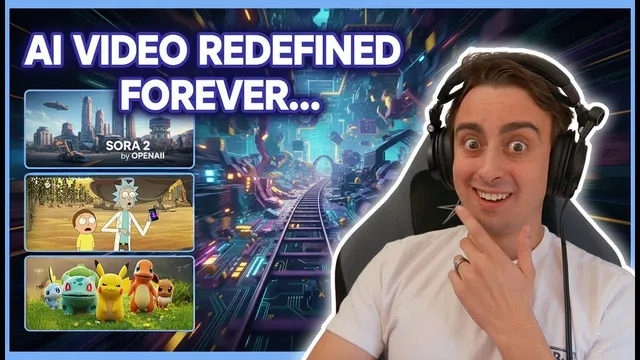
Open AI's Sora 2 made me rethink what's possible.
Based on MattVidPro's video on YouTube. If you like this content, support the original creators by watching, liking and subscribing to their content.
Sora 2 is described as producing short AI video clips with unusually realistic motion, stronger audio, and high style/detail adherence from simple prompts.
Briefing
OpenAI’s Sora 2 is being treated as a step-change in AI video generation because it produces short, cinematic clips with unusually convincing motion, audio, and style matching—often from simple prompts. Early examples highlighted phone-like “real footage” framing, realistic physics (like shirt motion revealing a back during backflips), and fast, coherent action that still preserves fine details such as fabric shake, skateboard thrust, and background environmental clutter. Audio quality also stands out: the clips include dialogue and sound that feel more natural than earlier generations, with timing and delivery that can track the scene.
Beyond raw generation quality, Sora 2’s rollout is tied to a social app experience that pushes remix culture. Access is invite-only via codes distributed through existing users, and once inside, generation is described as free with usage caps that can reset daily or dynamically. The interface is positioned as deliberately simple: users pick orientation (landscape or portrait), optionally upload a photo reference, and generate. Drafts queue for 1–3 minutes per clip, and notifications track likes and when others “cast” a user into their videos.
The most distinctive feature is “cameo” creation—an AI replica of a person based on their profile and likeness. The transcript describes generating a self-cameo that can act out scenarios (including ordering a McDonald’s meal) with prompt adherence and brand accuracy such as logos and consistent visual themes. Users can also add up to three AI twins/cameos in one prompt, though face quality can degrade when multiple identities are involved. Cameo permissions include controls for who can use a person’s likeness (self-only, approved mutuals, or everyone), plus custom instructions for how others should use it. The system is framed as both entertaining and potentially risky, since voice and likeness replication can be extremely close.
That closeness is where the biggest tension lands: the transcript repeatedly points to copyright and IP concerns. Examples include near-accurate recreations of recognizable characters and franchises (including Nintendo and other copyrighted styles), plus audio and voice cloning that can sound like specific TV characters. There’s also discussion of partial censorship—nudity and gore are blocked, and some prompts are flagged unexpectedly—while copyrighted material appears to pass more often than expected. The creator’s takeaway is that many outputs look like parody or obviously fake content, but some could still mislead viewers if prompted carefully.
Overall, Sora 2 is portrayed as a tool that makes “TikTok-style” storytelling the default—fast cuts, short narrative arcs, and quick scene changes—yet can be steered toward more cinematic pacing with better prompting. The transcript suggests the model likely learned from short-form video patterns, which helps explain its speed and editing-like behavior. The concluding mood is both excitement and caution: creativity is surging through instant remixes and social distribution, but the responsibility to prevent close cloning of copyrighted characters and voices is likely to intensify as legal pressure grows.
Cornell Notes
Sora 2 is presented as a major leap in AI video generation, producing short clips with realistic motion, convincing audio, and strong style adherence from simple prompts. The standout differentiator is the companion social app: users can generate “cameos” (AI replicas of themselves) and let others cast them in new videos, with permission controls for who can use a likeness. Access is invite-only via codes, and generation is described as free with usage caps that may reset daily. While the results are often entertaining and parody-friendly, the transcript flags serious copyright and voice-cloning concerns, including recreations of recognizable characters and audio that can be extremely close to originals. The overall impact is a fast remix loop—prompt, generate, cast, and iterate—built for short-form storytelling.
What makes Sora 2 feel different from earlier AI video generators in the transcript’s examples?
How does the cameo/AI twin system work, and what controls exist for likeness usage?
What access model and usage limits are described for Sora 2?
Where does the transcript draw the line between entertaining parody and potentially harmful deception?
What technical/behavioral pattern does the transcript claim about how Sora 2 handles time and pacing?
Review Questions
- Which features in the transcript are used to justify that Sora 2 is a step-change (motion, audio, style, or something else)?
- How do cameo permission settings change who can cast a person’s likeness, and what does the profile show about those casts?
- What kinds of examples are cited as evidence of copyright/voice-cloning risk, and what counterpoint is offered about parody or obvious fakery?
Key Points
- 1
Sora 2 is described as producing short AI video clips with unusually realistic motion, stronger audio, and high style/detail adherence from simple prompts.
- 2
The companion Sora app adds a social loop: users generate drafts, get notifications for likes and when others cast them, and remix content through natural-language prompts.
- 3
Cameos let users create AI replicas of themselves and control usage via permissions (self-only, mutuals, or everyone) plus custom instructions.
- 4
Access is invite-only via codes, with generation described as free but capped, and limits that may reset daily or dynamically.
- 5
The transcript flags significant copyright and IP concerns, including close recreation of recognizable characters/styles and voice cloning that can sound like specific TV personas.
- 6
Guardrails appear uneven: nudity and gore are blocked, some prompts are flagged, but copyrighted material and audio seem to pass more often than expected.
- 7
Sora 2’s default pacing is short-form and fast (often ~10 seconds), with stability dropping in highly detailed continuous scenes unless prompts steer it otherwise.