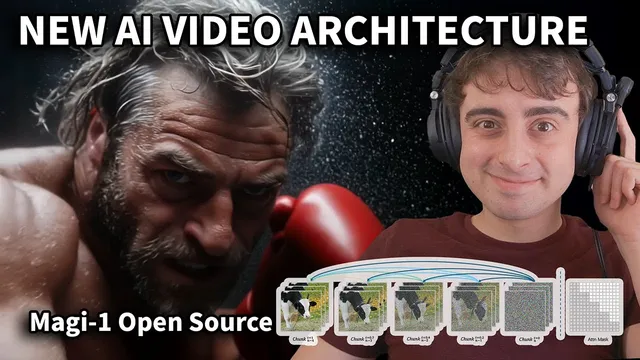
Open Source AI Video BEAST! Magi -1 Autoregressive AI Video Gen
Based on MattVidPro's video on YouTube. If you like this content, support the original creators by watching, liking and subscribing to their content.
MAGI 1 is an open-source autoregressive video generator from Sand AI, with weights and inference code available for download.
Briefing
Sand AI’s MAGI 1 is being positioned as a new open-source benchmark for AI video generation—delivering unusually lifelike motion, physics-like interactions, and strong instruction following—while also promising “infinite” video extension and second-level timeline control. Early examples highlighted a roughly 7-second clip where a young girl moves her head toward a plant and the plant reacts with convincing jiggle and lighting/shadow behavior, plus facial expressions that read as natural rather than synthetic. The pitch matters because open-source video models have historically struggled with both realism and controllability; MAGI 1’s first wave of outputs suggests it may narrow that gap.
Beyond the demo-worthy realism, MAGI 1’s differentiators are tied to how it generates video. It works autoregressively by predicting fixed-length chunks of consecutive frames, trained with a denoising schedule where noise changes monotonically over time. That chunk-based design is presented as the reason it can support streaming generation and more native long-horizon extension—continuing based on broader context rather than simply stitching from the last exact frame. Sand AI also claims precision timeline control at the “second level,” enabled through chunkwise prompting so users can craft smoother scene transitions and fine-grained, text-driven control.
In-house evaluation results from Sand AI place MAGI 1 at the top across multiple categories when compared with heavyweight open-source competitors such as Hailu, Juan Video, WAN 2.1, and Kling (with Kling 1.6 cited). Reported win rates vary by benchmark, but MAGI 1 generally leads on motion quality, instruction following, and visual quality. The transcript also notes that some comparisons show close results—especially where Hailu can be comparable—yet MAGI 1 still comes out ahead overall in the presented numbers.
Practical testing on the accompanying interface adds a more nuanced picture. The workflow allows image-to-video generation, duration control (with a stated maximum of 10 seconds per generation), and extensions that are described as more “native” than traditional frame-to-frame continuation. Users can toggle an “enhanced prompt” feature, and credits are consumed at roughly 10 credits per second in high-quality mode. In short runs, outputs can look impressively coherent—keeping a person’s arms separated while sprinting away, producing cinematic smoke/fire trails from a moving car prompt, and generating intentionally creepy “VHS footage” aesthetics.
Still, the hands-on results point to limitations. Car motion consistency appears weaker, with ground/tire behavior suggesting the model sometimes misreads whether the vehicle is actually moving. Longer 3D-style animation attempts (e.g., a rocket landing on the moon) devolve into morphing and glitching, and extensions don’t always preserve the intended camera move. The overall takeaway is that MAGI 1 is powerful and open-source (weights and inference code are available), but it can feel less forgiving and more “untamed” than more established generators.
Local deployment requirements are steep: a smaller MAGI14.5B variant is described as runnable on a single RTX 490 with 24 GB VRAM, while larger distill/quantized variants are framed as server-farm territory (H100/H800 clusters or many RTX 4090s). For most users, the immediate path is the web interface, where pricing is framed as relatively affordable for credits, alongside a free trial. The transcript ultimately lands on a balanced verdict: MAGI 1 may be the new realism king for open-source video, but it demands learning its quirks—and for everyday ease, WAN 2.1 still has the advantage of broader community workflows and maturity.
Cornell Notes
MAGI 1, an open-source autoregressive video generation model from Sand AI, is presented as a major step toward lifelike motion and better instruction following. It generates video in fixed-length chunks and uses chunkwise prompting to support streaming generation and more native long-horizon extension, with claims of “infinite” continuation and second-level timeline control. Reported in-house evaluations place MAGI 1 ahead of other open-source competitors (including Hailu, Juan Video, WAN 2.1, and Kling) across motion quality, instruction following, and visual quality. Hands-on tests show impressive short-form results—especially for facial expression and stylized effects—but also reveal weaknesses in consistent object motion and some 3D animation tasks. The model is open for local use, though hardware requirements for larger variants are substantial.
What makes MAGI 1’s “infinite extension” claim plausible, even if it isn’t literally the first to extend videos?
How does chunkwise prompting relate to timeline control?
What does the denoising training description imply about how the model generates motion over time?
Where did hands-on tests confirm MAGI 1’s strengths, and where did they expose weaknesses?
How do hardware and deployment constraints shape who can use MAGI 1 locally?
Review Questions
- What architectural choice (chunking vs frame-to-frame stitching) is credited with making MAGI 1’s extensions feel more seamless?
- How do chunkwise prompting and autoregressive chunk generation work together to support timeline control claims?
- In the hands-on tests, what specific failure modes appeared in car motion and 3D animation, and what do they suggest about controllability?
Key Points
- 1
MAGI 1 is an open-source autoregressive video generator from Sand AI, with weights and inference code available for download.
- 2
The model generates video in fixed-length frame chunks and is trained with a monotonic denoising schedule per chunk.
- 3
Chunkwise prompting is presented as the mechanism behind smoother transitions, long-horizon synthesis, and fine-grained text control, including claims of second-level timeline control.
- 4
Sand AI’s reported evaluations place MAGI 1 at or near the top across motion quality, instruction following, and visual quality versus other open-source models such as Hailu, Juan Video, WAN 2.1, and Kling.
- 5
Hands-on results show strong short-form realism and stylized effects, but weaker consistency for some physical motion (notably a car) and unstable behavior in certain 3D animation prompts.
- 6
Local deployment is hardware-intensive for larger variants; the transcript cites RTX 490/24 GB VRAM for MAGI14.5B and multi-GPU requirements for larger distill/quantized models.
- 7
The web interface supports image-to-video, high-quality vs lower-quality modes, extensions, and a credit system with an indicated ~10 credits per second in high-quality generation.