Open source is dying
Based on Theo - t3․gg's video on YouTube. If you like this content, support the original creators by watching, liking and subscribing to their content.
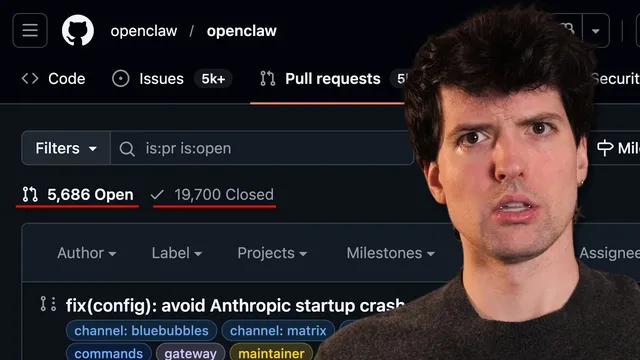
AI increases the speed and volume of low-signal contributions, creating a review bottleneck that can push maintainers toward burnout.
Briefing
Open source is facing a stress test driven by AI—an onslaught of low-signal pull requests, noisier bug reports, and escalating hostility toward maintainers—pushing key projects toward burnout and, in the worst case, deliberate sabotage. The core worry isn’t that AI is “bad” at coding; it’s that AI makes it easier to flood repositories faster than humans can review, understand, and maintain them. That mismatch threatens not only individual projects but the broader software ecosystem that depends on shared foundations.
Concrete examples land early: Tail Draw’s move to automatically close PRs from external contributors, Node.js raising friction around reporting bugs because AI spam is overwhelming issue triage, and Tailwind’s funding troubles affecting its ability to sustain the team. The fear is systemic—if maintainers can’t keep up, software reliability degrades, and the industry loses the common building blocks that make modern development possible.
The transcript then shifts from macro warning to lived experience. T3 Code, public for about five days, quickly accumulated around 150 open PRs even while contributions were explicitly discouraged. The creator describes the operational cost: triaging, testing, shipping releases, and managing issues consumed an entire weekend and left Monday unusable. To cope, additional help was brought in just to track the volume. The PR flood is paired with a deeper concern about “system understanding”: when code is produced by AI agents and merged without full comprehension, the maintainer’s grasp of the codebase erodes over time—turning small gaps into a compounding inability to safely maintain the project.
A second pressure point is “install vs prompt” user behavior—people who want the end product without engaging with the code. As AI lowers the barrier to building, questions from non-developers become more frequent, more technical in wording, and often harder to parse because crucial context is missing. That creates extra cognitive load for maintainers and can degrade the quality of community discussion. The transcript also highlights etiquette breakdowns: tagging maintainers en masse, submitting redundant or broken PRs, and treating silence as an invitation to escalate.
Beyond noise and rudeness lies a security angle. The transcript argues that the same mechanisms enabling AI-driven spam also make it easier to run social-engineering attacks—using sockpuppet accounts and PR flooding to pressure maintainers into quitting. The XZ backdoor story is invoked as a cautionary template: burnout and manipulation can become a pathway to real compromise.
Solutions are offered in layers. Some projects add trust and triage tooling; the standout example is Vouch, a community trust management system that labels PRs as “vouched” and filters the queue down dramatically (from 150 to 43 in the example). Other ideas include PR-scanning tools like anti-slop, though the transcript warns that AI-based filtering can become expensive and complex. Funding is treated as equally urgent: the Open Source Pledge is presented as a concrete mechanism where companies commit at least $2,000 per devbit per year, with named sponsors and examples of meaningful contributions.
The closing message is practical and moral: reduce the burden on maintainers by improving issues and PRs, provide clear, small, well-explained changes, and—most importantly—be kind. The transcript frames gratitude and direct, genuine acknowledgment as a retention strategy: maintainers keep building because they care, and AI-driven pressure makes that care easier to burn out.
Cornell Notes
AI-driven contribution flows are overwhelming open source maintenance with PR spam, low-signal bug reports, and rising hostility—creating a burnout spiral that can degrade software reliability and even enable targeted sabotage. The transcript uses T3 Code’s first days as a case study: despite discouraging PRs, it still attracted ~150 open PRs, consuming weekends and forcing extra staffing. It also argues that AI increases the “slop” problem by making it easier to merge changes maintainers don’t fully understand, shrinking their system-level grasp over time. Proposed remedies include trust/triage tooling like Vouch to filter PRs, anti-slop style scanning (with cost concerns), and funding commitments such as the Open Source Pledge. The bottom line: protect maintainers with better tooling, real money, and better community behavior.
Why does PR volume become more dangerous when AI is involved, beyond just being “annoying”?
What does the T3 Code example show about the real workload of maintaining a popular repo?
How does the transcript connect “bad user behavior” to maintainer burnout?
What security risk is raised, and how does it relate to AI spam?
What is Vouch, and why is it presented as a practical fix?
How does funding fit into the “open source is dying” thesis?
Review Questions
- What mechanisms does the transcript claim cause AI-driven PRs to degrade maintainer system understanding over time?
- How does Vouch’s trust labeling change the maintainer’s workflow, and what problem does it specifically reduce?
- Which parts of the transcript treat etiquette and user behavior as a contributor to burnout, and what concrete behaviors are criticized?
Key Points
- 1
AI increases the speed and volume of low-signal contributions, creating a review bottleneck that can push maintainers toward burnout.
- 2
Merging AI-generated changes without full understanding can erode maintainers’ system-level grasp, making long-term maintenance harder.
- 3
PR spam and hostile etiquette (bulk tagging, redundant/breaking PRs) add cognitive and emotional load beyond the raw number of requests.
- 4
AI-enabled spam also raises a security risk by making social-engineering and sockpuppet pressure campaigns easier to execute.
- 5
Trust and triage tooling like Vouch can make large PR queues manageable by filtering to “vouched” contributors.
- 6
Funding mechanisms such as the Open Source Pledge aim to offset rising maintenance burden by committing real, recurring money from companies.
- 7
The transcript argues that kindness and genuine gratitude are not just moral—they help keep maintainers building instead of quitting.