Open Source Is Where Dreams Go To Die
Based on The PrimeTime's video on YouTube. If you like this content, support the original creators by watching, liking and subscribing to their content.
Open source burnout often comes from a mismatch between volunteer maintenance effort and user expectations for immediate fixes and new features.
Briefing
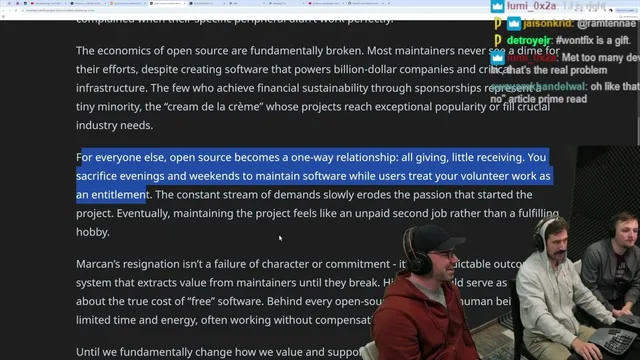
Open source burnout is less a moral failing than a predictable outcome of a broken economic loop: maintainers pour in evenings and weekends, while users treat that volunteer labor like an entitlement—demanding fixes, new features, and immediate turnaround without paying, contributing, or even closing issues. The resignation of Linux on Apple silicon work—framed through Hector Martin’s exhaustion after years of reverse engineering hardware without documentation—lands as the clearest example of how “free software” can still carry an expensive human cost.
The discussion traces how that cost accumulates. A project often starts as a labor of love, then shifts into unpaid technical support as bug reports arrive like customer tickets. Communities can also escalate expectations beyond what maintainers can reasonably deliver: users ask for “more awesome” functionality, complain when it doesn’t match their ideal, and sometimes push for work the maintainer never built or even has the context to implement. Examples range from a developer who built emulators and faced relentless demands from an audience, to a maintainer who disabled GitHub issues for Laravel because the inflow of requests became unmanageable.
Financial sustainability is presented as the core mismatch. Most maintainers never see compensation despite powering billion-dollar companies and critical infrastructure. Sponsorships exist, but they’re described as a tiny minority solution—useful for some, not a systemic fix. Even when corporate sponsorship is discussed, the conversation highlights the friction: legal and marketing overhead can make it hard for companies to pledge money, while individuals often face the “damned if you do, damned if you don’t” dilemma of whether to pay at all.
The conversation also challenges the emotional contract behind open source. “It’s time to give back” can sound like a reverse entitlement—maintainers voluntarily released software, yet some users assume they’re owed something in return. Still, the practical takeaway is not to abandon open source, but to change behavior: say no, close issues, avoid “googleable” questions, and contribute when possible. One recurring theme is that many people underestimate how quickly a hobby becomes a job once maintenance and support dominate.
Several alternative models and tools are mentioned as partial relief. Open Collective and Sentry’s Open Source Pledge are cited as mechanisms to route money without forcing every project into a separate legal structure; the pledge model is described as a per-employee annual commitment rather than a complex redistribution algorithm. There’s also a broader “public source” mindset: release code for freedom and reuse, but don’t promise ongoing support—fork it, adapt it, and treat the maintainer’s time as finite.
By the end, the conversation widens beyond money to incentives and attention. The same way social media can feel like “shadowbanning” when creators don’t understand why audiences value their work, open source can feel crushing when popularity doesn’t translate into support. The most durable framing is pragmatic: build what you want, pick problems worth solving, don’t expect riches from free releases, and protect your time—because the system that extracts value from maintainers will eventually extract everything they have.
Cornell Notes
Open source can burn out maintainers because the economics and expectations don’t match: volunteers maintain critical software while users file bug reports and request features as if they’re paying customers. The resignation of a Linux-on-Apple-silicon contributor is used to illustrate how years of reverse engineering and ongoing support can exhaust even highly skilled developers. Sponsorship and donation platforms (like Open Collective and Sentry’s Open Source Pledge) help some projects, but they’re not a universal fix because most maintainers never receive meaningful compensation. A practical countermeasure is cultural: say no, close issues, avoid low-effort requests, and contribute when possible. Some developers also adopt “public source” behavior—release code without committing to perpetual support—so users can fork and self-serve.
Why does open source maintenance so often turn into burnout rather than staying a hobby?
What’s the economic mismatch at the center of the argument?
How do reverse engineering and user expectations intensify the problem?
What behavioral changes are suggested to reduce harm to maintainers?
What alternatives to traditional open source support are proposed?
Why does the conversation compare open source expectations to social media “shadowbanning”?
Review Questions
- What specific mechanisms turn a volunteer project into an “unpaid second job,” and how do those mechanisms show up in bug reports and feature requests?
- How do sponsorship models like Open Collective and Sentry’s Open Source Pledge differ from each other, and what problem does each try to solve?
- What does “public source” change about the implied contract between maintainers and users, and what responsibilities shift to users?
Key Points
- 1
Open source burnout often comes from a mismatch between volunteer maintenance effort and user expectations for immediate fixes and new features.
- 2
Bug reports and feature requests can function like unpaid technical support tickets, especially as projects gain popularity.
- 3
Most maintainers lack financial sustainability; sponsorship helps some projects but doesn’t cover the majority of maintainers.
- 4
Cultural practices—saying no, closing issues, and avoiding low-effort “googleable” questions—can reduce the maintenance burden.
- 5
Funding infrastructure such as Open Collective and Sentry’s Open Source Pledge can lower friction for sponsorship, but they don’t eliminate the underlying labor imbalance.
- 6
Some developers reduce risk by adopting “public source” behavior: release code while making it clear that ongoing support isn’t guaranteed.
- 7
The conversation links open source frustration to incentive and attention problems: popularity doesn’t automatically produce reciprocity or compensation.