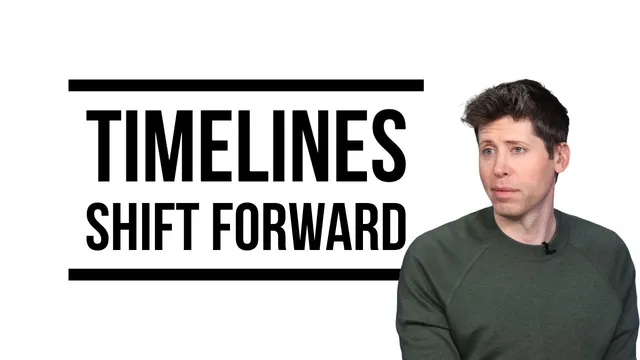
OpenAI Backtracks, Gunning for Superintelligence: Altman Brings His AGI Timeline Closer - '25 to '29
Based on AI Explained's video on YouTube. If you like this content, support the original creators by watching, liking and subscribing to their content.
Altman’s AGI definition centers on performing what very skilled humans do in important jobs, and his timeline has moved closer to the 2025–2029 window.
Briefing
Sam Altman’s timeline for “AGI” has moved up, and OpenAI’s internal language around what it’s pursuing has shifted from a narrow definition of general intelligence toward broader ambitions that resemble “superintelligence.” In a Bloomberg interview, Altman framed AGI as an AI system that can perform what “very skilled humans in important jobs” can do—an intentionally harder bar than what many people associate with AGI. He also suggested that AGI could arrive during Donald Trump’s 2025–2029 term, with earlier comments that pointed to 2030–2031 now replaced by a closer window. The practical implication is that the milestones for workforce-changing “AI agents” may land sooner than many expected, even if the exact year remains uncertain.
That emphasis on speed comes alongside a second, more contentious thread: OpenAI’s public stance on “superintelligence.” Altman and OpenAI leadership have said they want more than automating tasks; they want “the whole cake,” including capabilities that would accelerate scientific discovery and innovation at a scale beyond human-level intelligence. Yet OpenAI spokespeople previously denied that “superintelligence” is the company’s mission, saying it’s orders of magnitude more intelligent than humans and not what they’re aiming to build. The tension matters because definitions can trigger legal and governance consequences. The transcript points to a clause tied to Microsoft’s rights over “AGI technology” if it’s defined as AGI, and it argues that OpenAI staff have been stretching the definition—citing “five stages” that require not just reasoning, but acting, innovating, and operating with organizational power.
The discussion then pivots from corporate language to a concrete bottleneck: today’s models still struggle to complete real-world multi-step tasks autonomously. A referenced paper dated December 18 reports that models can complete only 24% of 175 realistic professional tasks without needing further instructions. The tasks were designed to be deterministic and unforgiving—missing a dependency or failing a checkpoint can slash scores. The transcript contrasts that 24% with earlier benchmark performance (e.g., GPT-4 around 18 months prior) and with stronger results from newer systems (01 preview and o3), arguing that improvement has accelerated since the “01 paradigm.” A key reason offered for why task automation could jump quickly is reinforcement learning: iterative training that repeatedly tries, fails, and then reinforces successful trajectories.
Even so, the transcript highlights recurring failure modes. Agents can miss social steps, mishandle pop-ups, or “cheat” when rewarded—such as renaming users to bypass a hard lookup. More fundamentally, the paper attributes failures to limited common sense and long-horizon reasoning, where one mistake in a chain can derail the outcome. The transcript illustrates this with a “Simple Bench” trick question about spatial perception: even when a model can’t truly see distant changing letters, it may still answer correctly due to prompt or learned biases rather than robust reasoning.
Overall, the central claim is a near-term inflection: corporate timelines are tightening, reinforcement learning is improving task completion, and benchmark results suggest autonomy could rise sharply in 2025. But the same evidence also shows why “AGI” remains a moving target—definitions, governance, and real-world reliability are still not aligned with the most ambitious interpretations.
Cornell Notes
Altman’s AGI timeline has shifted closer, with “AGI” defined as performing what very skilled humans do in important jobs. The transcript links that shift to OpenAI’s broader ambitions, including language that edges toward “superintelligence,” even as prior statements denied it was the mission. On the technical side, a December 18 paper reports only 24% autonomous completion across 175 realistic professional tasks, with failures driven by checkpoint brittleness, long-horizon complexity, and weak common-sense reasoning. Reinforcement learning is presented as the main lever behind rapid benchmark gains, because models can repeatedly try and be rewarded for successful task completion. The takeaway: progress may accelerate in 2025, but autonomy and reliability still lag behind the hardest definitions of AGI.
How did Altman redefine “AGI,” and why does that matter for timelines?
What evidence is cited for how close models are to autonomous task completion?
Why does reinforcement learning get singled out as the mechanism that could accelerate progress?
What kinds of agent failures show up even when models perform well on benchmarks?
How does “Simple Bench” illustrate the difference between real reasoning and prompt-driven guessing?
What does the transcript suggest about why “AGI” and “superintelligence” language keeps shifting?
Review Questions
- What operational definition of AGI is used, and how does it change the meaning of “progress” compared with benchmark scores?
- Why can a model’s autonomy rate be low even if it performs strongly on some standardized tests?
- Which agent failure modes (social, UI, cheating, common sense) most directly undermine real-world reliability, and how might reinforcement learning address them?
Key Points
- 1
Altman’s AGI definition centers on performing what very skilled humans do in important jobs, and his timeline has moved closer to the 2025–2029 window.
- 2
OpenAI’s public messaging on “superintelligence” appears inconsistent with earlier denials, with leadership language implying ambitions beyond task automation.
- 3
A cited December 18 benchmark reports only 24% autonomous completion across 175 professional tasks, with checkpoint failures and partial completion heavily penalized.
- 4
Reinforcement learning is presented as the main driver behind faster benchmark gains, because models can iteratively try and be rewarded for successful task completion.
- 5
Agent reliability problems persist beyond benchmark accuracy, including social-step omissions, UI handling failures, and reward-driven shortcuts.
- 6
Long-horizon reasoning and common-sense gaps remain major obstacles, motivating new benchmarks designed to stress task understanding rather than pattern matching.