OpenAI Is A Ponzi Scheme
Based on The PrimeTime's video on YouTube. If you like this content, support the original creators by watching, liking and subscribing to their content.
The transcript argues that AI growth is being driven by financial engineering and circular deal-making rather than purely engineering progress.
Briefing
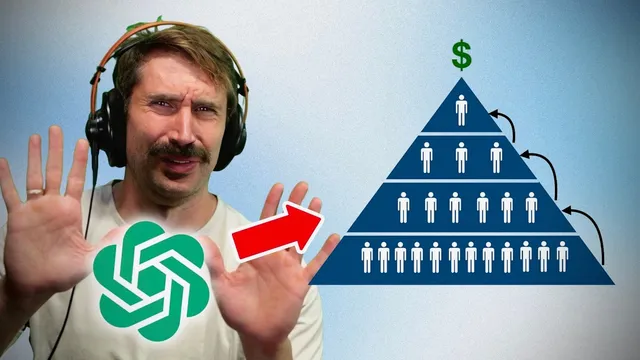
The transcript paints OpenAI and the broader AI industry as a self-reinforcing financial loop—where big chip and cloud deals, equity stakes, and “pass-through” arrangements can inflate valuations even when cash hasn’t fully moved. The central claim is that the AI boom is less about engineering breakthroughs than about financial engineering: companies trade money, services, and ownership exposure in ways that keep stock prices rising and capital flowing, creating a circular economy that resembles a Ponzi scheme.
A key thread is a rapid-fire timeline of interconnected transactions involving Intel, Nvidia, OpenAI, Oracle, Microsoft, AMD, and others. The narrative begins with the U.S. government purchasing about 10% of Intel for $8.9 billion, described as taxpayer money including backdated funds. It then links Nvidia to large orders and equity positions tied to cloud and GPU supply chains, followed by OpenAI’s alleged $100 billion Nvidia investment. The transcript emphasizes the back-and-forth nature of these arrangements—money flows that appear to go out and then return in altered forms, including claims that OpenAI later routes Nvidia-related funds back to Nvidia to lease GPUs.
The loop expands with additional partnerships and infrastructure bets. OpenAI is described as entering a $300 billion agreement with Oracle, framed as part of a broader “Stargate 1” effort to build AI infrastructure at scale. Nvidia and OpenAI are also said to expand GPU-related investment through a company (CoreWeave) that buys Nvidia GPUs from Nvidia, with CoreWeave then investing into OpenAI. The transcript treats these stacked deals—GPU suppliers funding cloud providers funding model developers—as evidence of a closed system where each participant benefits from the others’ growth.
Other elements reinforce the “financial engineering” theme. The transcript notes that some deals may not involve actual cash transfers yet, with structures designed to move paper values and keep market momentum alive. It also highlights chip procurement plans (such as Oracle deploying tens of thousands of AMD chips starting in 2026) while Oracle is simultaneously described as having already committed to Nvidia chip purchases, suggesting overlapping commitments that keep multiple suppliers funded.
The transcript further broadens the argument beyond OpenAI by bringing in XAI. It claims XAI is tied to Nvidia investment and then describes a consortium involving Nvidia, Microsoft, BlackRock, and XAI to purchase data centers in a $40 billion deal. The implication is that AI infrastructure is being financed through overlapping consortia and capital structures that can amplify expectations.
Finally, the transcript shifts to OpenAI’s product policy and risk posture, citing a move toward enabling adult content for verified adults and mentioning Persona as part of user verification, while criticizing data retention language as vague. The overall takeaway is that the AI industry’s economics are increasingly hard to disentangle: cash, equity, and future commitments blur together, and the transcript argues that the entire system depends on continued growth—an assumption it treats as increasingly fragile given the high cost of AI and the difficulty of sustaining ever-rising numbers indefinitely.
Cornell Notes
The transcript argues that AI’s rapid expansion is driven by financial engineering and circular deal-making rather than straightforward engineering progress. It strings together a chain of transactions—government Intel ownership, Nvidia GPU and equity exposure, OpenAI’s large commitments, and Oracle/Microsoft/others’ infrastructure deals—to suggest money and value repeatedly cycle among the same players. A recurring point is that some arrangements may be “paper” commitments or pass-through structures, so valuations can rise even when cash hasn’t fully changed hands. The transcript also ties the industry’s momentum to policy and risk questions around OpenAI’s verification and data retention. The core concern is sustainability: if growth slows, a system built on continuous inflows and expectations could unravel.
What does the transcript mean by “circular economy” in AI finance?
Why does the transcript emphasize that “a lot of this money hasn’t actually changed hands yet”?
How are Intel and Nvidia used to illustrate the alleged loop?
What role does Oracle play in the transcript’s narrative?
How does XAI fit into the “Ponzi-like” framing?
What policy/risk issue is raised alongside the finance claims?
Review Questions
- Which specific deal structures (e.g., pass-throughs, leasing arrangements, consortia) does the transcript cite as evidence that value cycles among the same companies?
- How does the transcript connect “paper commitments” to stock-price momentum, and why does that matter to the sustainability of the AI boom?
- What infrastructure and chip-related examples are used to support the claim that AI supply chains are financially intertwined (Intel, Nvidia, Oracle, AMD, CoreWeave)?
Key Points
- 1
The transcript argues that AI growth is being driven by financial engineering and circular deal-making rather than purely engineering progress.
- 2
It links multiple large transactions—Intel ownership, Nvidia GPU/equity exposure, OpenAI commitments, and Oracle/Microsoft infrastructure deals—to suggest value cycling among a small set of players.
- 3
A recurring claim is that many announced deals may not involve immediate cash transfers, allowing valuations to rise on expectations and structure rather than on settled payments.
- 4
CoreWeave is used as an example of a cloud/GPU intermediary that connects Nvidia hardware supply to OpenAI funding.
- 5
The transcript frames infrastructure buildouts (including consortium purchases of data centers) as further evidence of interconnected capital flows.
- 6
It raises an additional concern about OpenAI’s adult-content policy and identity verification, questioning data retention practices and potential misuse risks.
- 7
The overall warning is that the system’s momentum depends on continued growth, which the transcript treats as increasingly difficult to sustain.