OpenAI just made your entire tech stack obsolete...
Based on Fireship's video on YouTube. If you like this content, support the original creators by watching, liking and subscribing to their content.
OpenAI’s strategy positions ChatGPT as an app platform that can perform actions across other services, potentially reducing reliance on separate websites and mobile apps.
Briefing
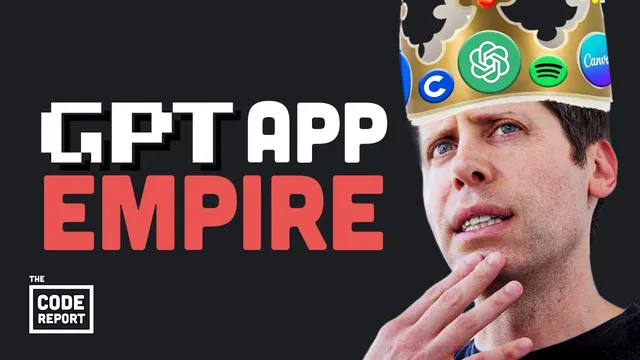
OpenAI’s latest Dev Day push reframes ChatGPT from a chatbot into an app platform—an approach that could make traditional websites and mobile apps feel obsolete for many AI-powered workflows. The pitch is simple: instead of opening a separate app (say, Spotify) and manually tapping controls, users would open ChatGPT and ask it to perform actions across services. That shift matters because it turns ChatGPT into a distribution channel, with OpenAI banking on its roughly 800 million weekly active users to attract developers early. Early adopters could profit from building “ChatGPT apps” that sit at the center of everyday tasks, effectively acting like an operating system for connected actions.
The rollout isn’t starting with everything at once. The transcript notes that “apps and ChatGPT” are currently being trialed by major, recognizable apps, and it argues the model could be especially useful for high-friction services—real estate is offered as an example, where an AI could help evaluate options faster than a human-only process. Still, there’s skepticism: in many cases, a clean app interface may be easier than routing routine actions through a chatbot, which can add complexity rather than reduce it.
Beyond the platform idea, the announcement list gets more concrete for developers. OpenAI’s API updates include access to Sora 2 and GPT5 Pro, both described as available through the API. The transcript also flags pricing and cost risk: Sora 2 is listed at 50 cents per 1 second of high-quality video, translating to roughly $1,800 for an hour-long output—an expense that could quickly balloon during experimentation. For teams adding voice or image generation, the transcript mentions two smaller, cheaper models designed to reduce costs while still delivering useful capabilities.
A separate productivity play targets developer workflow. OpenAI released a GitHub action for Codex that automatically reviews code quality on every new pull request. The same automation is positioned as a multi-purpose tool—checking for security flaws, generating documentation, and handling other review-related tasks—aimed at cutting down time spent on manual code review.
The most ambitious tooling update is “agent kit,” described as a unified set of tools for building, deploying, and optimizing agents. It uses a flowchart-style canvas to let developers implement logic without stitching together as much custom code. That could broaden access for non-engineers, but the transcript warns that no-code or low-code systems often hit a complexity ceiling that eventually forces a return to traditional engineering.
Finally, the transcript adds a sponsor note: JetBrains launched an AI coding agent called Juni, integrated with the JetBrains IDE and designed to understand the context of an entire codebase. It’s portrayed as slower than some code generators but strong on context and accuracy, with asynchronous job handling via integrations like GitHub—an approach aimed at reducing context switching for developers on larger projects.
Cornell Notes
OpenAI’s Dev Day messaging pushes ChatGPT beyond a chatbot into an app platform, aiming to replace many manual steps inside separate websites and mobile apps. The strategy leans on ChatGPT’s massive user base (about 800 million weekly active users) to create a new distribution channel for developers building “ChatGPT apps.” On the developer side, the API adds Sora 2 and GPT5 Pro, plus cheaper smaller models for voice and image generation, but video costs can escalate quickly. OpenAI also released a Codex GitHub action to automate PR code review, security checks, and documentation. A new Agent Kit provides flowchart-style tools for building and optimizing agents, though it may eventually require traditional coding as complexity grows.
Why does turning ChatGPT into an “app platform” matter more than another chatbot feature?
What’s the main risk called out for developers experimenting with Sora 2 through the API?
How does the Codex GitHub action change day-to-day engineering work?
What is Agent Kit, and what tradeoff does the transcript highlight?
How does Juni fit into this ecosystem, and what’s its claimed strength?
Review Questions
- What would it mean for a developer to build an app “on top of” ChatGPT rather than inside a standalone website or mobile app?
- How do the transcript’s cost figures for Sora 2 influence decisions about prototyping and production video generation?
- Where does automation (Codex GitHub action) help most in the software lifecycle, and where might it still need human oversight?
Key Points
- 1
OpenAI’s strategy positions ChatGPT as an app platform that can perform actions across other services, potentially reducing reliance on separate websites and mobile apps.
- 2
ChatGPT app development is framed as a distribution play, leveraging OpenAI’s scale of about 800 million weekly active users.
- 3
The API now includes Sora 2 and GPT5 Pro, with additional smaller models for cheaper voice and image generation features.
- 4
Sora 2 pricing is high enough that generating long or frequent video outputs can quickly become expensive during development.
- 5
A new Codex GitHub action automates PR code review, including security scanning and documentation generation.
- 6
Agent Kit offers flowchart-style tools to build, deploy, and optimize agents, but low-code approaches may hit a complexity ceiling.
- 7
JetBrains’ Juni integrates with the JetBrains IDE to use whole-codebase context and run multiple GitHub-linked jobs asynchronously.