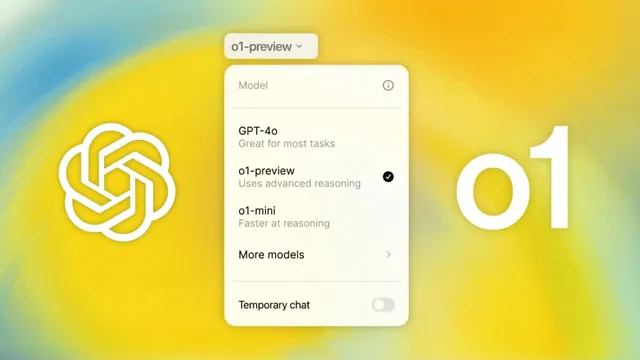
OpenAI o1 Released!
Based on The PrimeTime's video on YouTube. If you like this content, support the original creators by watching, liking and subscribing to their content.
OpenAI o1 preview is demonstrated as capable of generating working code for an interactive Transformer self-attention visualization, including hover-driven attention-score display.
Briefing
OpenAI o1 preview is positioned as a reasoning-first model that “thinks before answering,” and it’s being demonstrated through a practical coding task: generating an interactive visualization of the Transformer self-attention mechanism. The model produces code that renders attention edges whose thickness tracks attention scores, and it can follow multi-step requirements such as hovering over tokens to reveal relationships between words. The immediate takeaway is less about raw benchmark bragging and more about workflow: a user can specify an interface behavior and get working code quickly, including iterative fixes when the output is wrong.
That hands-on success sits alongside a broader set of claims from OpenAI about how o1 improves on earlier systems like o1 vs o4o (referred to in the transcript as “GPT 40”/“ChatGPT 40”). The core mechanism described is reinforcement learning aimed at complex reasoning, where the model generates a longer internal chain-of-thought before responding. The transcript frames “thinking” as a loop: produce an answer, reason about why it might fail, then revise based on that self-diagnosis. A concrete example given is code generation against unit tests—when initial code fails, asking for reasoning about the failure and then requesting a fix leads to working code, while simply regenerating code repeatedly can keep failing.
On performance, the transcript cites a range of evaluation results meant to show o1’s advantage on reasoning-heavy tasks. It’s said to improve with more test-time compute, with accuracy rising smoothly as the model spends more effort. In math, the transcript claims o1 solves a much larger share of problems on an exam designed for top U.S. high school students (with higher scores under consensus and reranking). In science-oriented benchmarks (GPQA Diamond), it’s described as surpassing human PhD experts on that specific set of questions. For coding competitions, o1 is described as ranking far above prior models on competitive programming evaluations, including an ELO rating that corresponds to outperforming most competitors.
Still, the transcript repeatedly questions what these metrics mean for real-world impact. Coding benchmarks are treated as algorithmic skill that language models can already excel at, and the “reasoning” gains are framed as potentially less useful if they don’t translate into solving messy, high-stakes problems that require sustained research and judgment. There’s also skepticism about whether o1’s improvements will reduce human coding work dramatically, with concerns that the cost of scaling training and inference could limit adoption, and that new users might outsource thinking rather than learn fundamentals.
Finally, safety and alignment are discussed through the lens of chain-of-thought. The transcript notes claims that reasoning-based training can improve robustness against jailbreaks and improve “safe completions” on harmful prompts, while OpenAI reportedly chooses not to show raw chain-of-thought to users—opting instead to provide summaries of reasoning. The overall picture is a model that looks more capable at structured problem solving and debugging, but whose real-world consequences—economic, educational, and safety-related—remain contested.
Cornell Notes
OpenAI o1 preview is presented as a reasoning-focused model trained with reinforcement learning to “think before answering,” producing an internal chain-of-thought that helps it debug and revise. In practice, it can follow detailed coding requirements to generate working Transformer self-attention visualizations with interactive hover behavior and attention-score-based edge thickness. The transcript links these behaviors to a loop-like process: generate, analyze why it fails (e.g., unit tests), then fix based on that analysis. Reported evaluations claim strong gains on reasoning-heavy benchmarks (math, science Q&A, and competitive programming), with performance improving as test-time compute increases. The discussion also challenges how much benchmark wins translate into real-world impact and raises concerns about safety transparency and potential over-reliance by new learners.
How does o1 preview’s “thinking” connect to better coding outcomes in the transcript?
What specific interactive behavior does o1 preview implement in the self-attention visualization example?
Why does the transcript treat “more test-time compute” as important for o1’s performance?
Which benchmark categories are cited as evidence of o1’s reasoning gains, and what skepticism follows?
How does the transcript describe o1’s approach to safety and chain-of-thought visibility?
What economic and educational concerns about AI coding appear in the transcript?
Review Questions
- What evidence in the transcript links o1’s internal reasoning to successful unit-test debugging rather than repeated code regeneration?
- Which benchmark types are cited as showing o1’s advantage, and what counterargument is raised about their real-world relevance?
- How does the transcript reconcile safety improvements with the decision not to expose raw chain-of-thought to users?
Key Points
- 1
OpenAI o1 preview is demonstrated as capable of generating working code for an interactive Transformer self-attention visualization, including hover-driven attention-score display.
- 2
The transcript connects “thinking” to an iterative loop: diagnose why an attempt fails (e.g., unit tests) and then revise based on that diagnosis rather than simply regenerating.
- 3
Reported performance claims emphasize both reasoning-heavy benchmarks and improvements that grow with additional test-time compute.
- 4
Math and science evaluations are cited as strong evidence of capability, but the transcript questions whether benchmark gains translate into real-world problem-solving impact.
- 5
Competitive programming results are presented as a major differentiator, yet the transcript argues that algorithmic tasks may not reflect broader engineering challenges.
- 6
Safety discussions highlight improved jailbreak resistance and safer completions, while also noting that raw chain-of-thought is not shown to users—only summaries.
- 7
The transcript raises economic and learning concerns: compute costs may limit adoption, and over-reliance could reduce users’ ability to reason independently.