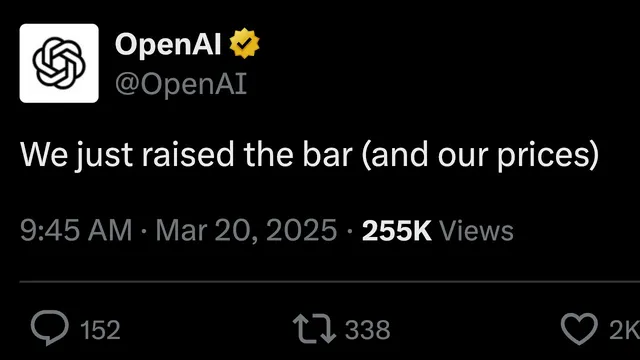
OpenAI’s new API is 200x more expensive than competition
Based on Theo - t3․gg's video on YouTube. If you like this content, support the original creators by watching, liking and subscribing to their content.
OpenAI’s 01 Pro API pricing is positioned as dramatically higher than competitors ($150 per million input tokens and 600 output tokens), creating a major value problem.
Briefing
OpenAI’s newly launched 01 Pro API pricing lands at $150 per million input tokens and 600 output tokens—an order-of-magnitude jump that makes it dramatically more expensive than competing reasoning models. The core issue isn’t just sticker shock; it’s that the “reasoning” work behind the scenes consumes extra tokens, so users pay for compute that often doesn’t translate into better results or better ergonomics.
The transcript breaks down how token-based billing turns “thinking” into cost. Tokens are the small chunks models process to predict the next token in a sequence, and more tokens generally means more GPU work. With reasoning-enabled models, the model can generate additional intermediate tokens before producing the final answer. OpenAI doesn’t expose those thinking tokens in the API, but they still exist—so enabling higher-effort modes can inflate both input and output token counts even when the final response length looks similar.
That dynamic helps explain why cheaper models can feel faster and more cost-effective. The speaker contrasts OpenAI’s pricing with Google’s Gemini 2.0 Flash, which undercuts older expectations by combining competitive quality with speed and low cost—attributed to Google’s vertical integration (its own processors, architecture, training data pipeline, and infrastructure). The transcript also points to competitive pressure from models like DeepSeek’s reasoning releases, which have repeatedly forced price adjustments across the market.
Within OpenAI’s own lineup, the pricing story becomes more contentious. The speaker says 03 Mini High delivers better real-world outcomes than 01 Pro while costing far less, and that 01 Pro’s experience is not only expensive but also unreliable in practice—failing requests, awkward UI behavior, and even incorrect answers on a known Advent of Code-style test. Even when 01 Pro eventually returns something, the transcript frames it as a poor trade: higher cost, slower or brittle behavior, and results that don’t justify the premium.
A key quantitative claim anchors the argument: 01 Pro is about 136x more expensive than 03 mini high for input tokens and roughly the same multiple for output tokens (600 vs 440). The speaker interprets this as a pricing outlier—possibly a “feature parody” move to ship something tied to internal work rather than a model optimized for value. They also argue that OpenAI’s margins on heavy usage models can be thin or negative, citing the earlier example of OpenAI’s 01 Pro being offered on a $200/month ChatGPT tier that allegedly cost money due to heavy usage.
The transcript ends by reframing the market direction: while OpenAI’s API pricing jumps upward, other providers keep pushing down costs and improving efficiency. The speaker expresses confusion that OpenAI would release a model that is both more expensive and, in their testing, worse than 03 Mini High—then suggests that the “high” tiers may be better understood as an allowed “effort” budget rather than a fundamentally different model, with UI limitations forcing separate naming on OpenAI’s side.
Cornell Notes
OpenAI’s 01 Pro API is priced at $150 per million input tokens and 600 output tokens, making it dramatically more expensive than competing options. The transcript ties the cost gap to token billing and reasoning: models that “think” generate extra intermediate tokens before producing the final answer, and those extra tokens still cost money even if the API doesn’t show them. In the speaker’s tests, 03 mini high delivers better or comparable outcomes at far lower cost, with claimed multiples around 136x cheaper for both input and output. The speaker also argues that OpenAI’s 01 Pro experience can be brittle (request failures and awkward UI behavior), further weakening the value proposition. Overall, the pricing move looks out of step with industry trends toward cheaper, faster inference.
Why does reasoning increase API cost even when the final answer length seems similar?
What makes Gemini 2.0 Flash cheaper in the transcript’s explanation?
How does the transcript quantify the gap between 01 Pro and 03 mini high?
What practical problems does the transcript associate with 01 Pro?
What does “high” mean for 03 mini high in the transcript?
Why does the transcript suggest OpenAI’s pricing move may be out of step with the market?
Review Questions
- How do token-based billing and hidden reasoning tokens combine to make “high effort” modes more expensive?
- What specific comparisons does the transcript use to argue that 03 mini high is better value than 01 Pro?
- According to the transcript, what does the “high” tier actually control, and why does that matter for cost?
Key Points
- 1
OpenAI’s 01 Pro API pricing is positioned as dramatically higher than competitors ($150 per million input tokens and 600 output tokens), creating a major value problem.
- 2
Token billing means reasoning modes can cost more because they generate extra intermediate tokens before the final answer.
- 3
OpenAI’s API doesn’t expose thinking tokens, but the transcript argues those tokens still exist and drive cost.
- 4
Gemini 2.0 Flash is described as cheaper due to Google’s vertical integration—processors, architecture, training pipeline, and infrastructure.
- 5
In the transcript’s testing, 03 mini high delivers better or comparable results at far lower cost than 01 Pro, with claimed ~136x multiples.
- 6
The transcript links 01 Pro’s poor value not only to price but also to reliability and UI/interaction friction (including request failures).
- 7
The transcript frames the broader market direction as cost-down and efficiency-up, making OpenAI’s pricing jump feel misaligned.