Oracle Audit Vault and Database Firewall – Overview
Based on Oracle Database Product Management's video on YouTube. If you like this content, support the original creators by watching, liking and subscribing to their content.
AVDF is positioned as an end-to-end database security system that combines audit monitoring, investigation support, enforcement (blocking), and reporting.
Briefing
Oracle Audit Vault and Database Firewall (AVDF) is positioned as a “surveillance camera” for database security—continuously monitoring activity, spotting suspicious behavior, blocking improper access, and turning large volumes of audit data into actionable answers. The core promise is faster, more reliable visibility into who accessed what data, whether privileged users behaved normally, and what happened after an incident—while also reducing the workload of meeting regulatory compliance requirements.
AVDF is framed around six practical use cases that map to real security questions. First, it supports database security posture management, introduced with Release Update 9, by providing a fleetwide, centralized view of security configuration assessments across Oracle databases. That includes security findings and associated risk, helping teams prioritize remediation instead of treating assessments as one-off, hard-to-repeat exercises.
Second, AVDF focuses on privilege user monitoring. Privileged users—VIPs with elevated permissions—are described as high-value targets for attackers because their access spans sensitive data. AVDF audits and monitors all user activity, including privilege users, and reports on privilege access to sensitive data. It also detects credential sharing patterns, such as when different operating system usernames map to the same database user name, and flags abnormal data access behavior—like privileged users accessing too many rows in a short period—described as potential data exfiltration attempts.
Third, AVDF is built for post-incident investigation. The transcript emphasizes that incident investigations often drag on for months because databases generate millions of audit records across many users and applications. AVDF’s advanced reporting and policy engine is presented as a way to quickly answer who did what, when it happened, and where the activity came from. Conditional reporting and drill-down capabilities are highlighted as tools for isolating activity of interest and producing usable reports to support forensic work.
Fourth, AVDF adds control through database firewall capabilities. It monitors SQL activity and defines trusted paths—such as which IPs or users can access which data. If requests violate those conditions, AVDF can block them. It can also profile application SQL by creating a SQL cluster and using an allow list, then block deviations to train the firewall engine on what should be permitted.
Fifth, AVDF aims to reduce time-to-discovery by proactively alerting on suspicious patterns. Examples include too many login failures in a short window, access to extremely sensitive data from outside the application, or privileged users accessing unusually large volumes of data quickly. The system is described as integrating with SIEM/log analyzers to provide enterprise-wide visibility while using conditions and filters to reduce false positives.
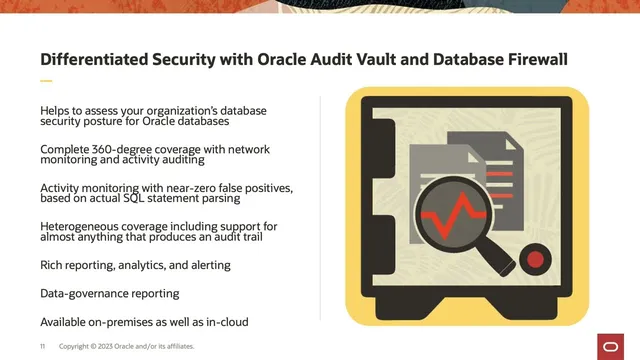
Finally, AVDF is positioned as a compliance accelerator. It provides self-service, regulator-specific reports for requirements such as PCI, GDPR, and other regulatory frameworks, with the ability to tailor reports to local auditor needs. The transcript also stresses “near zero false positives” achieved through actual SQL statement parsing rather than regular expressions, plus rich analytics and alerting that can integrate with other systems like SIEM, ticketing, and business analytics. Overall, AVDF is presented as an on-premises and cloud-capable platform for 360° coverage of network and database activity auditing, with actionable reporting and enforcement built in.
Cornell Notes
Oracle Audit Vault and Database Firewall (AVDF) is presented as a unified system for monitoring, investigating, and controlling Oracle database activity. It uses audit collection plus policy-driven analytics to assess security posture, track privileged users, investigate incidents faster, and block improper access via SQL-aware firewall rules. AVDF’s Release Update 9 adds fleetwide, centralized security configuration assessment views and risk prioritization. It also aims to shorten time-to-discovery by alerting on suspicious patterns (like repeated login failures or abnormal privileged data access) while reducing false positives through SQL statement parsing rather than regular expressions. For compliance, AVDF provides self-service regulator-specific reporting (e.g., PCI and GDPR) that can be tailored to auditor needs and integrated with SIEM, ticketing, and analytics tools.
What problem does AVDF try to solve for database security teams, and why does it matter?
How does AVDF handle security posture management across many Oracle databases?
What behaviors does AVDF flag involving privileged users, and what are the indicators?
Why is post-incident investigation difficult, and how does AVDF make it faster?
How does AVDF’s database firewall enforcement work at the SQL level?
How does AVDF support compliance reporting while aiming to reduce false positives?
Review Questions
- Which AVDF use case best matches the need to prioritize remediation after security configuration assessments, and what feature introduced with Release Update 9 enables that?
- Give two examples of suspicious activity patterns AVDF can alert on, and explain how the system reduces false positives.
- How do trusted paths and SQL allow lists work together to enforce database firewall policies in AVDF?
Key Points
- 1
AVDF is positioned as an end-to-end database security system that combines audit monitoring, investigation support, enforcement (blocking), and reporting.
- 2
Release Update 9 adds fleetwide, centralized database security posture management with security findings and associated risk to help prioritize remediation.
- 3
Privileged user monitoring includes detection of credential sharing (different OS usernames mapped to the same DB user) and abnormal data access patterns that may indicate exfiltration.
- 4
Post-incident investigation is accelerated by advanced reporting and a policy engine that helps answer who/what/when/where and supports conditional drill-down into activity of interest.
- 5
Database firewall capabilities monitor SQL, enforce trusted paths, and can block requests that violate policy; application SQL profiling via allow lists helps reduce deviations.
- 6
Proactive alerting targets suspicious patterns (e.g., repeated login failures, sensitive data access outside the application, unusual privileged row access) while using conditions/filters to reduce false positives.
- 7
Compliance support includes self-service regulator-specific reporting (e.g., PCI and GDPR) with near-zero false positives through SQL parsing and integration options for SIEM, ticketing, and analytics.