Ordinary Differential Equations 21 | Solution Set of Linear ODEs
Based on The Bright Side of Mathematics's video on YouTube. If you like this content, support the original creators by watching, liking and subscribing to their content.
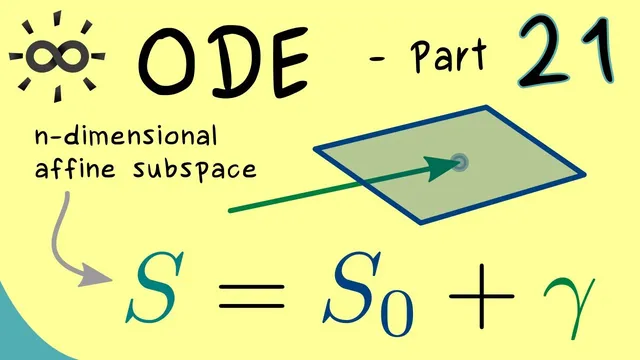
For X′(t)=A(t)X(t)+B(t), the solution set equals S0+γ, where S0 is the n-dimensional solution space of the homogeneous system X′(t)=A(t)X(t).
Briefing
A linear system of ordinary differential equations with a forcing term has a solution set that can be built from the homogeneous solutions plus just one particular solution. Concretely, for systems of the form X′(t)=A(t)X(t)+B(t), every solution can be written as “homogeneous part + one fixed solution,” and this structure determines the full geometry of the solution space.
Start with the homogeneous system X′(t)=A(t)X(t). Its solutions form an n-dimensional vector space S0 (with n matching the system size). That alone doesn’t directly solve the nonhomogeneous problem, but it provides the “directions” along which solutions can vary.
To handle the forcing term B(t), pick an initial value problem for the full system at some time t0 with initial state x0. Existence and uniqueness results guarantee a unique global solution γ(t) defined on the whole interval I. This γ is a particular solution: it’s one specific solution to the nonhomogeneous system, chosen once and then held fixed.
The key claim is that the entire solution set S for the nonhomogeneous system equals S0+γ, meaning every solution β(t) can be expressed as β(t)=α(t)+γ(t) for some homogeneous solution α(t) in S0. The inclusion S0+γ ⊆ S is shown by direct substitution and linearity: if α solves the homogeneous equation and γ solves the full equation, then (α+γ)′=α′+γ′=A(t)α+A(t)γ+B(t)=A(t)(α+γ)+B(t). So α+γ satisfies the original system.
The reverse inclusion S ⊆ S0+γ uses uniqueness. Take any solution β in S and compare it to γ at the initial time t0. Define a new initial value x0~ = β(t0). Consider the difference β−γ, and choose α to solve the homogeneous system with initial condition α(t0)=x0~−γ(t0). Because both α+γ and β solve the same initial value problem for the full system (they share the same initial state at t0), uniqueness forces β(t)=α(t)+γ(t) for all t in I. That pins down every solution as a shifted homogeneous solution.
As a result, the nonhomogeneous solution set isn’t a vector space (because it doesn’t generally contain the zero function), but it is an affine subspace: it has the same dimension n as S0, just translated by γ. For a 2×2 system, for example, the solution set forms a two-dimensional affine subspace in the space of vector-valued functions. The practical takeaway is simple and powerful: solve the homogeneous system once to get S0, find any one particular solution γ, and the rest of the solutions follow by addition.
Cornell Notes
For the linear nonhomogeneous system X′(t)=A(t)X(t)+B(t), the full set of solutions forms an affine subspace. Let S0 be the n-dimensional solution space of the homogeneous system X′(t)=A(t)X(t). Choose one particular solution γ(t) of the nonhomogeneous system (for instance, the unique solution of an initial value problem at time t0 with initial state x0). Then every solution β(t) can be written as β(t)=α(t)+γ(t) for some α(t) in S0, and every such sum is a solution. This matters because it reduces the nonhomogeneous case to solving the homogeneous system plus finding a single particular solution.
Why does adding a homogeneous solution to a particular solution produce another solution of the nonhomogeneous system?
How does uniqueness of initial value problems force every solution β to equal α+γ?
What role does the initial value problem at (t0, x0) play in defining γ?
Why is the solution set S an affine subspace rather than a vector space?
What determines the dimension of the solution set for the nonhomogeneous system?
Review Questions
- Given a particular solution γ(t) and a homogeneous solution α(t), show directly that α(t)+γ(t) satisfies X′=A(t)X+B(t.
- Explain how choosing α(t0)=β(t0)−γ(t0) leads to β(t)=α(t)+γ(t) using uniqueness.
- Why does the nonhomogeneous solution set have dimension n even though it is not a vector space?
Key Points
- 1
For X′(t)=A(t)X(t)+B(t), the solution set equals S0+γ, where S0 is the n-dimensional solution space of the homogeneous system X′(t)=A(t)X(t).
- 2
Any particular solution γ(t) of the nonhomogeneous system can be used as the fixed shift that generates all solutions.
- 3
Linearity guarantees that if α solves the homogeneous system and γ solves the full system, then α+γ solves the full system.
- 4
The reverse inclusion relies on uniqueness: for any solution β, the difference β−γ determines a homogeneous solution α with matching initial data.
- 5
The nonhomogeneous solution set is an affine subspace (a translate of S0), not generally a vector space.
- 6
The dimension of the nonhomogeneous solution set remains n, the same as the homogeneous solution space.
- 7
For a system size n (e.g., 2×2), the solution set forms an n-dimensional affine subspace in the space of vector-valued functions.