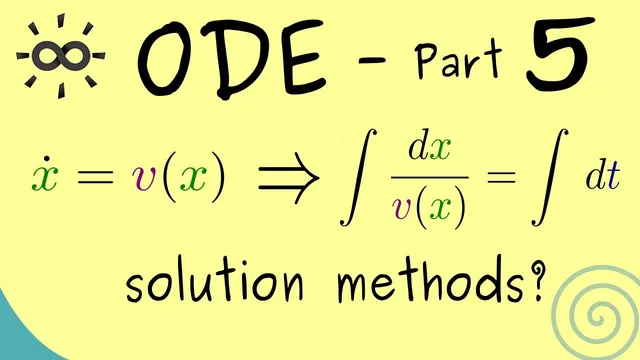
Ordinary Differential Equations 5 | Solve First-Order Autonomous Equations
Based on The Bright Side of Mathematics's video on YouTube. If you like this content, support the original creators by watching, liking and subscribing to their content.
Autonomous first-order ODEs ẋ = V(x) with x(0)=x0 can be solved by dividing by V(x) near x0 when V(x0)≠0.
Briefing
First-order autonomous differential equations admit a general, systematic solution method—provided the function driving the dynamics doesn’t vanish at the initial value. For an equation of the form ẋ = V(x) with a continuous V on ℝ and an initial condition x(0)=x0, the key move is to rewrite the ODE as ẋ/V(x)=1 near x0 (assuming V(x0)≠0). That turns the problem into an integrable relationship: integrating from 0 to t yields an equation involving an antiderivative of 1/V(x). Concretely, if F is any antiderivative of 1/V, then the solution satisfies F(x(t)) = t + constant. Solving for x(t) requires inverting F locally, giving x(t) = F^{-1}(t − C), where the constant C is fixed by enforcing x(0)=x0. This framework matters because it converts a differential equation into an algebraic inversion problem—often the difference between a solvable model and one that stays stuck in formal notation.
The transcript then grounds the method with two worked examples that show how the “antiderivative + inverse + constant” workflow plays out in practice. For ẋ = Λx with Λ>0 and x0≠0, separating variables leads to ∫(1/x)dx = ∫Λ dt. The left side becomes ln|x|, so ln|x(t)| = Λt + C. Exponentiating gives |x(t)| = e^{C}e^{Λt}, and the absolute value splits the solution into sign-consistent branches. Applying x(0)=x0 determines the constant so the final solution collapses to the familiar exponential form x(t)=x0 e^{Λt}. The treatment also notes that the absolute value doesn’t create ambiguity once the initial sign is fixed: the exponential factor stays positive, so the solution either remains always positive or always negative depending on x0.
The second example, ẋ = x^2 with x0≠0, produces a rational solution. Separation yields ∫x^{-2}dx = ∫dt, so −1/x(t) = t + C. Solving for x(t) gives x(t)=−1/(t+C). Enforcing x(0)=x0 determines C = −1/x0, leading to x(t)=x0/(1−x0 t). Unlike the exponential case, this expression reveals a finite-time blow-up: the denominator hits zero at t = 1/x0, so the solution cannot extend past that time.
Overall, the central insight is that autonomous first-order ODEs reduce to integrating 1/V(x) and inverting the resulting antiderivative—turning dynamics into a solvable “separate, integrate, invert, fit the constant” recipe. The examples also highlight how qualitative behavior (growth vs. blow-up) emerges directly from the algebraic form of the solution.
Cornell Notes
Autonomous first-order ODEs of the form ẋ = V(x) with x(0)=x0 can be solved by separating variables when V(x0)≠0. Dividing by V(x) gives ẋ/V(x)=1, which integrates to an equation involving an antiderivative F of 1/V: F(x(t)) = t + constant. The constant is chosen so the initial condition x(0)=x0 holds, and the solution is obtained by locally inverting F: x(t)=F^{-1}(t−C). Two examples show the workflow: ẋ=Λx leads to x(t)=x0 e^{Λt}, while ẋ=x^2 leads to x(t)=x0/(1−x0 t), which blows up when 1−x0 t=0.
Why does the method require V(x0)≠0, and what goes wrong if V(x0)=0?
How does the constant of integration get determined in the general autonomous method?
In the example ẋ = Λx, how does ln|x| appear and how does the absolute value affect the final solution?
For ẋ = x^2, why does the solution take a rational form and what does it imply about blow-up?
What is the practical “recipe” for solving an autonomous first-order ODE using this approach?
Review Questions
- Given ẋ = V(x) with x(0)=x0 and V(x0)≠0, what equation involving an antiderivative F of 1/V(x) must x(t) satisfy?
- For ẋ = Λx with Λ>0 and x0≠0, what is the explicit solution and why does the sign of x(t) stay fixed?
- For ẋ = x^2 with x0≠0, at what time does the solution blow up, and how is that time read from the formula x(t)=x0/(1−x0 t)?
Key Points
- 1
Autonomous first-order ODEs ẋ = V(x) with x(0)=x0 can be solved by dividing by V(x) near x0 when V(x0)≠0.
- 2
Integrating ẋ/V(x)=1 leads to an antiderivative relation F(x(t)) = t + constant, where F′(x)=1/V(x).
- 3
The integration constant is fixed by enforcing x(0)=x0, typically giving C=−F(x0) in the form x(t)=F^{-1}(t−C).
- 4
For ẋ = Λx (Λ>0), separation yields ln|x| = Λt + C and the solution simplifies to x(t)=x0 e^{Λt}.
- 5
For ẋ = x^2, separation yields −1/x(t)=t+C and the solution becomes x(t)=x0/(1−x0 t).
- 6
Rational solutions like x0/(1−x0 t) can blow up at finite time when the denominator reaches zero.
- 7
The method is fundamentally local: it relies on being able to invert F near the initial value.