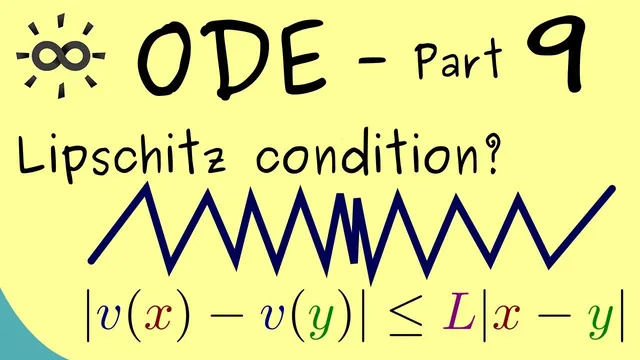
Ordinary Differential Equations 9 | Lipschitz Continuity
Based on The Bright Side of Mathematics's video on YouTube. If you like this content, support the original creators by watching, liking and subscribing to their content.
Locally Lipschitz continuity strengthens continuity by enforcing a uniform bound on output changes relative to input changes within a small neighborhood.
Briefing
Lipschitz continuity sits between mere continuity and full continuous differentiability—and that “middle ground” is exactly what makes uniqueness of solutions to initial value problems in ordinary differential equations (ODEs) possible. The key idea is that locally Lipschitz functions control how fast outputs can change when inputs change, using a single constant that works throughout a small neighborhood. That uniform control prevents the same initial condition from branching into multiple solution curves.
The transcript begins by positioning Lipschitz continuity as stronger than continuity but weaker than requiring a continuously differentiable function. For a function V: R^N → R^N (or on an open subset), “locally Lipschitz” means: at every point x in the domain, there exists an ε-neighborhood around x and a constant L ≥ 0 such that for all points y and z inside that neighborhood, the output difference is bounded by L times the input difference. In norm language, it takes the form ‖V(y) − V(z)‖ ≤ L‖y − z‖. The crucial feature is that the same L works for all y and z in the chosen ball, not just for a single pair.
From this definition, two immediate consequences follow. First, local Lipschitz continuity implies ordinary continuity. If y_n → y, then the Lipschitz estimate forces V(y_n) → V(y), since the right-hand side goes to zero. Second, local Lipschitz continuity bounds “slopes” in a way that rules out blow-up: by rearranging the inequality, the difference quotient (the ratio of output change to input change) stays bounded by L within the neighborhood. In other words, locally Lipschitz functions cannot develop arbitrarily steep behavior.
The transcript then connects Lipschitz continuity to differentiability. For a C^1 function in one dimension, the mean value theorem turns secant slopes into tangent slopes: for points y and z near x, the difference quotient equals f′(c) for some intermediate c between y and z. Taking absolute values and using the continuity of f′, the derivative stays bounded on the ε-neighborhood. That boundedness supplies a valid Lipschitz constant L, showing that every C^1 function is locally Lipschitz. The argument is presented in one dimension for clarity, with the note that the same logic extends to higher dimensions.
With these pieces in place, the stage is set for the next step in the ODE course: when the ODE’s right-hand side V is locally Lipschitz, the initial value problem admits a unique solution. The transcript emphasizes that this uniqueness result depends on the slope-control property encoded by the Lipschitz constant, which prevents multiple trajectories from satisfying the same initial condition while staying within the same local region.
Cornell Notes
Locally Lipschitz continuity provides a quantitative strengthening of continuity that is strong enough to support uniqueness for ODE initial value problems. For V: R^N → R^N, local Lipschitz means that around every point x there is an ε-ball and a constant L such that ‖V(y) − V(z)‖ ≤ L‖y − z‖ for all y, z in that ball. This condition immediately implies ordinary continuity and also bounds difference quotients, preventing arbitrarily steep behavior locally. A key bridge to calculus: if f is C^1 (continuously differentiable), the mean value theorem and boundedness of f′ on a neighborhood yield a Lipschitz constant, so C^1 functions are locally Lipschitz. That “bounded slope” property is the ingredient needed for uniqueness in the next part of the ODE course.
What does “locally Lipschitz” require, and what makes it different from global Lipschitz continuity?
Why does local Lipschitz continuity automatically imply ordinary continuity?
How does local Lipschitz continuity control “slopes” or difference quotients?
How does the mean value theorem show that a C^1 function is locally Lipschitz in one dimension?
Why does the transcript emphasize that the Lipschitz constant works for all y and z in the neighborhood?
Review Questions
- State the formal inequality that defines local Lipschitz continuity for V: R^N → R^N and explain what can vary with the point x.
- Explain why local Lipschitz continuity implies continuity using a sequence argument.
- Using the mean value theorem, outline how boundedness of f′ on a neighborhood produces a Lipschitz constant for a C^1 function.
Key Points
- 1
Locally Lipschitz continuity strengthens continuity by enforcing a uniform bound on output changes relative to input changes within a small neighborhood.
- 2
For V: R^N → R^N, local Lipschitz means that for every x there exist ε > 0 and L ≥ 0 such that ‖V(y) − V(z)‖ ≤ L‖y − z‖ for all y, z in the ε-ball around x.
- 3
Local Lipschitz continuity implies ordinary continuity because the Lipschitz estimate forces ‖V(y_n) − V(y)‖ → 0 whenever y_n → y.
- 4
Local Lipschitz continuity bounds difference quotients, preventing local “slope” blow-up.
- 5
A C^1 function in one dimension is locally Lipschitz: the mean value theorem converts secant slopes to f′(c), and continuity of f′ ensures a finite bound on a neighborhood.
- 6
The next ODE step uses local Lipschitz continuity of the right-hand side V to guarantee uniqueness of solutions to initial value problems.