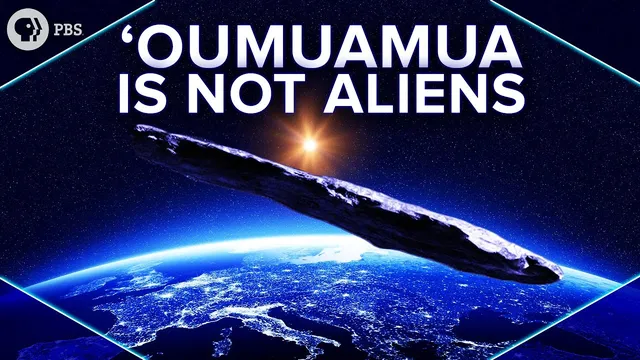
'Oumuamua Is Not Aliens
Based on PBS Space Time's video on YouTube. If you like this content, support the original creators by watching, liking and subscribing to their content.
‘Oumuamua’s interstellar trajectory and small non-gravitational acceleration renewed interest in its origin and composition.
Briefing
‘Oumuamua—1I/2017 U1—was first flagged as an interstellar visitor because its path didn’t match any solar-orbiting asteroid or comet. The renewed attention comes from a June Nature report describing a small but measurable non-gravitational acceleration as it left the Sun. That extra push, combined with a highly elongated, tumbling shape and the absence of a visible coma or tail, has fueled a provocative hypothesis: the object could be an artificial light sail attached to an alien probe.
The light-sail idea centers on how the acceleration changes with distance. The measured effect appears to follow an inverse-square trend, which fits solar radiation pressure—the force sunlight exerts on a reflective, thin surface. Radiation pressure could also help explain why ‘Oumuamua looked like a “space baguette,” potentially a thin sheet with a reflective surface. In calculations associated with the proposal, Schmuel Bialy and Avi Loeb argue that a roughly 50-meter-wide, sub-millimeter-thick, highly reflective sheet could reproduce both the observed brightness and the acceleration. The concept is not purely science fiction: solar sails have already been demonstrated, including Japan’s IKAROS mission to Venus, and Breakthrough Starshot is planning to use light sails for interstellar travel.
Still, natural explanations remain viable. Outgassing is the most obvious alternative for non-gravitational acceleration, and comets do accelerate as volatile material evaporates. The sticking point is observational: ‘Oumuamua showed no coma or tail. But that absence can be reconciled if the ejected material contains little dust, consists of unusually large grains that reflect less light, or if the surface has been altered into a crust by long exposure to cosmic rays. Even the lack of clear changes in tumbling is not yet a decisive blow; it would require detailed modeling to show that outgassing should measurably alter the rotation.
The object’s odd shape also has non-alien pathways. One set of ideas involves tidal disruption—being pulled apart by a star or a gas giant in its home system—followed by gravitational reassembly into an unusual form. Another possibility is breakup driven by rapid rotation before reassembling later.
The biggest statistical challenge cuts both ways. Detecting an interstellar object like ‘Oumuamua may require far more interstellar debris than standard models predict, though several counter-arguments exist: more debris could be produced than expected, the encounter could be a rare lucky event, or ‘Oumuamua might have originated from our own Oort cloud and been kicked outward.
The light-sail hypothesis also faces constraints. It doesn’t naturally explain the tumbling motion expected of a functioning probe, and it would imply an enormous population of broken sails in interstellar space. Speed is another mismatch: ‘Oumuamua entered the solar system at about 26 km/s, while Starshot-style sails target roughly 20% of light speed over decades. Taken together, the unnatural scenario still looks less likely than natural ones.
Where the controversy really escalates is communication. The light-sail proposal was first raised publicly by Avi Loeb and then amplified after the Bialy–Loeb preprint appeared, with many outlets emphasizing “Harvard astrophysicists” and “alien probe” framing. The analysis may be scientifically legitimate as a plausibility exercise, but the public narrative often stretched beyond what the evidence supports.
The segment ends with corrections and follow-up on particle-physics topics, including a clarification that neutrinos can pass through Earth at high energies and that the MSW effect suppresses oscillations into tau neutrinos in matter—making a tau-neutrino signal from directly below far less likely than it might sound at first.
Cornell Notes
‘Oumuamua (1I/2017 U1) is an interstellar object whose trajectory and small non-gravitational acceleration set it apart from typical comets and asteroids. The acceleration appears consistent with an inverse-square dependence on distance from the Sun, which matches solar radiation pressure and motivates a light-sail hypothesis proposed by Schmuel Bialy and Avi Loeb. Their calculations suggest a thin, highly reflective sheet could reproduce the observed brightness and acceleration, and solar-sail technology already exists in missions like IKAROS and planned efforts like Breakthrough Starshot. However, natural explanations—especially outgassing with low or dust-poor ejecta—can still account for the acceleration without producing a visible coma or tail. The segment argues that while the alien-sail idea is scientifically plausible to test, media coverage often overstated how likely it is.
What observational facts about ‘Oumuamua most strongly drive the light-sail hypothesis?
Why does inverse-square acceleration matter for distinguishing radiation pressure from gravity?
How can outgassing still fit the data even though no coma or tail was seen?
What non-alien ideas have been proposed to explain ‘Oumuamua’s unusual shape?
What are the main weaknesses of the alien light-sail interpretation?
Why does the segment criticize some media coverage even if the science is allowed to be speculative?
Review Questions
- Which specific feature of ‘Oumuamua’s acceleration pattern is used to connect it to solar radiation pressure?
- List two ways outgassing could occur without producing a visible coma or tail, according to the discussion.
- What combination of shape, tumbling, and speed challenges makes the light-sail hypothesis less straightforward than the acceleration fit alone?
Key Points
- 1
‘Oumuamua’s interstellar trajectory and small non-gravitational acceleration renewed interest in its origin and composition.
- 2
The reported acceleration trend is consistent with an inverse-square dependence expected from solar radiation pressure.
- 3
A light-sail model can match both acceleration and brightness if ‘Oumuamua is an extremely thin, highly reflective sheet.
- 4
Natural explanations remain plausible, especially outgassing scenarios with low dust production, large grains, or a cosmic-ray-altered crust.
- 5
Tidal disruption and rotational breakup/reassembly are among the proposed mechanisms for ‘Oumuamua’s elongated shape.
- 6
The light-sail hypothesis faces additional constraints, including difficulty explaining tumbling and requiring an implausibly large population of broken sails.
- 7
Media coverage often amplified the alien interpretation beyond what the underlying calculations justify as “plausible.”