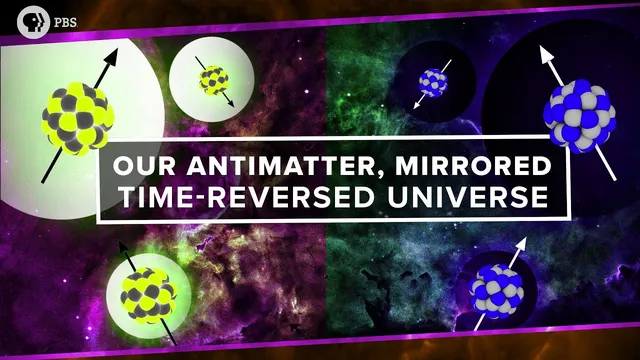
Our Antimatter, Mirrored, Time-Reversed Universe
Based on PBS Space Time's video on YouTube. If you like this content, support the original creators by watching, liking and subscribing to their content.
Parity violation shows up as directional differences in physical processes, such as how decay products move relative to a detector in a mirrored setup.
Briefing
Parity symmetry—physics looking the same in a perfect mirror—was once treated as a basic expectation. Instead, experiments found that nature distinguishes left from right, most famously through the weak interaction. That parity violation matters because it threatens a deeper, more structural symmetry in quantum field theory: CPT, the combined operation of charge conjugation (C), parity inversion (P), and time reversal (T). If CPT were broken, the foundations of modern physics would wobble; if it holds, then other symmetries must adjust in compensating ways.
A key thought experiment uses Richard Feynman’s “mirror clock.” In a mirror, a clock’s geometry flips: a mirrored clock would tick the opposite way because left-right handedness and spatial orientation reverse. Feynman then proposes a clock whose ticks are governed by radioactive decay—specifically cobalt-60 nuclei in a magnetic field. In ordinary matter, the cobalt nuclei align with the field, and the emitted decay electrons move toward a detector, producing ticks. In a literal parity-inverted mirror universe, the electrons would move away from the detector, so the mirrored clock would fail to tick. The point is not the clock itself; it’s that parity violation shows up as a real, directional difference in physical behavior.
To rescue the symmetry structure, Feynman’s workaround is to build the “mirror” clock out of antimatter. Antimatter flips the relevant charge properties: electrons become positrons, and the magnetic behavior of nuclei reverses relative to their angular momentum. When the antimatter clock is also parity-reflected, the electron direction gets flipped twice—once by the mirror and once by the antimatter charge/magnetic reversal—so the electrons still head toward the detector. The clock ticks again, suggesting that while parity alone fails, a combined CP transformation can restore the expected behavior.
That CP symmetry, however, is not perfectly respected either. The weak interaction treats left- and right-chiral fermions differently, and antimatter swaps which chiralities participate in the weak force. Neutral kaons provided a decisive test: James Cronin and Val Fitch observed that long-lived KL states sometimes transform into short-lived KS states, even though their CP properties should prevent such mixing if CP were conserved. The observed oscillations imply CP violation.
Once CP is violated but CPT is believed to hold, time reversal symmetry must also be violated. The transcript distinguishes two notions of “time reversal.” One is literal rewinding of the universe, which effectively undoes CP in a way that preserves information. The CPT “T” is subtler: it reverses the direction of evolution of a physical system—turning decays into the time-reversed processes like particle creation, while reversing momenta and spins. If T symmetry holds, forward and backward transition rates match. Experiments such as BaBar’s 2012 tests of B-meson transitions found a mismatch, indicating T violation.
The overall arc is a symmetry accounting exercise: parity breaks, CP breaks, and T breaks in a way that keeps CPT intact. The end result is a “perfect mirror universe” only when all three operations—charge, parity, and time—are applied together. The transcript then pivots to a separate discussion responding to comments about a PBS Space Time episode on string theory, arguing that criticisms about supersymmetry’s non-detection and the “string landscape” don’t fully undermine string theory, and that untestability at quantum-gravity scales doesn’t automatically disqualify it as science.
Cornell Notes
Nature fails to respect mirror symmetry (parity) and also fails to respect CP symmetry, but the CPT theorem keeps the combined operation intact. Feynman’s cobalt-60 “mirror clock” shows how parity violation changes decay directions, while using antimatter can restore ticking under CP. Neutral kaon experiments by James Cronin and Val Fitch reveal CP violation through KL→KS oscillations that should be forbidden if CP were exact. If CP is violated and CPT holds, time reversal (T) must be violated too. BaBar’s measurements of B-meson transition rates provide evidence that forward and backward evolution are not perfectly symmetric, consistent with T violation while preserving CPT.
Why does a mirrored cobalt-60 decay clock fail to tick in a parity-inverted universe?
How does switching to antimatter make the “mirror clock” tick again even though parity is violated?
What did Cronin and Fitch’s neutral kaon experiment demonstrate about CP symmetry?
Why does CP violation imply T violation if CPT symmetry holds?
What’s the difference between “rewinding the universe” time reversal and the T in CPT?
How did BaBar’s 2012 results relate to T symmetry?
Review Questions
- In Feynman’s cobalt-60 mirror clock setup, what specific role does the magnetic field play in determining whether electrons hit the detector?
- Why do KS and KL not mix if CP symmetry is conserved, and what observation contradicts that expectation?
- How does the CPT-based notion of T differ from literal time rewinding, and why does that distinction matter for interpreting experiments?
Key Points
- 1
Parity violation shows up as directional differences in physical processes, such as how decay products move relative to a detector in a mirrored setup.
- 2
Feynman’s cobalt-60 “mirror clock” illustrates that parity inversion alone can prevent a clock from ticking because decay electrons reverse direction relative to the detector.
- 3
Replacing matter with antimatter can restore ticking under CP by flipping the magnetic/charge behavior that controls decay electron trajectories.
- 4
Neutral kaon experiments (Cronin and Fitch) provided direct evidence of CP violation through observed KL→KS oscillations that should be forbidden if CP were exact.
- 5
If CP is violated but CPT is preserved, time reversal symmetry must also be violated to maintain the CPT relationship.
- 6
T violation can be tested by comparing forward and backward transition rates in systems like B-mesons, as done by BaBar in 2012.