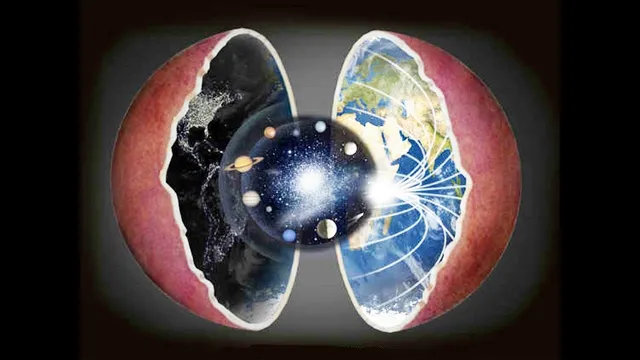
Our Narrow Slice
Based on Vsauce's video on YouTube. If you like this content, support the original creators by watching, liking and subscribing to their content.
Modern society is portrayed as a razor-thin slice of human history, not the default condition of humanity.
Briefing
Human history’s “modern” era is a razor-thin slice—so thin that today’s assumptions about progress, politics, and technology look almost accidental when placed against the full timescale of human existence. The pyramids of Giza, for instance, were built so long ago that they’re roughly as old to the ancient Romans as the ancient Romans are to people today. The point isn’t just that the past is distant; it’s that the present sits on top of layers of earlier eras, with major events and beliefs overlapping in ways that standard timelines hide.
That narrowness becomes clearer through a recurring pattern: multiple “chapters” of history can coexist in the same narrow window of time. Anne Frank and Martin Luther King Jr. were born in the same year. The late 1960s brought spaceflight milestones—humans sending probes and preparing for Moon landings—while segregation laws still made interracial marriage illegal in 16 U.S. states. Even technologies and institutions that feel ancient can be surprisingly recent in practice: the guillotine, often treated as a relic, was used in France to execute a criminal the same year Star Wars was released. Meanwhile, the American frontier and major infrastructure development overlapped: General Custer fought on the plains while the Brooklyn Bridge was being built. Within a single human lifetime, people could go from Custer’s last stand to Neil Armstrong’s first steps.
To sharpen the argument, the discussion introduces “WEIRD” societies—an acronym coined by Jared Diamond for “Western, educated, industrial, rich and democratic.” These societies represent a small subset of humanity. Most of human evolution—spanning roughly 6 million years—played out in traditional societies, and many of the features taken for granted today (writing, kings, widespread encounters with strangers) emerged only within the last 10,000 years, and especially within the last 5,000–10,000 years. Even today’s information ecosystem—media and the internet—arrived only in the last few decades. Because knowledge spreads so fast in WEIRD contexts, societies can quickly outgrow earlier beliefs, sometimes replacing one set of “common sense” with another.
The transcript illustrates that volatility with examples of confident predictions and cultural misjudgments. In 1903, The New York Times predicted that building a flying machine would take 1 to 10 million years—yet the Wright brothers flew at Kitty Hawk that same year. In 1908, a claim circulated that no flying machine would ever fly from New York to Paris; one of the Wright brothers made the earlier prediction. Music industry gatekeeping also produced errors: Decca rejected the Beatles in 1962 for sounding wrong and claimed guitar music was on the way out. Even the naming of Led Zeppelin is traced to a dismissive remark about “The New Yardbirds,” which Jimmy Page repurposed.
The most consequential lesson comes from Thomas Midgley Jr., whose inventions show how quickly “progress” can become harm. Midgley synthesized CFCs, later linked to roughly 4% ozone-layer depletion per decade. He also helped popularize tetraethyllead in gasoline to reduce engine knocking; safer alternatives existed, but profit incentives and advertising drove widespread lead exposure. Lead is described as a neurotoxin: after leaded gasoline spread, 88% of American children had blood lead levels above the modern reference threshold (<5 micrograms per decilitre), and when leaded gasoline was phased out in the 1970s, that figure fell to 9%. Studies cited connect lead exposure to lower intelligence and higher antisocial behavior, including patterns in juvenile violent crime.
The closing takeaway is stark: modern life occupies a brief flash on a 100,000-year timescale of human history. The present is not the whole story—it’s a thin, fast-moving slice layered over a much longer human past, and it’s easy to miss how contingent today’s “normal” really is.
Cornell Notes
The transcript argues that today’s world is a tiny slice of human history, and that many “modern” assumptions only make sense within a narrow WEIRD (Western, educated, industrial, rich and democratic) context. It contrasts the recency of current institutions and technologies with the much longer span of human evolution and traditional societies. Examples show how radically different events can occur within the same narrow timeframe—spaceflight milestones alongside segregation laws, or the guillotine alongside Star Wars. The discussion also uses Thomas Midgley Jr.’s inventions to illustrate how fast societies can adopt harmful technologies before the damage is understood. The result is a caution: modern progress is brief and layered, not the default condition of humanity.
Why does comparing the pyramids to the ancient Romans matter to the transcript’s main point?
How does the transcript use the WEIRD concept to frame human nature and culture?
What do the “same year” and “same decade” examples reveal about how history is usually taught?
What’s the significance of the flying-machine predictions and the Beatles/Decca rejection?
How does Thomas Midgley Jr.’s story function as a cautionary tale?
What does the “time travel” ending imply about how people should view the modern world?
Review Questions
- What does the transcript claim is the relationship between WEIRD societies and how people interpret human nature?
- Which examples show that “progress” and “harm” can occur within the same narrow timeframe, and what do they demonstrate?
- How does the transcript connect lead exposure to later social outcomes, and what evidence is cited?
Key Points
- 1
Modern society is portrayed as a razor-thin slice of human history, not the default condition of humanity.
- 2
Major “chapters” of history overlap in time, so neat timelines can hide how different realities coexisted.
- 3
WEIRD (Western, educated, industrial, rich and democratic) societies are treated as a small subset of humanity, making generalizations risky.
- 4
Technological and cultural predictions can be confidently wrong, as shown by early aviation forecasts and music-industry gatekeeping.
- 5
Thomas Midgley Jr.’s CFCs and leaded gasoline illustrate how quickly harmful technologies can spread before their consequences are understood.
- 6
Lead exposure is described as a neurotoxin, with cited links to intelligence and antisocial behavior and with population-level changes after leaded gasoline was phased out.
- 7
A 100,000-year “time travel” framing ends with a warning: the modern world is brief—don’t miss how contingent it is.