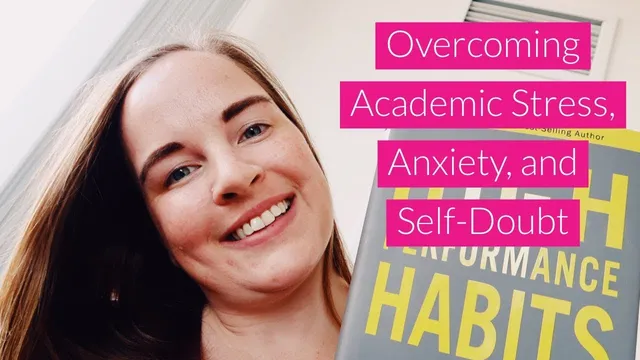
OVERCOMING WRITING and STUDYING-RELATED ANXIETY, STRESS, and SELF DOUBT (PhD Candidate perspective)
Based on Jacqueline Beaulieu's video on YouTube. If you like this content, support the original creators by watching, liking and subscribing to their content.
Pre-select the emotional state you want before writing or studying, including both how you want to feel during the session and what you want to take away afterward.
Briefing
Writing and studying anxiety—stress, self-doubt, and worries about performance—can derail focus and productivity. A practical way to counter that pattern is to deliberately “calibrate” the emotional state you want before starting, so challenging feelings don’t automatically take over the session. The approach draws on research summarized in Brendon Burchard’s book High-Performance Habits, where high performers are described as articulating both the energy they want to feel going into a situation and the energy they want to carry out afterward. The goal isn’t to eliminate anxious thoughts; it’s to transform how those emotions are framed and to keep attention anchored to a chosen purpose.
The method begins with a simple question: when negative emotions show up, is there any way to redefine that energy rather than treat it as a stop sign? That reframing can be harder when emotions connect to mental health challenges or disabilities, but the underlying suggestion remains: attempt to redirect the emotional “fuel” toward the experience you want. In this framework, the “zone” is less a mysterious state and more a result of entering work with clear intentions about how you want to feel and what you want to take from the session.
To make the idea concrete, the PhD candidate builds a document listing targeted feelings and the energy she wants to experience during writing and study time, then reviews it immediately before starting. The pre-session intention includes curiosity (a strong desire to learn and grow skills to reach her potential), excitement (moving toward future research phases and generating creative, innovative ideas), gratitude (for learning, the PhD program, and the gift of time), and joy (pleasure in learning about topics she cares about, plus appreciation for the “coziness” of the study environment). After the session, the desired outcomes shift toward curiosity again, gratitude, accomplishment (feeling she did her best), calm and enjoyment of the environment, and forward-looking inspiration for the next session.
The strategy is reinforced with an athlete analogy: before a figure skating competition, skaters warm up under pressure and can either fixate on being judged or adopt a mindset focused on sharing their craft. That mindset choice—what emotional meaning gets attached to performance—transfers to academia. Instead of treating writing as a test of worth, the intention becomes sharing ideas and doing the work to the best of ability, with results arriving afterward.
In short, the core move is to pre-load writing and studying with chosen emotional targets and a reminder of purpose. When stress or self-doubt appears, the intention-setting document provides a tool to redirect attention, making negative thoughts easier to manage and less likely to dominate. The candidate encourages viewers to create their own cue—often a document—and to share what feelings and reminders work best for them.
Cornell Notes
The transcript recommends reducing writing and studying anxiety by pre-selecting the emotional state you want before starting work. Research on high performance (as summarized in Brendon Burchard’s High-Performance Habits) describes high performers as articulating both the energy they want to feel going in and the energy they want to take away afterward. The key is not to avoid difficult emotions like stress or self-doubt, but to redefine and redirect them toward the chosen purpose. A concrete implementation is to write a short list of target feelings (e.g., curiosity, excitement, gratitude, joy) and desired end-of-session outcomes, then review it right before writing or studying to help enter a focused “zone.”
What does “calibrating how you want to feel” mean in the context of writing and studying?
How does the strategy handle negative emotions like anxiety and self-doubt?
What is the concrete tool the PhD candidate uses before writing or studying?
Why does the transcript connect this approach to “being in the zone”?
What emotional outcomes does the candidate want at the end of a session?
Review Questions
- Before starting a writing session, what two categories of intentions does the transcript recommend setting (during-session feelings vs. after-session takeaways)?
- How does the transcript suggest responding when stress or self-doubt appears—avoid it, or redirect it? What specific question is used to guide that response?
- What feelings does the candidate list as her in-session targets, and what does she want to feel when the session ends?
Key Points
- 1
Pre-select the emotional state you want before writing or studying, including both how you want to feel during the session and what you want to take away afterward.
- 2
Use the intention-setting practice even when anxiety or self-doubt shows up; the aim is to redefine and redirect the energy, not eliminate it.
- 3
Create a short cue document (or similar reminder) and review it right before starting to help attention lock onto purpose.
- 4
Target emotions can include curiosity, excitement, gratitude, and joy—paired with end-of-session outcomes like accomplishment, calm, and forward-looking inspiration.
- 5
Adopt a performance mindset that focuses on sharing your craft rather than fixating on judgment or ranking.
- 6
When negative emotions are tied to mental health challenges, reframing may require extra care, but intention cues can still provide a practical redirect for attention.