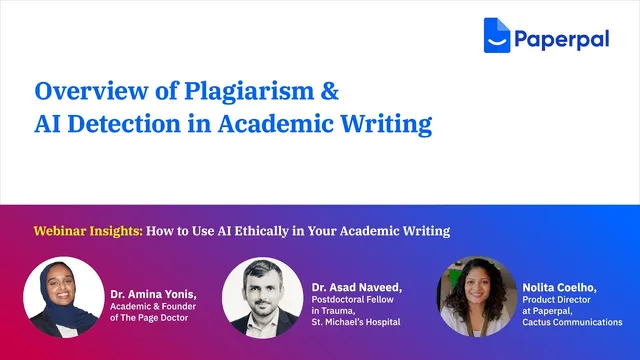
Overview of Plagiarism & AI Detection in Academic Writing
Based on Paperpal Official's video on YouTube. If you like this content, support the original creators by watching, liking and subscribing to their content.
Plagiarism detectors are built to find overlap with existing sources, while generative AI produces new wording that may not match prior text.
Briefing
AI-generated text is widely unlikely to be flagged by plagiarism-detection systems, largely because modern detectors struggle to recognize writing that is newly generated rather than copied. Yale’s guidance, cited during the discussion, says controlling AI use through surveillance or detection technology is “probably not feasible,” and notes that Turnitin has acknowledged reliability problems with its detection tool—so Yale has not enabled that feature in classes. The practical takeaway is that the central risk for students is not “getting caught” by detection software, but producing work that violates academic integrity rules such as copying without attribution.
The explanation hinges on how plagiarism tools work. Traditional plagiarism detection compares submitted text against existing sources—often trained on large collections of papers—to spot overlaps. Generative AI changes the equation: it doesn’t reuse a specific source text to write the submission, but instead produces new wording by recombining language patterns. That makes similarity-based detection far less effective, even when the output is clearly AI-assisted. The discussion also frames paraphrasing as a human cognitive process—reading to understand, swapping in synonyms, simplifying complex ideas, and restructuring sentences—and argues that AI tools automate those same steps. When AI is used as an assistant under human supervision, the resulting text is treated as new and original in substance, which is why detection tools may fail to label it as plagiarism.
Rather than relying on detection, the guidance emphasizes supervised use: AI should support the student’s own thinking and writing, not replace it. For students who remain concerned, the talk recommends scanning drafts with tools such as Turnitin’s checks as a self-audit, while warning that many free AI scanners are unreliable. The discussion points out that even ChatGPT previously offered a detector but stopped because it produced unreliable results.
The conversation then shifts to ethics and how universities are setting boundaries. Current institutional guidelines generally discourage using AI to generate full text and forbid listing AI as an author or acknowledging it as a major contributor in ways that misrepresent authorship. Still, the landscape is moving: at least one UK university allows AI for proof-reading or enhancing text, and the broader trend is toward permitting limited, integrity-preserving uses—especially for improving clarity and academic tone, including helping non-native English speakers express ideas they otherwise might struggle to communicate. Across these approaches, the core ethical line remains consistent: students should not copy and paste text that isn’t theirs, regardless of where it came from. The emphasis is on transparency about process when required by a school or journal, and on aligning AI use with the specific rules of the institution and the publication venue.
Cornell Notes
Generative AI text is often difficult for plagiarism detectors to flag because it is newly generated rather than copied from existing sources. Yale guidance cited in the discussion says detection-based control is likely not feasible and notes reliability issues with Turnitin’s AI detection feature. The ethical focus therefore shifts from “beating detectors” to maintaining academic integrity: AI may be used to assist under supervision (e.g., paraphrasing, simplifying, restructuring, proof-reading), but students should not copy and paste text that is not theirs or misrepresent authorship. Universities are increasingly allowing limited uses—particularly to improve language for non-native speakers—while still restricting full-text generation and improper attribution.
Why are plagiarism detectors less effective against AI-generated writing than against copied text?
What does “paraphrasing” look like in practice, and how does AI change the workflow?
What does Yale’s guidance imply about using detection technology to manage AI use?
What is the recommended approach for students who want to use AI while staying within integrity rules?
How are universities’ ethical policies evolving around AI in writing?
Review Questions
- What specific mechanism makes similarity-based plagiarism detection less reliable for generative AI output?
- How does the discussion distinguish between permissible AI assistance (e.g., proof-reading or language enhancement) and impermissible use (e.g., copying or full-text generation)?
- Why does the talk caution against relying on free AI detectors, even when students are concerned about detection?
Key Points
- 1
Plagiarism detectors are built to find overlap with existing sources, while generative AI produces new wording that may not match prior text.
- 2
Yale guidance cited in the discussion says AI detection-based enforcement is probably not feasible and points to reliability issues with Turnitin’s detection feature.
- 3
Using AI under human supervision is framed as the integrity-preserving approach; letting AI run independently increases ethical risk.
- 4
AI-assisted paraphrasing can automate synonym swaps, simplification, and sentence restructuring—so students must remain accountable for the final work.
- 5
Free AI scanners are described as unreliable, and even ChatGPT’s detector was discontinued for that reason.
- 6
Many universities are moving toward allowing limited AI uses like proof-reading and language enhancement, particularly for non-native English speakers.
- 7
The consistent ethical line is simple: don’t copy and paste text that isn’t the student’s, and follow institution/journal rules about disclosure and authorship.