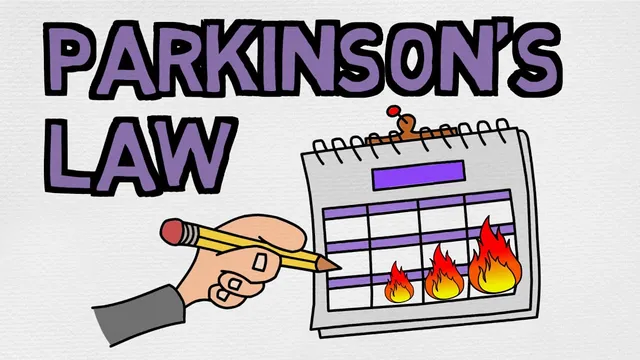
Parkinson's Law - Manage Your Time More Effectively
Based on Better Than Yesterday's video on YouTube. If you like this content, support the original creators by watching, liking and subscribing to their content.
Parkinson’s Law predicts that work will expand to fill the time available, so longer deadlines often increase procrastination rather than productivity.
Briefing
Parkinson’s Law—“Work expands so as to fill the time available for its completion”—explains why giving yourself more time often produces worse results: the extra days get absorbed by procrastination, not by the task itself. A month-long window for mowing a lawn typically turns into nearly the full month, while a one-week window compresses the work into a week. The practical takeaway is blunt: when time is abundant, urgency stays low and focus leaks away; when time is tight, urgency forces prioritization and reduces distractions.
The lesson lands through a personal high-school example. With a month to write a longer essay, the narrator didn’t start because the deadline felt distant. Days turned into weeks without a single word, and only about two days before submission did panic kick in. That narrow runway triggered intense focus: video games and other distractions disappeared, the essay became the top priority, and the paper was finished in time—along with a solid grade. The story illustrates the mechanism behind Parkinson’s Law: the “available time” doesn’t just stretch the work; it stretches the procrastination.
A key warning follows: tasks without specific deadlines often never get done. Without a date to act as pressure, there’s no growing sense of urgency to override everyday diversions. The transcript argues that people mistakenly assume more time automatically improves outcomes, but in practice the extra time is mostly spent delaying the start—like waiting 29 days to begin a job that could be completed in one day.
To make the idea memorable, the deadline is framed as a fire. When the deadline is far away, the fire is small and easy to ignore, so attention goes elsewhere. As the deadline approaches, the fire grows until it threatens the whole “house,” forcing immediate action and eliminating time-wasting behaviors—no casual email checks, no social media scrolling, no gaming. In that state, people don’t have the luxury to get lost in unimportant details.
From there, the guidance becomes actionable. If a task can realistically be finished in a day, setting a two-day deadline invites unnecessary slack and distraction. But deadlines also need to be reasonable: setting tomorrow as the deadline for something that truly takes a week is counterproductive. The transcript suggests pushing limits when possible—sometimes shorter timelines reveal shortcuts—but emphasizes that any deadline is better than none. The core message is to create urgency deliberately: if there’s no “fire” yet, build one with a specific, achievable deadline so the work doesn’t expand into wasted time.
Cornell Notes
Parkinson’s Law says work expands to fill the time available, so longer deadlines often lead to longer procrastination rather than better output. The transcript uses a high-school essay story: a month-long deadline produced weeks of delay, while the final two days created urgency and intense focus, resulting in on-time submission and a solid grade. Deadlines act like a growing “fire”—small when distant, threatening when close—forcing prioritization and cutting distractions. The practical rule is to match deadlines to realistic effort: don’t give a one-day task two days, but don’t set tomorrow for something that truly takes a week. Most importantly, tasks without deadlines tend to stall indefinitely, so creating a specific deadline is essential.
What does Parkinson’s Law predict about how people use extra time?
How does the essay example demonstrate the “urgency” mechanism behind the law?
Why does the transcript claim that deadlines improve outcomes even when they are shorter?
What happens when a task has no deadline?
How should someone choose a deadline without making it unrealistic?
What is the “fire” metaphor meant to communicate about time management?
Review Questions
- How does Parkinson’s Law explain procrastination differently than a simple lack of motivation?
- Give an example of a task where setting a deadline shorter than the available time would likely improve focus—and explain why.
- What trade-off does the transcript suggest when deadlines are pushed too far beyond what’s realistically possible?
Key Points
- 1
Parkinson’s Law predicts that work will expand to fill the time available, so longer deadlines often increase procrastination rather than productivity.
- 2
Specific deadlines are crucial; tasks without deadlines tend to stall indefinitely.
- 3
Deadlines create urgency that improves prioritization by reducing time for distractions and unimportant details.
- 4
Match deadlines to realistic effort: don’t set a one-day task for two days, and don’t set tomorrow for something that truly takes a week.
- 5
Shorter, achievable deadlines can lead to better outcomes because they force focus on the critical work.
- 6
If no “fire” exists yet, create one with a concrete deadline; any deadline is better than none.
- 7
Pushing deadlines can uncover shortcuts, but overly aggressive timelines may require later polishing rather than total failure.