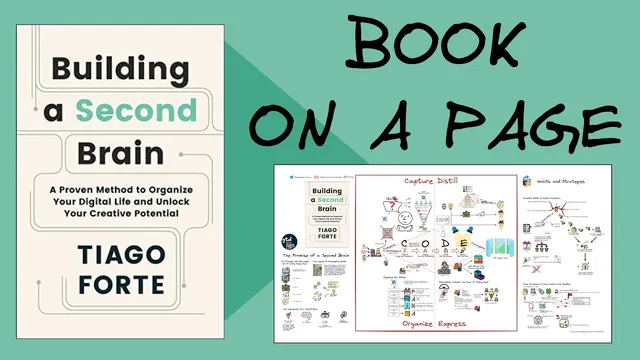
Part 1 Building a Second Brain Book on a Page
Based on Zsolt's Visual Personal Knowledge Management's video on YouTube. If you like this content, support the original creators by watching, liking and subscribing to their content.
Capture only what resonates using a filter based on inspiration, personal relevance, surprise, and usefulness, aiming for a small number of high-signal notes per day.
Briefing
A “second brain” isn’t a place to hoard information—it’s a system for turning scattered ideas into usable thinking over time. The core promise is that writing things down, packaging them for your future self, and organizing them around real projects can make creativity more reliable than inspiration alone. The approach matters because modern information abundance tempts people to collect endlessly, yet that volume becomes noise unless it’s filtered, distilled, and routed into the work it’s meant to support.
The framework starts with a simple behavioral shift: capture insights immediately by writing them down, ideally in a digital medium. Instead of treating notes as permanent storage, the method treats them as “packets” that should be sent forward to the future. That mindset echoes the tradition of commonplace books—handmade repositories where educated readers saved fragments and later recombined them into new patterns—updated for today’s digital access. Creativity, in this view, doesn’t arrive by accident; it emerges from a structured process that makes ideas concrete, observable, and remixable.
To prevent digital hoarding, the capture step is paired with a filter. Richard Feynman’s “12 favorite problems” functions as an example of how a person can test incoming information against what they care about, capturing only what resonates. Thiago Forte’s funnel of filtering is built around four questions: does it inspire, is it personal, did it surprise, and is it useful (potentially repurposable later). The goal isn’t mass note-taking; it’s capturing one or two notes per day that match ongoing interests and projects.
After capture comes separation: organizing should not happen at the moment of collecting. Organizing too early adds friction and mental burden, and it often delays capture. Instead, information lands in an inbox, then gets organized when it’s time to use it. Organizing is guided by actionability rather than categories like “book notes” or “podcast notes.” The recommended structure is PARA—Projects, Areas, Resources, Archives—using a practical analogy: projects are active “on the stove,” areas are long-term commitments, resources are reference material, and archives hold completed or unresolved items.
Distillation turns raw notes into something future-proof. The key question becomes: how can this be useful later? Progressive summarization provides the mechanism—starting from full text, creating literature notes, then highlights, and ending with an executive summary in the author’s own words. The method warns against over-highlighting; the point is to extract essence, not to mark everything. A Picasso example illustrates decomposition toward a simplified form that still preserves the core idea.
Finally, expression and reuse drive the system forward. Notes are treated like LEGO blocks—intermediate packets that can be assembled into new outputs. This supports “interruption-proof” progress, more frequent feedback through sharing, and better quality through iterative building. Three strategies reinforce that workflow: build from an “archipelago of ideas” rather than a blank page, use “yesterday’s momentum” by planning the next step at the end of each session, and “dial down the scope” by shipping small, concrete pieces.
The habits close the loop: project kickoff and completion checklists, weekly reviews that move items from inbox into the second brain without trying to understand them immediately, monthly reviews for a bird’s-eye view of goals and system health, and a noticing habit that collects opportunistically using the same resonance filters. The result is a knowledge flywheel that converts information into projects and outcomes—slow burns, small packets, and deliberate processing instead of heavy-lift multitasking.
Cornell Notes
The second brain system is designed to convert abundant information into usable thinking by capturing insights, organizing them around real work, and distilling them into future-ready summaries. Instead of collecting everything, it uses filters (inspiration, personal relevance, surprise, and usefulness) to keep only what resonates, aiming for roughly one or two strong notes per day. Notes are stored and routed using PARA—Projects, Areas, Resources, Archives—so information is placed based on actionability, not note type. Progressive summarization turns full text into literature notes, highlights, and an executive summary, extracting essence without over-highlighting. Creativity is supported through intermediate packets (“LEGO blocks”), shared for feedback, and assembled into outputs using strategies like archipelago building, Hemingway-style momentum, and shipping small deliverables.
Why does the system treat “capture” as a filtered act rather than a storage habit?
What’s the practical difference between capturing and organizing, and why does it matter?
How does PARA structure notes so they stay usable?
What does progressive summarization do that simple note-taking doesn’t?
Why are “intermediate packets” central to the system’s creative output?
How do the three creative strategies reduce the risk of getting stuck?
Review Questions
- How would you decide whether a new idea should be captured using the four resonance questions?
- Walk through how you would route a new note using PARA when you’re not sure which category it fits.
- What steps make progressive summarization different from simply highlighting or writing a single summary?
Key Points
- 1
Capture only what resonates using a filter based on inspiration, personal relevance, surprise, and usefulness, aiming for a small number of high-signal notes per day.
- 2
Separate capture from organizing by using an inbox first; organize later when the information is needed to reduce friction and mental load.
- 3
Organize notes by actionability using PARA: Projects, Areas, Resources, and Archives, routing new information by project first, then area, then resource, then archives.
- 4
Distill for future usefulness by using progressive summarization—literature notes, highlights, and an executive summary—while avoiding over-highlighting.
- 5
Treat work products as reusable intermediate packets (“LEGO blocks”) so progress continues even when interrupted and outputs can be assembled from components.
- 6
Use creative strategies that prevent blank-page paralysis and scope overload: build from an archipelago of ideas, plan the next step at session end, and ship small deliverables.
- 7
Maintain the system with project kickoff/completion checklists plus weekly and monthly reviews, and collect opportunistically through a noticing habit.