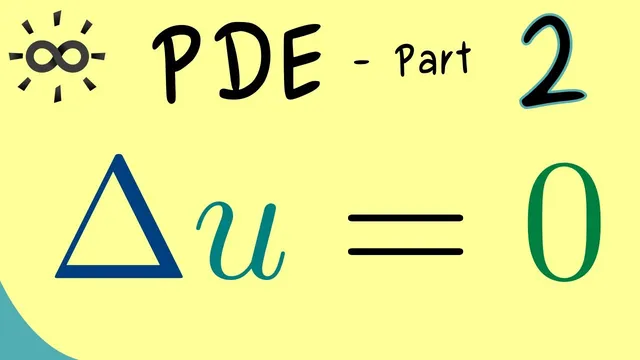
Partial Differential Equations 2 | Laplace's Equation
Based on The Bright Side of Mathematics's video on YouTube. If you like this content, support the original creators by watching, liking and subscribing to their content.
Laplace’s equation is ∆u = 0, and its solutions are harmonic functions u ∈ C².
Briefing
Laplace’s equation—defined by setting the Laplacian of a function to zero—becomes especially tractable when the function is assumed to be radially symmetric. In physics, that translates directly to electrostatic potential in regions with no charge: away from sources, the potential must satisfy ∆u = 0. Mathematically, the focus is on harmonic functions, meaning twice continuously differentiable functions u (in C²) on an open set Ω whose second derivatives combine to give zero.
To find nontrivial harmonic functions, the discussion narrows to domains with a “puncture,” removing the origin (Ω = Rⁿ \ {0}). Under radial symmetry, u(x) depends only on the distance r = ||x||, so u(x) can be written as u(x) = φ(r) for some single-variable function φ defined on (0, ∞). Plugging this form into the Laplacian converts the PDE into an ordinary differential equation. Carrying out the chain rule and product rule for derivatives of φ(||x||) yields a radial ODE:
φ''(r) + (n − 1)/r · φ'(r) = 0 for all r > 0.
This step matters because it turns a multi-variable second-order PDE into a solvable one-variable equation, letting standard ODE techniques take over.
The ODE is linear and is handled by introducing f(r) = φ'(r). The equation then becomes a first-order relation for f(r), and an integrating factor simplifies it. The integrating factor comes from the coefficient (n − 1)/r, whose antiderivative is (n − 1) ln r, producing an integrating factor r^{n−1}. After multiplying through, the equation collapses to a single derivative:
d/dr [ r^{n−1} f(r) ] = 0.
So r^{n−1} f(r) must equal a constant, giving f(r) = c₁ r^{1−n}. Integrating once more produces φ(r), introducing a second constant c₂. The final form depends on dimension:
- For n = 2, φ(r) = c₂ + c₁ ln r. - For n ≠ 2, φ(r) = c₂ + c₁ r^{2−n} (with constants absorbing factors).
Therefore, every radially symmetric harmonic function on Rⁿ \ {0} has the form u(x) = φ(||x||) with φ as above. The three-dimensional case (n = 3) yields a 1/r behavior, which is highlighted as the shape of the fundamental solution to Laplace’s equation—an ingredient expected to play a central role in what comes next.
Cornell Notes
Laplace’s equation requires the Laplacian of a function to vanish: ∆u = 0. Harmonic functions are those u ∈ C² whose second derivatives combine to give zero, and radial symmetry makes the problem solvable. On the punctured domain Rⁿ \ {0}, assuming u(x) = φ(r) with r = ||x|| converts the PDE into the ODE φ''(r) + (n−1)/r · φ'(r) = 0. Solving via an integrating factor r^{n−1} gives φ'(r) = c₁ r^{1−n}, and integrating again yields φ(r) = c₂ + c₁ ln r when n = 2, or φ(r) = c₂ + c₁ r^{2−n} when n ≠ 2. This produces explicit families of radially symmetric harmonic functions, including the 1/r form in three dimensions.
Why does assuming radial symmetry turn Laplace’s equation into an ODE?
What is the exact radial ODE that φ(r) must satisfy?
How does the integrating factor method solve the ODE?
Why is n = 2 a special case?
What do the solutions look like in three dimensions, and why is that important?
Review Questions
- Derive the radial ODE starting from u(x)=φ(||x||) and ∆u=0: what terms combine to produce (n−1)/r · φ'(r)?
- Solve φ''(r) + (n−1)/r · φ'(r) = 0 using f(r)=φ'(r). What integrating factor do you use and what is the resulting expression for φ'(r)?
- Explain why the solution involves ln r specifically when n = 2, and give the power-law form for n ≠ 2.
Key Points
- 1
Laplace’s equation is ∆u = 0, and its solutions are harmonic functions u ∈ C².
- 2
In charge-free physics regions, electrostatic potential satisfies Laplace’s equation.
- 3
Assuming radial symmetry on Rⁿ \ {0} lets write u(x)=φ(r) with r=||x||.
- 4
Substituting u(x)=φ(r) into ∆u=0 yields the radial ODE φ''(r) + (n−1)/r · φ'(r) = 0.
- 5
Introducing f(r)=φ'(r) reduces the ODE to first order and is solved using integrating factor r^{n−1}.
- 6
The resulting radially symmetric solutions are φ(r)=c₂+c₁ ln r for n=2 and φ(r)=c₂+c₁ r^{2−n} for n≠2.
- 7
In three dimensions, the non-constant term behaves like 1/r, foreshadowing the fundamental solution.