Passing A Portal Through Itself
Based on minutephysics's video on YouTube. If you like this content, support the original creators by watching, liking and subscribing to their content.
Portal behavior is modeled as a fixed mapping: entering one portal exits the other at the same relative position and orientation.
Briefing
A portal that passes through itself can be made logically consistent—at least in an idealized model—without ever “hiding” parts of the portal inside an impossible interior. The key rule is the same one used for ordinary portal behavior: anything entering one portal exits the other at the same relative position and orientation. Once that mapping is applied recursively, a portal can emerge from itself in a way that looks like parts are disappearing, even though every segment remains accounted for.
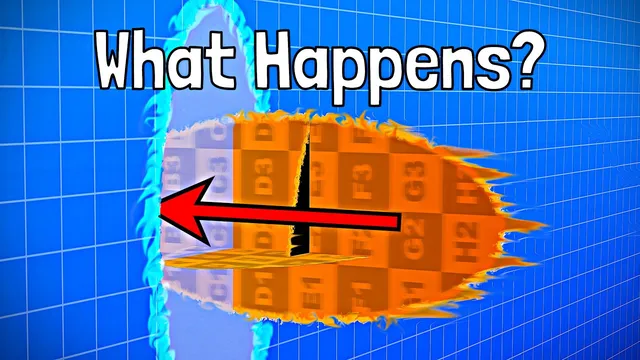
The setup starts in 2D, where a portal is treated like a line. Two portals are placed back-to-back so that, from the outside, there’s no obvious sign of a portal at all—an object’s relative position is preserved as it crosses the boundary. The thought experiment then keeps that relative behavior fixed while the “blue” portal itself moves into the “orange” portal. As the blue portal’s end enters the orange one, the blue portal’s corresponding part exits from the other side, again preserving relative orientation. That produces a counterintuitive effect: the blue portal can appear to come out of itself closer to one end, then loop back so that the portion “coming out of itself” re-enters the orange portal.
At first glance, the recursion seems to imply that the circular end of the blue portal is vanishing into the orange portal. But the disappearance is an illusion created by how the exit mapping lines up against the orange portal’s face. When the orange portal is hidden, the blue portal segments that were “going into” the orange portal are still present—they’re simply emerging from the star end and sitting right up against the orange portal’s boundary. To manage the bookkeeping, the model can label positions along the blue portal; the crucial claim is that a portal has no internal volume in this idealization. Since anything that passes through one portal is immediately outside the other, 100% of the blue portal must remain visible and existing at all times.
The experiment also runs into a physical-looking constraint: for the blue portal to fully pass through itself, the very last bit would need to finish exiting at the same moment it disappears into the orange portal. That simultaneous “finish” seems impossible for a rigid, non-infinitesimal portal, because the geometry would otherwise get stuck, squeezed, or jammed. The transcript suggests this is likely mathematically impossible for a rigid portal with nonzero thickness, but it shows that if the portal is allowed to be flexible, a self-passing configuration becomes possible in 2D and can be extended to 3D with additional rotational constraints.
Finally, the discussion notes that the portal-through-itself visuals can be rendered with computer graphics, though the underlying logic still depends on the idealized relative-position rule. The takeaway is less about sci-fi spectacle and more about consistency: even in a made-up universe, recursion can be made to work—provided the model’s assumptions (especially about thickness and rigidity) are handled carefully.
Cornell Notes
The thought experiment treats a portal as an ideal mapping: anything entering one portal exits the other at the same relative position and orientation. In 2D (a line), moving one portal into another produces a recursive “comes out of itself” effect that looks like parts of the portal vanish, but the missing-looking segments are actually still present—just aligned against the other portal’s face. The model argues there’s no meaningful “inside” to a portal, so the entire portal must remain accounted for at all times. Completing a full self-pass appears to require an infinitely thin portal if it’s rigid, but allowing flexibility makes self-passing configurations possible, and 3D versions require careful handling of rotations.
What rule makes a portal passing through itself logically possible in the model?
Why does the blue portal appear to “disappear” into the orange portal?
How can the model claim the entire blue portal remains visible and real?
What seems to block a rigid portal from fully passing through itself?
How does allowing flexibility change the outcome?
Review Questions
- In the ideal portal model, what does “same relative position and orientation” mean, and how does it apply when the portal itself is the moving object?
- What evidence in the explanation supports the claim that a portal has no “inside,” and how does that affect the accounting of the portal’s length during recursion?
- Why does rigidity and nonzero thickness create a likely impossibility for complete self-passage, and what specific assumption change (flexibility) makes self-passage feasible?
Key Points
- 1
Portal behavior is modeled as a fixed mapping: entering one portal exits the other at the same relative position and orientation.
- 2
Recursive motion (moving one portal into another) can produce a “portal comes out of itself” effect without violating the mapping rule.
- 3
Apparent disappearance is an overlap illusion caused by exit alignment against the other portal’s face, not by true vanishing.
- 4
In the idealization, portals have no interior; therefore the entire moving portal must remain visible and accounted for at all times.
- 5
A rigid, non-infinitesimal portal likely cannot fully pass through itself because the final end would need a simultaneous exit/entry that geometry would prevent.
- 6
Allowing portal flexibility enables self-passing configurations in 2D, and 3D versions require additional rotational constraints to fit through itself.
- 7
The visuals rely on computer graphics and coding, but the core consistency comes from the assumed relative-position portal rule.