Patterns! | Mini Math Movies | Scratch Garden
Based on Scratch Garden's video on YouTube. If you like this content, support the original creators by watching, liking and subscribing to their content.
A pattern is a sequence that repeats in the same order.
Briefing
Patterns are sequences that repeat in the same order, and recognizing that “core” repetition is the key skill. The lesson starts with everyday examples—like repeating sweater stripes in a fixed order (red, green, yellow repeating)—to show that patterns aren’t just sounds or actions. Once the idea of repetition is clear, the activity shifts to hands-on practice using simple repeating sequences.
First comes an AB pattern. With two hands, the learner raises the left hand when prompted “left” and the right hand when prompted “right,” creating a repeating left-right sequence. The same structure is then expressed with letters: “A” for left and “B” for right. The instructor emphasizes that an AB pattern isn’t just “A happens” and “B happens” separately; the repeating unit is the pair together—A then B—repeating in that exact order.
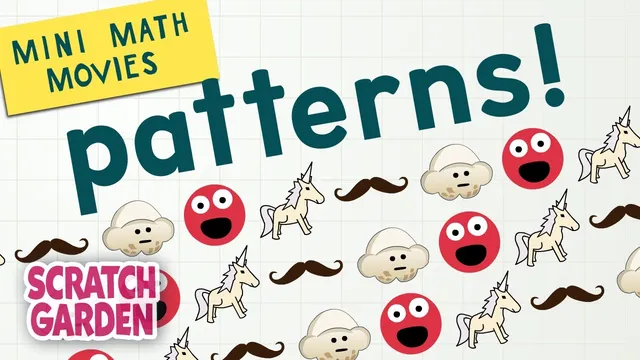
Next, the lesson turns the AB idea into a color pattern: red and blue alternate as “Red Blue Red Blue Red Blue Red Blue.” Here, the “core” of the pattern is the combined red-blue sequence, and that core repeats continuously. The same logic is then extended to three-item patterns, labeled ABC. Instead of left and right, the sequence becomes left, right, up, repeating as “ABCABCABC.” To make the concept stick, the lesson swaps the abstract letters for playful items—popcorn, unicorn, and mustache—creating a three-part repeating core: “Popcorn Unicorn Mustache” repeated over and over.
The final practice is built around prediction and completion. When the core is given as popcorn, unicorn, mustache, the next item must be popcorn, followed by unicorn, then mustache—because the pattern’s order never changes. A second question asks what happens as the pattern continues; the answer is that it stays the same before and after, repeating the same core sequence. The last challenge removes part of the sequence and asks learners to fill the missing spots. After trying incorrect options (like inserting orange juice, or a pink airplane with a funny hat), the correct completion is “popcorn, unicorn, mustache, popcorn, unicorn, mustache,” restoring the repeating core.
By the end, the takeaway is straightforward: patterns are defined by repeating sequences in a fixed order, and once the core repeats, the next steps can be predicted and missing pieces can be filled in. The lesson closes by pointing viewers to another patterns video—“Pattern Practice Song”—and encourages them to keep practicing and “repeat” the learning.
Cornell Notes
A pattern is a sequence that repeats in the same order. The lesson teaches this by building AB patterns (two repeating items) and ABC patterns (three repeating items). Learners practice with hand motions (left/right as A/B) and then with colors (red/blue) to identify the “core” that repeats together. The same idea scales to three-item sequences like left-right-up (ABC) and playful sets such as popcorn, unicorn, mustache. Prediction and fill-in-the-blank questions reinforce that the pattern stays the same as it continues and that missing pieces must match the repeating core.
What makes something a “pattern” rather than random repetition?
How do AB patterns work, and why does the “core” matter?
What changes when moving from an AB pattern to an ABC pattern?
If the core is “popcorn, unicorn, mustache,” what comes next and why?
What should happen if the pattern keeps going—stay the same or change?
How do you fill in missing parts of a repeating pattern?
Review Questions
- Given an AB pattern where A=blue and B=green, what sequence comes after “blue, green, blue” if the pattern continues?
- If a pattern’s core is “left, right, up,” what is the 5th and 6th item in the repeating sequence?
- A gap appears in the sequence “popcorn, unicorn, mustache, popcorn, ___.” What must fill the blank to keep the pattern correct?
Key Points
- 1
A pattern is a sequence that repeats in the same order.
- 2
The repeating “core” is the full sequence of items together (not just one item repeating by itself).
- 3
AB patterns alternate two items in a fixed order: A then B, repeating.
- 4
ABC patterns cycle through three items in a fixed order: A then B then C, repeating.
- 5
Once a pattern’s core is identified, the next items can be predicted exactly.
- 6
When a pattern continues, it stays the same before and after; the order does not change.
- 7
Missing pieces in a pattern can be filled by continuing the established repeating core sequence.