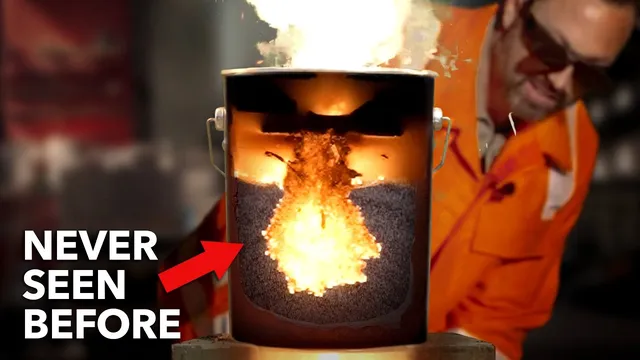
People said this experiment was impossible, so I tried it - Thermite Part 1
Based on Veritasium's video on YouTube. If you like this content, support the original creators by watching, liking and subscribing to their content.
Thermite’s heat comes from oxygen transferring from a metal oxide to aluminum, releasing energy when aluminum–oxygen bonds form.
Briefing
Thermite’s defining trick isn’t just that it burns hot—it’s that it can be engineered to burn hot on command, then behave predictably enough for industrial welding, demolition, and even data destruction. The chemistry behind that control traces back to the Goldschmidt brothers’ late-1800s push to produce pure metals, and it culminates in modern factories that treat thermite like a managed heat source rather than a runaway hazard.
Karl and Hans Goldschmidt worked in a dye business where bright, color-fast pigments depended on access to pure metals. Their problem was practical: separating metals is hard because they tend to form mixed crystals (an alloy-like state) with similar melting behavior. Hans proposed a route that swapped oxygen partners. By reacting a metal oxide—like chromium oxide—with aluminum metal, oxygen would leave the oxide and form aluminum oxide, leaving behind the target metal. That oxygen-for-metal exchange is now known as an aluminothermic (thermite) reaction.
At Electro-Thermit in Germany, the process is recreated with measured batches and professional safety oversight. A first run using copper thermite shows the core phenomenon: aluminum’s strong bond with oxygen releases far more energy than needed to break the starting oxide bonds. Temperatures typically exceed 2,000°C and can reach about 2,500°C, melting the reaction products into glowing liquid metal and slag. The brightness is so intense it overwhelms camera exposure.
A major question then becomes separation. In iron thermite, the molten outputs separate by density: liquid iron is more than twice as dense as liquid aluminum oxide, so iron settles while slag floats. When the metal drains through the crucible bottom, iron exits first; only after it drains does the slag follow. The transcript also notes that violent ejection and sloshing can occur, plausibly tied to boiling of components at extreme temperatures (aluminum boils around 2,500°C; iron above 2,800°C; some elements like manganese around 2,000°C).
Beyond chemistry, the segment emphasizes how thermite’s behavior can be tuned. The reaction’s “pulsing” and burst-like advance is observed directly, with hypotheses including imperfect grain-size ratios and air pockets that heat, expand, and alter pressure between reacting regions. Industrial control also depends on timing (“tap time,” the delay before molten metal flows out): too short risks incomplete separation from slag; too long can dissolve silica from crucible walls and cool the output. Temperature control is achieved by adjusting the thermite mixture, including damping variations.
Historically, thermite’s first big use was remote, reliable welding—such as repairing broken shafts at sea—because it needs minimal equipment and produces a strong joint. Later, it became a tool for controlled destruction: melting gun barrels after the Cold War, and demolishing parts of structures when conventional explosives would cause unacceptable collateral damage. The transcript also describes a modern application aimed at information security: heating magnetic storage past the Curie temperature so data becomes unrecoverable.
Finally, the safety message lands with a practical demonstration. Even with large stored quantities, thermite resists ignition from ordinary fire sources because aluminum is protected by a tough aluminum-oxide layer and the reaction has high activation energy. Only specially designed igniters—barium hydroxide, similar to sparklers—can reliably start it by providing enough heat to break through that oxide barrier. Once ignited, the reaction is effectively irreversible, which is precisely why it can be used deliberately rather than recklessly.
Cornell Notes
Thermite works by forcing oxygen to transfer from a metal oxide to aluminum, forming aluminum oxide and leaving molten metal behind. The reaction can reach roughly 2,000–2,500°C, but it is not easy to start: aluminum’s oxide layer creates a high activation-energy barrier, so ordinary flames or torches may melt thermite without igniting it. In iron thermite, molten iron separates from aluminum-oxide slag by density, draining out first and enabling high-purity metal production when timing (“tap time”) is controlled. Industrial practice tunes ignition, reaction rate, and output temperature by adjusting mixture composition and batch preparation. This controllability underpins uses ranging from remote welding to demolition and heating magnetic drives above the Curie temperature to destroy data.
Why does thermite reach extreme temperatures, and what determines the brightness and melting?
How does molten iron thermite separate iron from slag inside the crucible?
What causes the burst-like pulsing seen during thermite reactions?
What is “tap time,” and why does it matter for product quality?
Why doesn’t thermite ignite from ordinary fire sources even when it can melt?
How is thermite used to destroy data on magnetic drives?
Review Questions
- What role does aluminum-oxide play in both thermite’s extreme heat output and its resistance to accidental ignition?
- Explain how density-driven separation and tap time combine to determine whether iron drains out cleanly before slag.
- List two proposed mechanisms for thermite’s burst-like pulsing and describe how each would affect reaction propagation.
Key Points
- 1
Thermite’s heat comes from oxygen transferring from a metal oxide to aluminum, releasing energy when aluminum–oxygen bonds form.
- 2
Thermite can exceed about 2,000°C and sometimes reach roughly 2,500°C, melting reaction products into glowing metal and slag.
- 3
In iron thermite, density differences drive separation: iron settles and drains first, while aluminum-oxide slag follows after the iron drains.
- 4
Reaction behavior can show pulsing/bursts, potentially due to grain-ratio pockets and/or air expansion between grains.
- 5
Product quality depends on timing: tap time must be long enough for separation but not so long that silica dissolves from the crucible walls or the metal cools.
- 6
Accidental ignition is difficult because aluminum’s oxide layer creates a high activation-energy barrier; ordinary flames may melt but not ignite.
- 7
Industrial applications—from remote welding to demolition and Curie-temperature heating of magnetic drives—depend on thermite’s controllable, deliberate energy release.