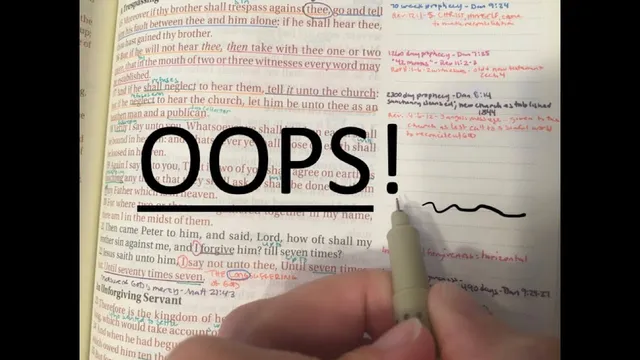
“Permanent” mistakes when using pens? Not if you do this…
Based on Bible Notetaking with Katie 's video on YouTube. If you like this content, support the original creators by watching, liking and subscribing to their content.
Micron pens are recommended for Bible notes because they keep lettering crisp and resist smearing and bleed-through over time.
Briefing
Micron pens are presented as the best way to keep Bible notes crisp and readable for years, with minimal smearing or ink bleed. The core claim is practical: after writing in a Bible since July 2021 with Micron pens (including very fine tips for tiny notes), the lettering stays sharp, there’s no smearing, and even oils from skin don’t noticeably affect the pages. The notes remain clear enough that the writing doesn’t bleed through to the other side, aside from slight coloring that becomes hard to notice once additional writing goes over it.
That durability is contrasted with a second Bible that was written using Staedtler pens starting April 2019. Over time, the pages deteriorated—so much so that the writer stopped using that Bible rather than risk further damage. The evidence offered is visual: ink marks and shapes (like circles) show messy bleed-through on the reverse side, and the writer reports that continued handling and oils would only worsen the problem. The takeaway is that “permanent” mistakes—ruined pages—can happen when the wrong pen is used, and switching later may not undo the damage.
The transcript also addresses a common alternative: using pencils instead of pens. Pencils are criticized for smudging when the page is handled repeatedly. As fingers rub over pencil marks, smudging increases—especially on pages revisited often during study—making pencil notes less reliable for long-term clarity.
For people who want the ability to correct mistakes, the transcript points to correction tape/white-out products. Because the writer is left-handed, the correction method is described as flipping the tape orientation so it can be wiped across the cream-colored page to cover the ink. The correction layer appears as white coverage, but it’s framed as functional: it removes or masks the original ink so new writing can be added on top.
A small caveat comes with corrections: if the white-out ink/tape layer isn’t fully dry, it can smudge. The fix is simple—wait a moment for drying before continuing—after which smudging problems disappear. Overall, the guidance is less about aesthetics and more about preservation: choose an archival-friendly pen system (Micron) and use corrections carefully so notes stay legible and pages remain intact over time.
Cornell Notes
Micron pens are recommended for Bible note-taking because they keep handwriting crisp and prevent smearing and bleed-through over long periods. The writer reports using Micron pens in a Bible since July 2021 with no smearing and no significant ink transfer to the opposite page, even with skin oils. A different Bible written with Staedtler pens starting April 2019 is described as becoming messy, with visible bleed-through and worsening damage as it was handled. Pencil notes are discouraged due to smudging from repeated finger contact on frequently revisited pages. Corrections are handled with white-out/correction tape, with the main caution being to let it dry fully to avoid smudging before writing over it.
What evidence is given that Micron pens preserve Bible notes better than other options?
How does the experience with Staedtler pens differ, and what problem emerges over time?
Why are pencils discouraged for Bible note-taking in this transcript?
How are corrections handled, and what changes for a left-handed writer?
What causes smudging during corrections, and how is it prevented?
Review Questions
- What specific long-term qualities (smearing, bleed-through, oil effects) are used to justify Micron pens?
- Compare the failure mode described for Staedtler pens with the smudging behavior described for pencils.
- What practical steps are recommended for correcting mistakes without creating new smudging issues?
Key Points
- 1
Micron pens are recommended for Bible notes because they keep lettering crisp and resist smearing and bleed-through over time.
- 2
A Bible written since July 2021 with Micron pens is described as having no ink smearing and no meaningful transfer to the opposite page.
- 3
Staedtler pens are linked to visible bleed-through and page damage that worsened with continued use and handling.
- 4
Pencils are discouraged because repeated finger contact can smear pencil marks, especially on frequently revisited pages.
- 5
Corrections can be made with white-out/correction tape, and left-handed use may require flipping the tape orientation for proper wiping.
- 6
Avoid smudging after corrections by waiting for the correction layer to dry fully before writing over it.