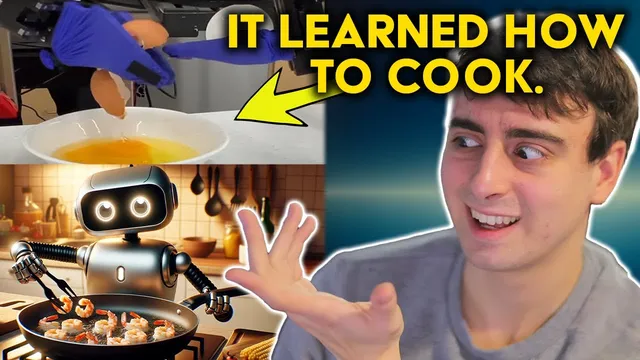
Personal AI Robots are a LOT Closer than you think!
Based on MattVidPro's video on YouTube. If you like this content, support the original creators by watching, liking and subscribing to their content.
Mobile Aloha targets imitation learning for mobile, whole-body, bimanual tasks rather than tabletop-only manipulation.
Briefing
Mobile, two-handed robots trained through human demonstrations are moving beyond tabletop tasks—showing autonomous cooking, cleaning, and household assistance in ways that look close enough to feel practical. Stanford’s “mobile Aloha” system targets a gap in imitation learning: many robot results assume a seated, table-bound setup, but real homes demand whole-body mobility, two-hand dexterity, and coordinated control. The approach imitates mobile manipulation from human demonstrations, focusing on “Bimanual” tasks that require both hands and whole-body movement, with the goal of making robots useful in everyday, cluttered environments.
In the demos highlighted, a large two-handed robot performs a sequence of kitchen and housekeeping actions without appearing to rely on pre-scripted motions. It pours oil, picks up and cooks a shrimp, handles utensils like a spatula, and transfers food to a plate. Other clips emphasize messy, real-world chores: it cleans up a wine spill by picking up a rag, manages glassware, rinses a pan, and even moves items around a workspace. The robot also tackles non-kitchen tasks—opening drawers, running around an office, watering plants, vacuuming, and handling items like dishes and laundry. A particularly striking segment shows a “high five” interaction that reads as fully autonomous rather than staged, reinforcing the claim that the system is learning manipulation skills tied to perception and environment interaction.
The cooking demonstrations include multi-step meal prep—stir-frying, blanching shrimp, cracking eggs, chopping garlic, and assembling multiple dishes—presented as a proof of capability rather than a guarantee of perfect culinary timing. Even when some actions look imperfect (like scrubbing performance), the core takeaway is the autonomy: the robot appears to perceive objects and execute multi-step manipulation in sequence, including tasks that typically require careful hand-eye coordination.
Beyond robotics, the transcript pivots to a cluster of AI advances. Suno AI is credited with strong audio generation, while Suno’s “Parakeet” speech recognition model is described as state-of-the-art, fully open source, and freely usable for commercial purposes, with performance claimed to beat leading alternatives like Whisper. Another thread covers video-to-video synthesis work (attributed to Meta) that enables style transfer and localized edits—turning a person’s video into anime, ink paintings, pixel art, or even swapping objects and backgrounds—though it’s framed as not clearly open source. Text generation and editing tools also appear, including an Alibaba demo for fixing corrupted text inside images via an API.
The transcript closes with platform and policy signals: OpenAI’s GPT Store is expected “next week,” Japan is described as moving to limit copyright protections for AI training data, and Microsoft documentation reportedly references “GPT 4.5 turbo,” fueling speculation about upcoming model releases. Taken together, the message is that robotics is getting closer to real homes, while speech, video, and developer ecosystems are accelerating in parallel—raising both practical expectations and policy questions about how fast these systems should spread.
Cornell Notes
Mobile Aloha is presented as a step toward robots that can do real household work by learning bimanual, whole-body manipulation from human demonstrations. Instead of tabletop-only skills, the system targets tasks that require two hands and coordinated movement through space. Demos emphasize autonomous cooking (e.g., handling shrimp, eggs, utensils), plus messy chores like spill cleanup, rinsing pans, and general housekeeping such as drawers, vacuuming, and laundry. The broader transcript also highlights rapid progress in speech recognition (Suno’s Parakeet), video-to-video style transfer and localized edits (Meta), and developer-facing tools like the upcoming GPT Store. The combined theme: autonomy and multimodal AI are converging toward everyday use cases.
What problem does “mobile Aloha” try to solve compared with earlier imitation-learning robotics results?
What kinds of tasks show up in the autonomy demos, and what makes them feel “autonomous” rather than scripted?
How should viewers interpret the cooking clips—are they presented as perfect outcomes or capability demonstrations?
What is Parakeet, and why does open sourcing matter in the speech recognition discussion?
What does the video-to-video segment claim to enable beyond simple style transfer?
What policy and platform signals are mentioned that could affect how quickly these tools spread?
Review Questions
- How does bimanual, whole-body control change what a robot can do compared with tabletop-only imitation learning?
- Which non-cooking household tasks in the demos are used to support the claim of autonomy, and what perception/manipulation skills do they imply?
- Why does the transcript treat open-source speech recognition (Parakeet) as strategically important compared with closed models?
Key Points
- 1
Mobile Aloha targets imitation learning for mobile, whole-body, bimanual tasks rather than tabletop-only manipulation.
- 2
Kitchen demos emphasize multi-step autonomy—handling utensils, cooking ingredients, and transferring food—while acknowledging some imperfections.
- 3
Housekeeping clips broaden the claim from cooking to messy, real-environment chores like spill cleanup, rinsing, drawers, vacuuming, and laundry handling.
- 4
Suno’s Parakeet is highlighted as open source, commercially usable, and positioned as faster and higher-performing than Whisper.
- 5
Meta’s video-to-video work is presented as enabling both global style changes and localized edits/object swaps, though artifacts can appear.
- 6
The GPT Store is expected to launch soon, with distribution tied to making GPTs public and using builder profiles.
- 7
Japan’s stance on copyright for AI training data is framed as a major policy shift that could accelerate AI development and training activity.