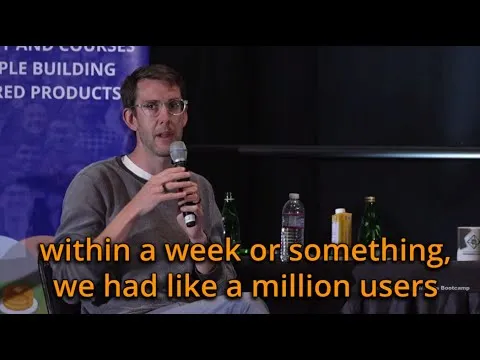
Peter Welinder - Fireside Chat with OpenAI VP Product (LLM Bootcamp)
Based on The Full Stack's video on YouTube. If you like this content, support the original creators by watching, liking and subscribing to their content.
Welinder’s career arc moves from physics and neuroscience toward computer vision, then toward product work centered on user usefulness.
Briefing
Peter Welinder traces a career path from early confusion about “artificial intelligence” to product-focused machine learning—and credits a series of pragmatic bets at OpenAI for turning research breakthroughs into widely usable systems. His through-line is simple: new techniques matter most when they solve real problems for people, whether that’s organizing photos, making enterprise data searchable, or eventually enabling AI systems to do economically useful work.
Welinder’s entry into machine learning began with a classic AI book in high school, but the subject felt unclear—so he pivoted to physics, then to neuroscience in graduate school. Neuroscience proved too demanding in terms of patience and real-world experimentation, pushing him toward computer vision as a more tractable way to build models. Around 2007–2008, he worked in an era dominated by SVMs and probabilistic approaches, before deep learning reshaped the field.
In 2011, he co-founded a startup that first tackled image organization for biology-related tracking tasks (like monitoring animals such as flies and mice). That market didn’t pay well—grad students could do similar work more cheaply—so the company pivoted to consumer photo organization. The timing aligned with the iPhone 4’s camera boom, and the startup’s technology helped power Carousel, later acquired by Dropbox. At Dropbox, Welinder helped build the company’s early machine learning computer vision team to index and make sense of massive photo libraries. He describes the deep learning transition as unusually fast: problems that once seemed like multi-year efforts could be solved in months once neural networks took over.
The move from academia to product came naturally to him: the key question wasn’t just how to build models, but why to build them and how they change user workflows. That mindset carried into OpenAI, where he joined in early 2017. He characterizes OpenAI as a small group tackling hard problems—robotics via deep reinforcement learning, plus other bets like game-playing agents—under uncertainty about timelines and even survival as an organization.
Welinder says OpenAI’s convergence toward GPT-style systems came from repeated lessons across bets. Dota 2 showed that a relatively straightforward neural network plus standard reinforcement learning, trained on huge amounts of data, could reach human and beyond-human performance. Robotics work—using simulation-to-real learning and tackling manipulation with a multi-arm robotic setup—reinforced the idea that “impossible” obstacles can yield to data and simpler reasoning than expected. Meanwhile, language models offered scaling laws and broad utility: once GPT-3 made the models feel more general, OpenAI shifted resources toward them.
Turning research into a product required a strategic choice: instead of picking one vertical application (translation, writing, or chat), OpenAI launched a general API so developers could discover the best uses. Early API inference was slow, and the team iterated rapidly—improving latency by roughly 100x over a few months—while speaking with hundreds of companies. ChatGPT then arrived after internal concerns about safety and model readiness, and it quickly became a mass-market interface. Welinder highlights two surprises: users found many workflows beyond a single “chatbot” use case, and large incumbents adopted the technology quickly once it was easy to try.
On whether AGI is near, he remains uncertain but suggests it’s plausible that something close to AGI could arrive by the end of the decade—defined as an autonomous system that can perform economically useful work at or beyond human levels, potentially by leveraging what computers already enable.
Cornell Notes
Peter Welinder’s career and OpenAI’s product path share one theme: machine learning should be judged by usefulness, not just technical novelty. He moved from physics and neuroscience toward computer vision, then into product work at Dropbox, where deep learning rapidly transformed photo indexing and semantic search. At OpenAI, he describes how multiple bets (Dota 2, robotics, and language models) taught the organization what kinds of approaches scale and generalize. GPT-style systems won out because they combined broad utility with scaling behavior, and the API strategy let developers find real-world applications. ChatGPT’s success came from a natural conversational UX plus massive availability, which turned a research capability into a widely adopted tool.
How did Welinder’s early academic interests shape his later focus on product usefulness?
Why did the first startup pivot away from animal-tracking computer vision?
What lessons did OpenAI draw from Dota 2 and robotics that influenced later bets?
Why did OpenAI consolidate around GPT-style language models instead of continuing to push robotics and games?
What product decision made the API strategy central, and what did early adoption look like?
What changed between the API and ChatGPT that drove mass adoption?
Review Questions
- Which experiences in Welinder’s background most directly explain his emphasis on “usefulness to people” rather than pure research progress?
- What specific evidence from Dota 2 and robotics does Welinder use to argue that “simple arguments plus lots of data” can overcome hard problems?
- How do Welinder’s reasons for choosing a general API differ from a strategy of building one vertical product from the start?
Key Points
- 1
Welinder’s career arc moves from physics and neuroscience toward computer vision, then toward product work centered on user usefulness.
- 2
A consumer photo-organization pivot followed a realization that animal-tracking computer vision had weak commercial economics.
- 3
At Dropbox, deep learning accelerated photo indexing and semantic search, turning multi-year problems into shorter engineering efforts.
- 4
OpenAI’s GPT-style direction emerged from comparative lessons across bets: Dota 2 showed reinforcement learning scalability; robotics showed data-driven transfer and perseverance; language models offered broad utility and scaling laws.
- 5
Launching a general API avoided committing to a single application too early, letting developers discover high-value use cases.
- 6
ChatGPT’s breakthrough adoption came from a natural conversational UX and broad, easy access that let people test value immediately.
- 7
Welinder remains uncertain about AGI timing but considers it plausible that something close to AGI could arrive by the end of the decade, defined as autonomous, economically useful work at human or beyond-human levels.