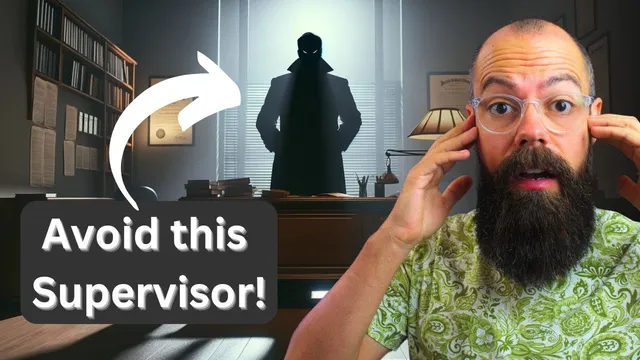
PhD Nightmare: Avoid These Critical Mistakes When Selecting Your PhD Advisor
Based on Andy Stapleton's video on YouTube. If you like this content, support the original creators by watching, liking and subscribing to their content.
Avoid choosing a PhD supervisor based on prestige alone; busy, high-profile academics may provide less direct supervision.
Briefing
Choosing a PhD supervisor is framed as the single most consequential decision in a doctorate because it shapes day-to-day research conditions, career trajectory, and how quickly problems get solved—or stall. The central warning is that many students pick supervisors using surface-level signals, especially prestige and public-facing marketing, then discover too late that the fit is wrong.
Prestige is called out as the biggest mistake: highly decorated, top-tier academics with large research groups can be among the worst supervisors because their time is scarce. In that scenario, PhD students may rarely interact with the supervisor, leaving them to navigate the “PhD treadmill” without consistent guidance. For most students, the prestige displayed on a supervisor’s website—awards, honors, and even large grant totals—is treated as a weak proxy for supervision quality. Prestige matters mainly if someone specifically wants an academic career, since the supervisor’s reputation can influence the visibility of the student’s future work.
Instead, the guidance shifts to measurable indicators of supervision performance. Students should look beyond grants and branding to track how many PhD graduates a supervisor produces, how many students are currently in the research team, and what recent thesis outputs look like. The tone and substance of recent thesis titles are suggested as a practical clue: if the list feels “boring,” it may foreshadow how the student will feel about their own research.
Another common error is confusing teaching ability with research supervision. A strong lecturer may enjoy teaching because it is lower pressure and involves direct interaction without the same competitive stress. Research supervision, by contrast, is described as high-stakes—funding, publishing, and constant pressure can bring out difficult personality traits. The takeaway: an excellent teacher does not automatically translate into an effective research mentor.
Funding is presented as a major differentiator in supervisory behavior. A supervisor with substantial money can “move stuff along,” explore more ideas, and maintain momentum when problems arise. A supervisor without funding is portrayed as more micromanaging and anxious, constrained by limited runway to keep research going. As a result, evidence of recent large-scale grant funding is recommended as a key selection criterion.
Finally, the transcript argues against self-funded PhDs unless the student is confident about a strong job outcome or has personal financial security. The stress of balancing personal finances with research demands is described as a direct threat to research focus and progress.
The overall message is pragmatic: gather online evidence, evaluate supervisors using outcome and capacity metrics (graduates, thesis patterns, team size, recent funding), and avoid assumptions based on prestige or teaching reputation. The decision is treated as urgent because the consequences often become clear only after 2–3 years—when changing course is costly.
Cornell Notes
Selecting a PhD supervisor should be treated as the most important early decision in a doctorate because it determines research support, momentum, and fit. Prestige and website “marketing” are presented as unreliable signals; even highly decorated academics may be too busy to supervise closely. Better indicators include how many PhD students a supervisor graduates, what recent thesis outputs look like, and whether the research group shows consistent activity. Funding is also framed as crucial: supervisors with recent large-scale grants can provide flexibility and keep projects moving, while those without money may become micromanaging or panicked. Teaching skill should not be assumed to predict research supervision quality.
Why is prestige alone treated as a poor way to choose a PhD supervisor?
What outcome-based metrics are recommended to judge whether a supervisor is a good fit?
How does the transcript distinguish teaching ability from research supervision quality?
Why does funding level matter for supervision style and research progress?
What guidance is given about self-funded PhDs?
Review Questions
- Which specific signals does the transcript recommend avoiding when choosing a supervisor, and what does it replace them with?
- How do recent thesis outputs and graduation rates function as evidence of supervision quality in the transcript’s framework?
- What differences between teaching and research supervision explain why a strong lecturer may still be a poor supervisor?
Key Points
- 1
Avoid choosing a PhD supervisor based on prestige alone; busy, high-profile academics may provide less direct supervision.
- 2
Use outcome and activity indicators such as the number of PhD graduates, current team size, and recent thesis patterns to assess fit.
- 3
Treat thesis titles and recent outputs as a practical clue to whether the research environment will feel engaging.
- 4
Do not assume teaching excellence predicts research supervision effectiveness; research supervision is shaped by funding and publication pressure.
- 5
Prefer supervisors with evidence of recent large-scale grant funding, since funding affects flexibility and momentum.
- 6
Be cautious about self-funded PhDs unless there is strong financial security or a clear, lucrative job path after graduation.