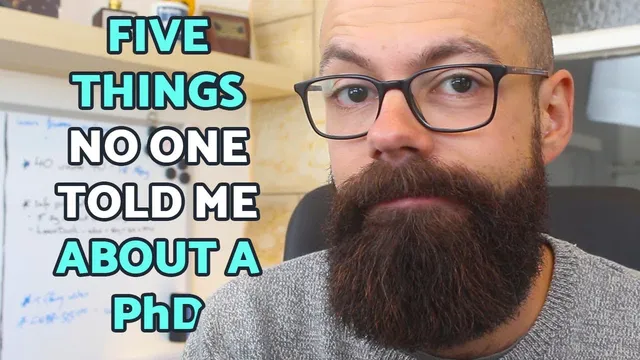
PhD Student Advice | 5 insider secrets no one tells you about a PhD
Based on Andy Stapleton's video on YouTube. If you like this content, support the original creators by watching, liking and subscribing to their content.
Supervisor expectations and availability can determine whether a PhD feels supportive or stressful, so fit matters early.
Briefing
A PhD’s day-to-day quality hinges less on the degree itself than on the relationship and incentives surrounding it—especially the supervisor’s expectations, the publish-or-perish competition, and the funding reality that can end jobs as quickly as grants run out. The most immediate determinant of whether the experience feels “nice” or punishing is compatibility with a supervisor: some supervisors provide regular meetings, fast feedback on thesis and chapter revisions, and steady lab support, while others demand constant availability (weekends, early-morning meetings) or are largely absent, leaving students to self-manage with little guidance. That fit, the advice stresses, shapes both success and day-to-day sanity.
Beyond supervision, the competitive pressure is broader than many incoming students expect. Competition can show up inside a research group—down to extreme scenarios where two students are placed on the same project and the first to produce results earns the PhD. It also shows up among peers through expectations about time at the bench, with some supervisors implicitly rewarding constant presence. Outside the lab, the academic system amplifies competition through measurable outputs: peer-reviewed papers and citation impact. The advice highlights the H-index as a career-defining metric, describing how it counts the number of papers with at least that many citations, and warning that clever actors can game the system by attaching names to papers they didn’t meaningfully contribute to.
Publishing expectations have intensified. Early in the PhD journey, the advice says, many students assume the work will resemble undergraduate lab courses—run experiments, write them up, and move on. Instead, peer-reviewed papers increasingly dictate academic trajectory. There’s also a sense that output targets have risen sharply, with claims that students are expected to produce multiple papers by the end of the PhD, and even examples of unusually high publication counts that likely reflect co-authorship and system gaming rather than wholly independent work.
Then comes the funding layer, which can be as decisive as papers. Academia relies heavily on external grants, so PhD students may face pressure to apply for funding near the end of the program, and researchers can lose positions when grant money dries up. The advice notes a common misconception: spending a decade in university doesn’t guarantee job security or high pay. Instead, grant availability—and whether a research topic is “sexy” or timely—can determine whether strong candidates get opportunities.
Finally, the emotional challenge: a PhD is hard to start because the finish line is uncertain. Unlike structured degrees with clear exams and milestones, progress depends on results that can’t be crammed for and aren’t guaranteed. The anxiety comes from continuous persistence—turning weekly efforts into graphs, analyses, and incremental breakthroughs—while the end goal (thesis completion and publishable novelty) keeps shifting. The advice frames this as a major mind shift from undergraduate routines: students must build self-driven project management and internal motivation, because no one else will drive the process for them.
Cornell Notes
The advice frames a PhD as an experience shaped by incentives and relationships more than by the degree title. Supervisor compatibility strongly affects daily life—some supervisors offer frequent meetings and rapid thesis feedback, while others impose extreme availability demands or provide little guidance. Competition is pervasive: it can occur within labs, among peers, and across academia through publication metrics like the H-index. Peer-reviewed papers increasingly determine career prospects, but grant funding can be just as decisive because jobs can end when money runs out. The biggest personal challenge is uncertainty: unlike exam-based paths, PhDs require continuous persistence toward results that may not arrive on schedule.
How does supervisor compatibility change the day-to-day reality of a PhD?
Where does competition show up beyond the obvious goal of finishing a thesis?
Why does the H-index matter in this advice, and how can it be manipulated?
What role do peer-reviewed papers play in academic success, and how have expectations shifted?
How can grant funding affect a researcher’s career even with strong publication records?
Why does the PhD start feel uniquely anxiety-inducing, and what strategy is offered to cope?
Review Questions
- Which specific supervisor behaviors (as described) most directly influence thesis turnaround and student experience?
- How do publication metrics like the H-index connect to incentives that can distort authorship and contribution?
- What mechanisms make grant funding a career bottleneck, even when research output looks strong?
Key Points
- 1
Supervisor expectations and availability can determine whether a PhD feels supportive or stressful, so fit matters early.
- 2
Competition can be intense inside labs, among peers, and across academia through publication and citation metrics.
- 3
Peer-reviewed papers increasingly function as the main credential for academic advancement, with rising pressure for high output.
- 4
Grant funding can control job security and career opportunities, regardless of publication strength.
- 5
The H-index is treated as a career-shaping metric, but it can be undermined by gaming behaviors in authorship and publishing.
- 6
PhD progress is inherently uncertain, so students need a plan for continuous, incremental work rather than exam-style milestones.
- 7
Strong self-management and project management skills become essential because others may not provide structured checkpoints.