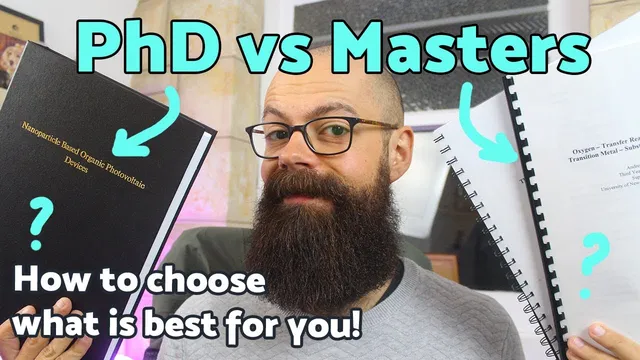
PhD vs Masters | What is best for YOU?!
Based on Andy Stapleton's video on YouTube. If you like this content, support the original creators by watching, liking and subscribing to their content.
A master’s degree usually takes about two years full-time and blends coursework with some research, making it more structured and career-focused than a PhD.
Briefing
A master’s degree is the faster, more career-oriented post-graduate option, while a PhD is a long, high-pressure research commitment aimed at producing new knowledge. The practical difference matters because it shapes what doors open afterward: master’s programs typically deepen specialization for industry roles and higher pay bands, whereas PhDs can unlock academic pathways like lecturing and running research groups—along with a much more demanding day-to-day life built around uncertainty.
A master’s is generally the first post-graduate qualification after an undergraduate degree in a related field. It usually takes about two years full-time and blends coursework with some research, functioning as a “teaser” for what research training feels like—without the full weight of original knowledge production. The degree is often designed for specialization; for example, a science background can lead into a Master of Science that narrows focus further. In career terms, master’s study is widely accepted in business and industry, and it can help separate graduates from those who stop at a bachelor’s.
A PhD, by contrast, is the highest degree and is fundamentally research-based. It typically runs three to six years, though timelines can stretch longer. The work centers on creating or refining a research question and testing a hypothesis through sustained investigation—work that can feel like “research hell” but also builds deep expertise. The payoff is not just a credential; it’s a long apprenticeship in becoming a specialist who can communicate research through writing and presentations, and who can pursue roles that require independent research capability. Traditionally, PhDs were mostly research-only, but universities are increasingly adding optional courses and skills—partly to address concerns that graduates can face limited career options.
Choosing between them comes down to three criteria. First is purpose: someone aiming for academia or intensely focused expertise is more likely to fit a PhD, while someone seeking proof of specialization and competence for industry may prefer a master’s. Second is time: a master’s can be completed in roughly two years full-time, while part-time PhDs can expand to a decade or more, which may be unrealistic for older students or those with limited bandwidth. Third is process fit: a PhD demands persistence through critical feedback, peer review, and long periods of uncertainty, whereas a master’s is more structured—coursework plus a smaller research component—so progress toward completion is clearer.
There’s also a blunt financial reality check. Beyond a small earnings difference (roughly a few percentage points between master’s and PhD holders, per the speaker’s figures), the monetary gain doesn’t automatically justify the extra years if the goal is purely income. The decision, then, is less about prestige and more about whether the individual wants the stretch of sustained research uncertainty or the more bounded, career-focused specialization of a master’s—and whether they can genuinely enjoy the work for years at a time.
Cornell Notes
Master’s and PhD programs differ most in time, structure, and career direction. A master’s is usually a two-year, coursework-and-research degree that specializes a student for industry roles and can be a practical stepping stone toward research. A PhD is a longer, three-to-six-year (sometimes more) research apprenticeship aimed at creating new knowledge, built around a research question, hypothesis testing, and sustained uncertainty. The choice should be driven by purpose (academic vs specialization), available time (full-time vs potentially long part-time timelines), and whether the student will enjoy the process—critical feedback and peer review for a PhD, versus a more structured path for a master’s.
What is the core structural difference between a master’s and a PhD?
How do career outcomes differ after each degree?
Why does time availability strongly affect the decision?
What does the speaker suggest about the “enjoy the process” factor?
Is the PhD financially justified compared with a master’s?
How can someone use a master’s to test whether a PhD is a good fit?
Review Questions
- If a student has limited time and wants a clear path to completion, which degree aligns better and why?
- What kinds of day-to-day pressures distinguish a PhD from a master’s, according to the transcript?
- How should a student decide based on purpose—academic ambition versus industry specialization?
Key Points
- 1
A master’s degree usually takes about two years full-time and blends coursework with some research, making it more structured and career-focused than a PhD.
- 2
A PhD is the highest degree and is primarily research-based, typically lasting three to six years (sometimes longer) and centered on a research question and hypothesis testing.
- 3
Master’s programs often specialize students for industry roles and are described as more accepted in business, while PhDs are positioned as the route to academic research and lecturing.
- 4
Time constraints matter: part-time PhDs can extend to roughly a decade, while master’s timelines are generally shorter and more predictable.
- 5
The financial payoff of a PhD over a master’s is described as small, so income alone may not justify the extra years.
- 6
The best-fit decision depends on process: PhDs demand persistence through uncertainty and critical feedback; master’s programs offer a more bounded coursework-and-project structure.
- 7
Choosing should start with purpose (academic vs specialization), then check time and whether the student will genuinely enjoy the work for years.