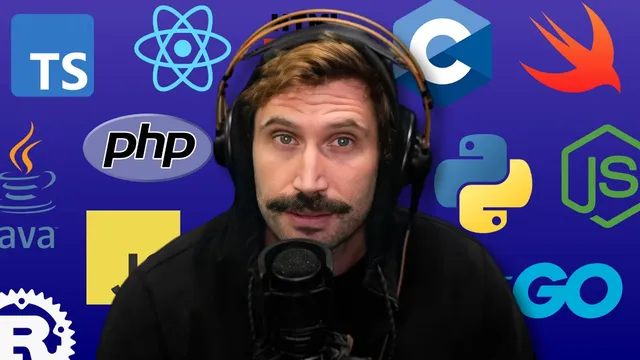
Picking A Language In 2025
Based on The PrimeTime's video on YouTube. If you like this content, support the original creators by watching, liking and subscribing to their content.
Go’s goroutine/green-thread runtime model makes multi-service asynchronous aggregation feel straightforward, matching the speaker’s Twitch/audio/service pipeline needs.
Briefing
Choosing a programming language for 2025 isn’t just a technical decision—it’s a long-term bet on ecosystem maturity, tooling, and how much time a developer will spend becoming “good” rather than merely productive. The core tension driving the discussion is that the speaker’s current work depends on lots of asynchronous, multi-service workflows (aggregating Twitch chat, recording and decoding audio via Whisper, then combining results into a final voice output), and that requirement doesn’t obviously map to where many newer languages are investing their design effort.
Go remains the default because it delivers exactly the kind of runtime behavior that makes these pipelines feel effortless: goroutines and green-thread scheduling make “do two things at once, then come back” straightforward. The tradeoff is emotional and philosophical. Go is described as full of “foot guns” and shallow depth—easy to learn quickly, but hard to become deeply excellent at because it lacks the richer language mechanics that invite mastery. Rust, by contrast, offers depth and capability, but the speaker reports a sustained lack of joy and growing frustration, even after multiple years using it. The result is an “emotional crisis” about whether to stick with Go’s productivity or switch to a language that offers deeper metaprogramming and a more rewarding path to expertise.
That’s where Zig enters the shortlist. Zig’s compile-time metaprogramming (“comp time”) is framed as a compelling middle ground: it stays within Zig rather than forcing developers into a separate macro language. The idea is that compile-time execution can generate code—effectively producing specialized functions based on reflection-like logic—without the conceptual split found in other systems. Odin and Elixir are also mentioned as having metaprogramming potential, with Odin highlighted for its professional examples (including an “embergen” project) and Elixir noted for metaprogramming generally.
But the conversation repeatedly returns to timing and risk. Becoming proficient takes far longer than learning syntax, and better programmers face a bigger burden: they must invent or discover the “great ways” to do things in a language before the community has fully settled best practices. Meanwhile, the language landscape is moving quickly, so picking now can mean doing extra work that might be obsolete in a decade—especially if tooling, adoption, or standard-library support for web/service integration lags behind.
The discussion also critiques “overselling” as a pattern that can lead to widely adopted but flawed languages—an outcome associated with C++. In contrast, Odin and Zig are praised for a more restrained posture: slower, more careful maturation rather than pushing adoption prematurely.
Ultimately, the speaker’s decision criteria narrow to two things: (1) whether a candidate language can handle the web-service aggregation workload as smoothly as Go, and (2) whether metaprogramming is strong enough to support long-term, serious development. The proposed next step is practical experimentation—spending time building small projects (like a tower defense in Zig) and then testing Odin, Zig, and potentially J (in beta) to see which environment feels most capable and enjoyable. The “best” language would be one that enables the speaker’s preferred style of vector/multicore-oriented computation without forcing an awkward paradigm shift, and that can be used confidently for the next ten years.
Cornell Notes
The discussion centers on how to pick a language for 2025 when the work depends on heavy asynchronous integration across many internet services. Go is favored for its runtime ergonomics (goroutines/green threads) even though it feels shallow and has “foot guns.” Rust is rejected emotionally despite its depth, while Zig is attractive because its compile-time (“comp time”) metaprogramming stays inside Zig and can generate specialized code without a separate macro language. A major warning is that choosing now is risky: proficiency takes time, best practices may not exist yet, and tooling/ecosystems for web/service work may lag. The practical plan is to run short, focused experiments in candidate languages and evaluate both service-integration quality and metaprogramming power.
Why does Go keep winning despite strong criticism of the language itself?
What makes Zig’s metaprogramming feel different from Rust-style macro systems?
Why is “picking a language now” portrayed as a strategic disadvantage for serious developers?
How do overselling and adoption pressure influence language quality, according to the discussion?
What practical evaluation method is proposed to reduce uncertainty?
What would most likely convince the speaker to switch languages?
Review Questions
- If Go is criticized as shallow, what specific technical feature makes it still the best fit for the speaker’s asynchronous service workflow?
- Why does the discussion claim that strong programmers face a bigger disadvantage when adopting a newer language?
- What two criteria does the speaker use to judge whether a language is worth switching to for the next decade?
Key Points
- 1
Go’s goroutine/green-thread runtime model makes multi-service asynchronous aggregation feel straightforward, matching the speaker’s Twitch/audio/service pipeline needs.
- 2
Rust’s depth doesn’t translate into enjoyment for this developer; frustration and lack of joy outweigh technical strengths.
- 3
Zig’s compile-time (“comp time”) metaprogramming is attractive because it stays within Zig and can generate specialized code without a separate macro language.
- 4
Choosing a language now is risky because proficiency takes time, best practices may not exist yet, and tooling/ecosystems for web/service integration may be immature.
- 5
Language adoption pressure and overselling can lead to widely used but flawed systems; Odin and Zig are praised for restraint.
- 6
A practical path forward is to run focused experiments (e.g., building a small game) and evaluate both web/service integration and metaprogramming capability before committing.
- 7
The speaker’s “switch” trigger would be a language that supports vector/multicore computation in the style they want, ideally via strong metaprogramming.